Prokaryotic Transcription Mechanisms and Regulation
This article explores the molecular machinery, stages, and regulatory factors of transcription in prokaryotes, including RNA polymerase, sigma factors, and termination mechanisms.
Transcription is the fundamental process by which a cell converts genetic information stored in DNA into a functional RNA polymer. In prokaryotes, this process is highly efficient and often occurs simultaneously with translation due to the absence of a nucleus. This article explores the molecular machinery, the stages of the transcription cycle, and the regulatory factors that ensure genes are expressed at the right time and in the right amounts.
The RNA Polymerase Machinery
The "main character" of transcription is the RNA polymerase (RNAP). Unlike eukaryotes, which utilize multiple specialized RNA polymerases, prokaryotes rely on a single type of RNAP to transcribe all classes of RNA.
The Core Enzyme
The bacterial RNAP core enzyme is a complex consisting of five subunits:
Alpha (α) subunits (2 of them): Responsible for enzyme assembly and promoter recognition.
Beta (β) subunit: The catalytic center where RNA synthesis actually occurs.
Beta prime (β′) subunit: Binds to the DNA template and stabilizes the RNA-DNA hybrid within the transcription bubble.
Omega (ω) subunit: Assists in the assembly and stability of the entire complex.
The catalytic process requires magnesium ions (Mg2+). These ions are bound to the polymerase and serve to stabilize the electronegative phosphate groups, allowing the $3'$ OH group of the growing RNA strand to attack the phosphate group of an incoming nucleoside triphosphate (NTP).
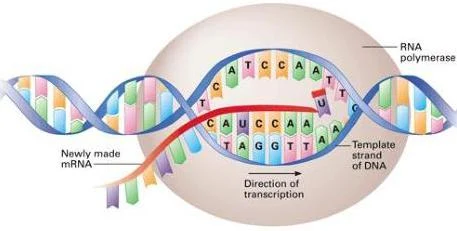
Illustration of the process of transcription, where RNA polymerase synthesizes a messenger RNA (mRNA) molecule from a DNA template strand.
The Holoenzyme and Sigma Factors
To initiate transcription, the core enzyme must associate with a sigma (σ) factor to form the complete RNAP holoenzyme. The sigma factor is responsible for recognizing specific promoter sequences on the DNA.
Different sigma factors allow the cell to respond to environmental changes by directing RNAP to different sets of genes:
Gene
Factor
Primary Use
rpoD
σ70
Most required/typical growth functions
rpoS
σS
Stationary phase/stress responses
rpoH
σ32
Heat shock response
rpoE
σE
Periplasmic/extracellular proteins
rpoN
σ54
Nitrogen assimilation
A molecular model of RNA polymerase holoenzyme, illustrating its various subunits labeled with Greek letters and sigma factor (σ70).
The Stages of Transcription
Transcription proceeds through three distinct stages: initiation, elongation, and termination.
1. Initiation and Promoter Elements
Initiation begins when the RNAP holoenzyme binds to promoter elements located upstream of the transcription start site (+1). Key regulatory sequences include:
-10 Element (TATA box): A sequence recognized by the sigma factor that facilitates the "melting" (unwinding) of the DNA double helix.
-35 Element: Another sequence recognized by the sigma factor to help position the polymerase.
2. Elongation and Regulatory Factors
Once the polymerase clears the promoter, it enters the elongation phase, moving along the DNA and creating a "transcription bubble". Several factors assist during this stage:
GreA/B Factors: These help the RNAP overcome "stalling." They act as endonucleases to help the polymerase backtrack and clear obstacles.
Nus Factors: These proteins stabilize the complex.
NusA stabilizes the RNA-polymerase complex.
NusG associates with the polymerase and helps keep ribosomes close to the RNAP, facilitating coupled transcription and translation.
NusE (S10) and NusB work together to assist in ribosome loading.
Note on Antitermination: Some sequences, known as nut sites (N utilization sequences), can prevent premature termination. For example, NusB and NusE can bind to the boxA sequence within a nut site to stabilize the RNAP-RNA complex, allowing it to continue through genes that might otherwise trigger termination.
3. Termination
Termination is the process of releasing the RNA transcript and dissociating the RNAP from the DNA. Prokaryotes use two primary mechanisms:
Rho-Independent (Intrinsic) Termination
This mechanism relies on the structure of the RNA itself. The RNA sequence forms a stable hairpin loop, often aided by the binding of NusA, which causes the polymerase to stall and dissociate from the DNA.
Rho-Dependent Termination
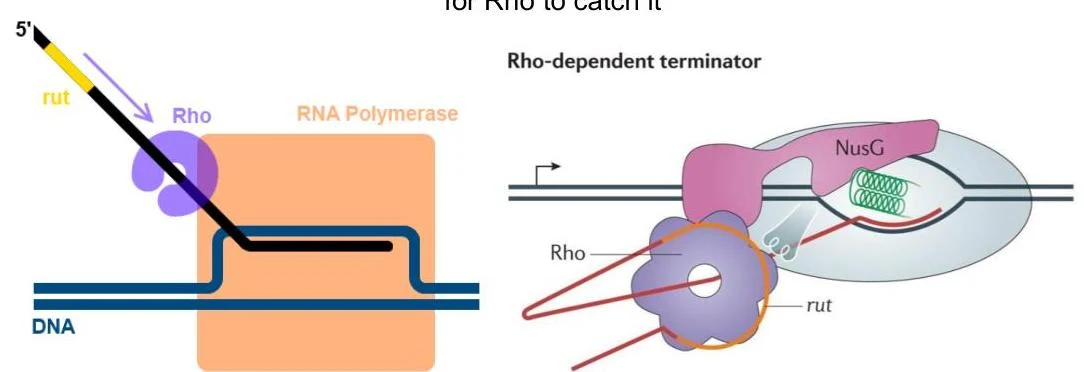
This mechanism requires the Rho factor, a protein that recognizes a specific sequence in the RNA called the rut (Rho utilization) site.
Rho binds to the rut site.
Rho "charges" down the RNA strand toward the polymerase.
When the RNAP slows down (often at a terminator hairpin), Rho catches up and physically pulls the RNA away from the polymerase.
Diagrams illustrating Rho-dependent transcription termination in bacteria, showing the interaction of Rho factor, RNA polymerase, and DNA.
DNA Topology: Supercoiling and Topoisomerases
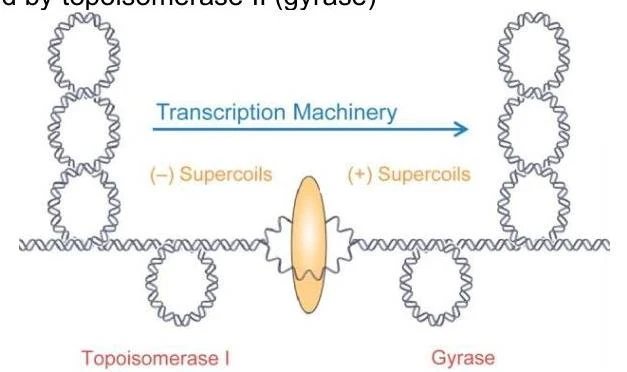
As RNA polymerase moves along the DNA, it does not move through a static structure. The physical act of unwinding the DNA creates mechanical tension in the form of supercoiling.
Ahead of the polymerase: The DNA becomes overwound, creating positive supercoils.
Behind the polymerase: The DNA becomes underwound, creating negative supercoils.
Negative supercoiling is actually beneficial for transcription because it helps the DNA double helix dissociate, making it easier for the sigma factor to melt the promoter. To prevent this tension from halting transcription, enzymes called topoisomerases manage the DNA topology:
Topoisomerase I relaxes negative supercoils.
Topoisomerase II (Gyrase) relaxes positive supercoils.
Diagram illustrating the roles of Topoisomerase I and Gyrase in managing DNA supercoils during transcription.
Exam Tip: Remember that transcription and translation are "coupled" in prokaryotes. Because there is no nuclear envelope, ribosomes can begin translating the $5'$ end of an mRNA while the $3'$ end is still being synthesized by RNA polymerase.
Keep reading for free.
Create an account to finish this reading and make it part of your study routine.