


In the vast hierarchy of biological life, the most fundamental building blocks are often the most overlooked. While complex multicellular organisms like humans dominate our visual landscape, the true foundation of life's history lies in the prokaryotes. These organisms represent some of the simplest true living entities on Earth, characterized by a streamlined biological design that prioritizes efficiency and rapid adaptation. By understanding prokaryotes, we gain insight into the very origins of life and the essential mechanisms that allow organisms to survive in nearly every environment on the planet.
Defining the Prokaryote
The term "prokaryote" is derived from Greek roots meaning "before nucleus." This etymology provides the most critical clue to their biological identity: prokaryotes lack a membrane-bound nucleus. Unlike eukaryotic cells, which sequester their genetic material within a protective nuclear envelope, prokaryotic DNA exists freely within the cytoplasm in a region often referred to as the nucleoid.
Furthermore, prokaryotes lack any internal membrane-bound organelles. This means they do not possess mitochondria for respiration, chloroplasts for photosynthesis, or an endoplasmic reticulum for protein transport. Every chemical reaction required for life—from energy production to DNA replication—occurs either within the cytosol or across the cell's outer plasma membrane.
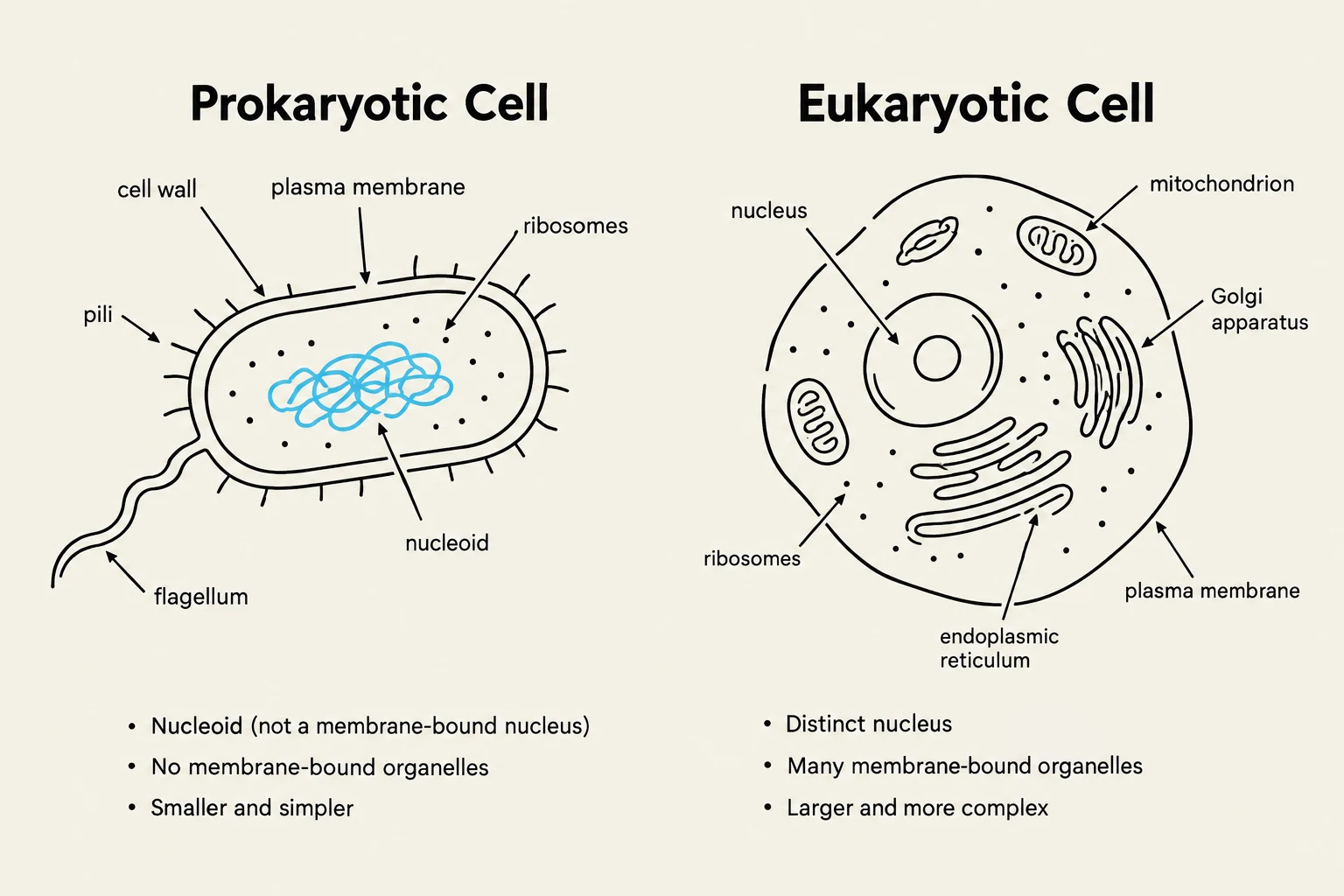
Exam Tip: If a question asks you to distinguish between a prokaryote and a unicellular eukaryote (like an amoeba), look specifically for membrane-bound organelles. Both are single-celled, but only the eukaryote has a nucleus and specialized internal compartments.
Keep reading for free.
Create an account to finish this reading and make it part of your study routine.
Continue reading freeAlready have an account? Log in
Updated