An overview of prokaryotic cells, including their structure, components, and specialized types like bacteria and cyanobacteria. Contrasts prokaryotes with eukaryotes.
In the study of biology, one of the most fundamental distinctions is how organisms organize their internal components. All living things are composed of cells, but these cells are not all built the same way. They are broadly classified into two categories: prokaryotic cells and eukaryotic cells. While eukaryotic cells (found in animals, plants, fungi, and protists) possess a membrane-bound nucleus and specialized organelles like mitochondria, prokaryotic cells take a much simpler, more streamlined approach to life.
Understanding Prokaryotic Cells
Diagram illustrating the anatomy of a typical prokaryotic cell, labeling its key components such as the capsule, cell wall, plasma membrane, cytoplasm, ribosomes, and nucleoid region.
Prokaryotic cells are single-celled organisms that lack a membrane-bound nucleus and other membrane-bound organelles. This group is incredibly diverse and includes three main types: archaea, bacteria, and cyanobacteria. Despite their lack of complex internal "rooms" (organelles), prokaryotes are highly efficient and can perform all the essential functions of life within a single, compact structure.
The Outer Layers: Protection and Support
A prokaryotic cell is organized in layers to protect its internal environment and interact with the world around it:
Capsule: Many prokaryotes are covered by a gelatinous outer layer called a capsule, which serves as a protective covering.
Cell Wall: Surrounding the plasma membrane is a supporting cell wall that provides structural integrity.
Plasma Membrane: This is the cellular membrane that encloses the cytoplasm, acting as a barrier that regulates what enters and exits the cell.
Internal Components and Genetic Material
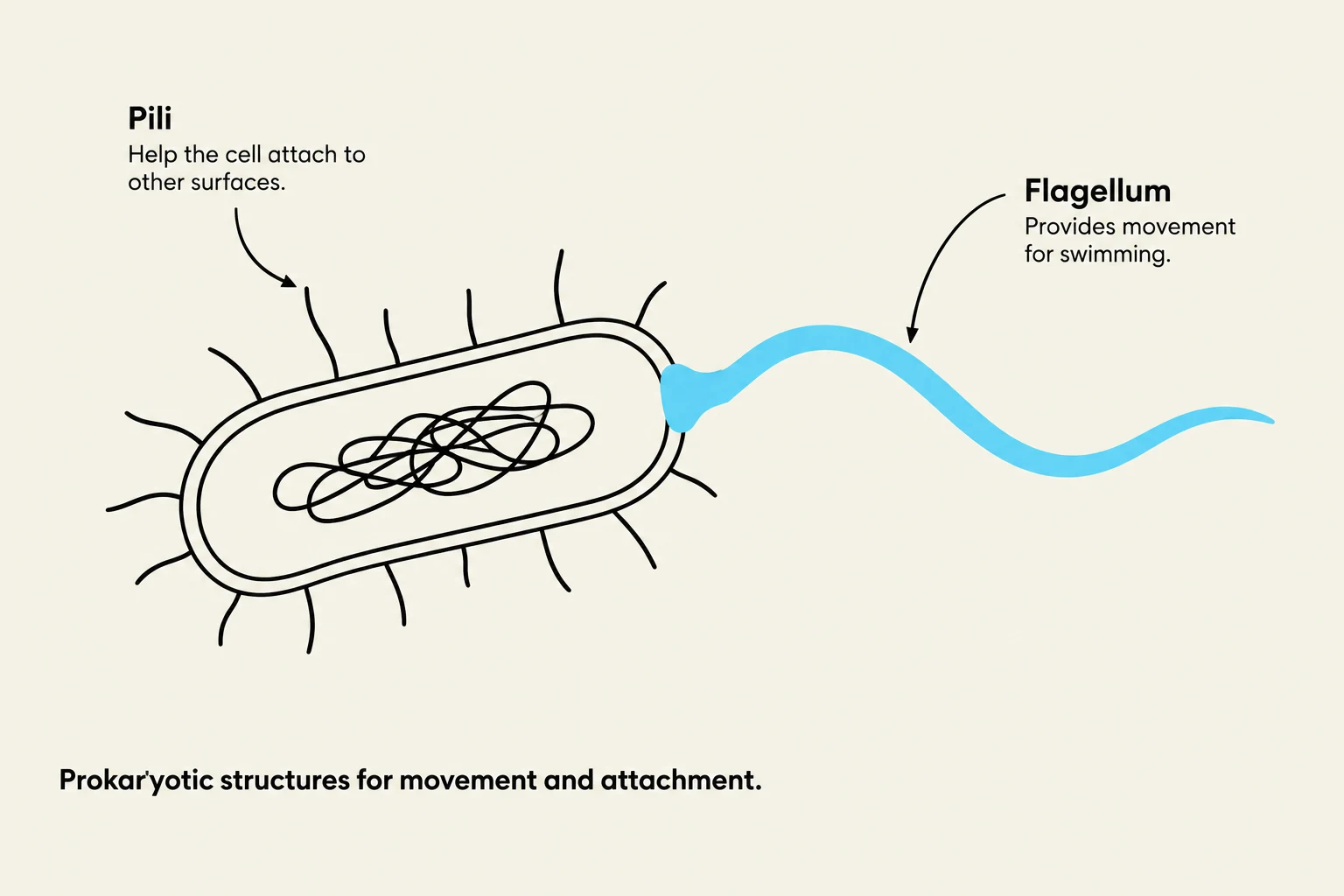
Diagram illustrating the pili and flagellum of a prokaryotic cell, highlighting their roles in attachment and movement.
Because there is no nucleus to house the genetic blueprints, the internal organization of a prokaryote is quite different from that of a human or plant cell:
Cytoplasm: This is the internal fluid that fills the cell and contains all the essential components necessary for life.
Nucleoid Region: Instead of a nucleus, the cell's genetic material—DNA—is found in a specific area called the nucleoid region. In prokaryotes, the DNA typically exists as a single, circular molecule that is folded within the cytoplasm.
Ribosomes: While they are not membrane-bound, prokaryotes do contain ribosomes. These are small organelles responsible for protein synthesis, the process of building the proteins the cell needs to function.
Exam Tip: If a question asks you to identify a prokaryote based on its DNA, look for the term "nucleoid" or "circular DNA." Unlike eukaryotes, which have linear chromosomes inside a nucleus, prokaryotes keep their DNA in a concentrated region without a surrounding membrane.
Locomotion and Attachment
To move through their environments or interact with other cells, many prokaryotes utilize specialized hair-like structures:
Flagella: These are long, whip-like structures used primarily for locomotion or movement.
Pili: These are shorter, hairlike outgrowths used to attach the bacteria to surfaces or to facilitate the exchange of genetic material with other bacteria.
Specialized Prokaryotes: Cyanobacteria and Bacteria
Not all prokaryotes are the same; they are often categorized by their specific biological functions and how they obtain energy.
Cyanobacteria: The Photosynthetic Giants
Internal structure of a photosynthetic cyanobacterium.
Cyanobacteria (formerly known as blue-green algae) are the largest of the prokaryotes. They are aquatic organisms that have the remarkable ability to perform photosynthesis.
Unlike eukaryotic plant cells, cyanobacteria do not have chloroplasts. Instead, they utilize specialized photosynthetic membranes called thylakoids. These thylakoids contain chlorophyll a and various accessory pigments that capture light energy. To protect themselves, cyanobacteria are often surrounded by a mucilaginous sheath. Within a colony of cyanobacteria, the cells that are actively growing and performing photosynthesis are referred to as vegetative cells.
Bacteria: The Microscopic Specialists
Most bacteria are significantly smaller than cyanobacteria and generally lack chlorophyll. They occupy almost every environment on Earth and play various roles in ecosystems and human life.
A classic example of a functional bacterium is Lactobacillus. This is a rod-shaped bacterium that has adapted to live on milk sugar, known as lactose. Through its metabolic processes, Lactobacillus converts lactose into lactic acid, which is the fundamental process used to turn milk into yogurt.
Feature
Cyanobacteria
Bacteria (e.g., Lactobacillus)
Size
Larger
Generally much smaller
Photosynthesis
Yes (via thylakoids)
Most lack chlorophyll
Key Pigments
Chlorophyll a
N/A
Example Structure
Mucilaginous sheath
Rod-shaped
Summary Comparison
To master this topic, remember that the primary "divider" in cellular biology is the presence of a membrane-bound nucleus.
Prokaryotes = No nucleus, no membrane-bound organelles, circular DNA in a nucleoid, includes Bacteria and Cyanobacteria.
Eukaryotes = Nucleus present, membrane-bound organelles (like mitochondria and chloroplasts), linear DNA, includes Plants and Animals.
Keep reading for free.
Create an account to finish this reading and make it part of your study routine.