Explore the foundational theories of cell biology, including cell theory, the physical constraints of surface area to volume ratio, and the structural differences between prokaryotic and eukaryotic cells. Learn about microscopy techniques used to visualize cells.
Biology is unified by the study of cells, the fundamental building blocks of all living things. Whether you are looking at a microscopic bacterium or a complex human cell, the principles of how they function, how they are structured, and how they interact with their environment follow specific biological laws. This article explores the foundational theories of life, the physical constraints that dictate cell size, and the structural differences between the two primary categories of cells: prokaryotes and eukaryotes.
The Foundation: Cell Theory
Before diving into the mechanics of individual cells, we must understand the principles that govern all life. The cell theory serves as a unifying principle in biology, establishing four key tenets:
Cells are the fundamental units of life.
All living organisms are composed of cells.
All cells come from preexisting cells.
Modern cells evolved from a common ancestor.
Understanding these tenets allows scientists to view life as a continuous, interconnected process rather than a collection of isolated events.
Physical Constraints: Surface Area to Volume Ratio
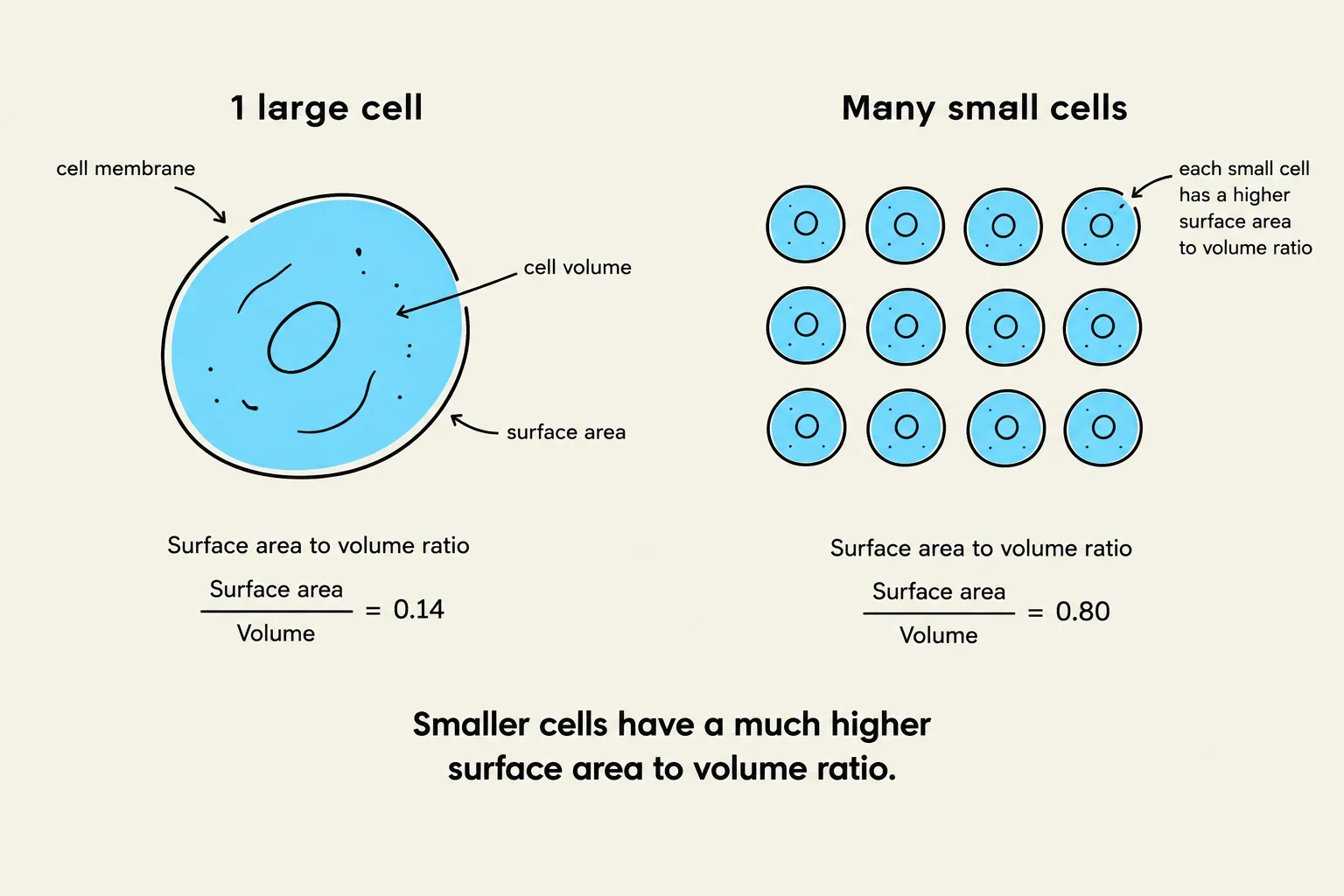
A critical question in biology is: Why are cells so small? The answer lies in the relationship between a cell's surface area and its volume.
All cells must exchange materials with their environment—taking in nutrients and releasing waste—through the cell membrane. The cell membrane is a phospholipid bilayer with embedded proteins that acts as the cell's gatekeeper.
As a cell grows larger, its volume increases much faster than its surface area. If a cell becomes too large, its surface area (the "doorway" for nutrients) becomes insufficient to support the massive volume (the "demand" for nutrients) inside.
Mathematically, this is expressed as the ratio:
Ratio=VolumeSurface Area
When this ratio is high, the cell can efficiently exchange materials. When the ratio becomes too small, the cell cannot carry out the exchange required for survival. This constraint explains why most cells are microscopic and why complex organisms are made of many small cells rather than one giant cell.
This illustration compares the surface area to volume ratio of one large cell versus many small cells, demonstrating that smaller cells have a higher ratio.
Exam Tip: If asked why an organism is multicellular rather than one massive single cell, always link your answer to the surface area to volume ratio and the efficiency of nutrient/waste transport.
Visualizing the Microscopic: Microscopy
Because most cells are too small to be seen with the naked eye, biologists rely on different types of microscopes to study them.
Light Microscopy: Uses glass lenses and visible light to form an image. It is ideal for visualizing living cells and observing some internal structures.
Electron Microscopy: Uses electromagnets to focus an electron beam, which is then directed at a digital camera or screen to create an image. This method provides much higher resolution, allowing scientists to see the fine details of subcellular structures.
Comparing Cell Types: Prokaryotes vs. Eukaryotes
While all cells share certain components—such as a cell membrane (phospholipid bilayer), cytoplasm (the contents of the cell), and cytosol (the fluid within the cytoplasm)—they are divided into two distinct categories:
Prokaryotic Cells
Prokaryotic cells (such as bacteria) are characterized by their simplicity and lack of internal membrane-enclosed compartments.
DNA Storage: Instead of a nucleus, DNA is stored in an irregularly shaped region called the nucleoid. Crucially, the nucleoid is not a membrane-bound compartment.
Cell Wall: Most prokaryotes possess a rigid cell wall outside the membrane, often made of peptidoglycan (polymers of sugars and amino acids), which provides shape and rigidity.
Specialized Features:
Capsules: Some bacteria have a slimy polysaccharide capsule for protection and adhesion.
Flagella: Made of the protein flagellin, these allow some prokaryotes to swim.
Pili: Hairlike structures used for adhering to other cells.
Because they lack a nucleus, transcription (making RNA from DNA) and translation (making protein from RNA) can happen at the same time and place in prokaryotes.
Eukaryotic Cells
Eukaryotic cells (such as human cells) are more complex due to compartmentalization. They contain membrane-enclosed organelles that allow different chemical reactions to occur simultaneously in specialized environments.
The Nucleus: Unlike the nucleoid, the nucleus is a true compartment surrounded by a double membrane called the nuclear envelope. It contains pores that regulate the movement of molecules and protects the DNA.
Endoplasmic Reticulum (ER): A vast network of membranes in the cytoplasm.
Rough ER (RER): Studded with ribosomes; it modifies, folds, and transports newly made proteins.
Smooth ER (SER): Lacks ribosomes; it synthesizes lipids and steroids, modifies small molecules, and stores calcium ions.
Golgi Apparatus: Composed of flattened sacs called cisternae, it receives proteins from the RER to modify, package, and sort them. It has distinct faces: the cis face (near the ER) and the trans face (opposite the ER).
Lysosomes: These are the cell's digestive centers. They contain enzymes that function best in an acidic environment (pH 5), which is significantly more acidic than the surrounding cytosol (pH 7.2).
Diagrams illustrating the differences between prokaryotic and eukaryotic cells, highlighting key organelles and structures.
Critical Thinking Question: Why can transcription and translation happen simultaneously in prokaryotes but not in eukaryotes?
Answer: In prokaryotes, there is no nuclear envelope separating the DNA from the ribosomes in the cytoplasm. In eukaryotes, the nuclear envelope acts as a physical barrier, requiring mRNA to be exported from the nucleus before translation can begin.
Keep reading for free.
Create an account to finish this reading and make it part of your study routine.