This article explores the fundamental mental model required for project managers to navigate complex environments and the anatomy of artifacts used for decision-making and coordination. It distinguishes between task tracking and coordinated leadership, emphasizing the integrator role of a PM and the Senior-PM reasoning
To the uninitiated, project management looks like a chaotic collection of spreadsheets, meetings, and status reports. However, for a professional, these are not mere administrative tasks; they are the tools of an integrator. A project manager (PM) does not succeed by producing the most documents, but by ensuring the project remains connected to its purpose, its people, its constraints, and its intended value.
This article explores the fundamental mental model required to navigate complex project environments and the "anatomy" of the artifacts used to drive decision-making and coordination.
The Project Manager Mental Model: The Integrator
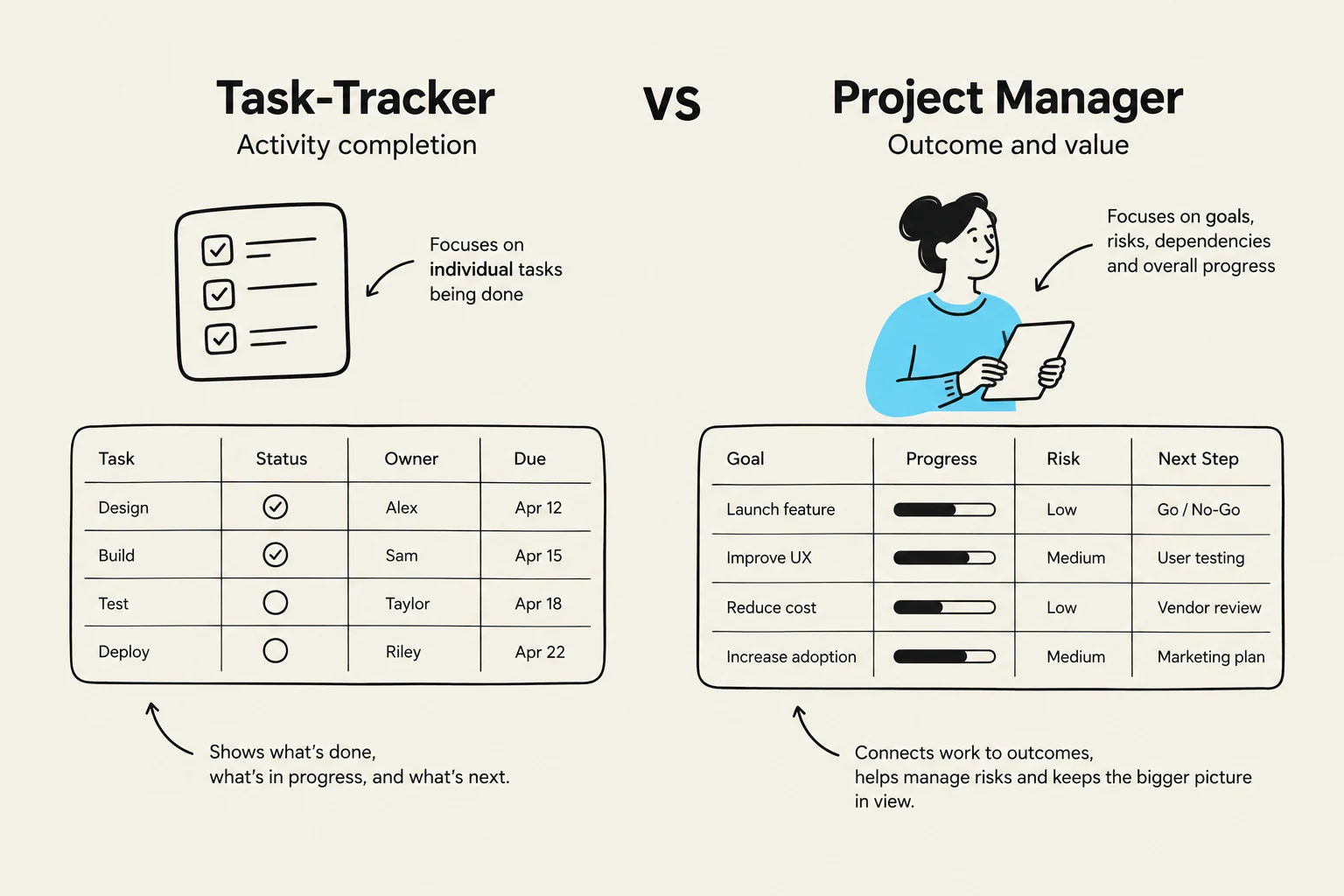
The most critical shift in professional project management is moving from "task tracking" to "coordinated leadership of change". A task tracker asks, "Is this task done?" An integrator asks, "How does this task affect the budget, the risk profile, the stakeholder expectations, and the ultimate business value?".
The PM acts as the connective tissue between technical depth and strategic breadth. While subject matter experts provide the depth, the PM ensures those expert decisions connect to the wider project system. This requires a consistent reasoning framework—often referred to as Senior-PM reasoning—to handle uncertainty and conflicting demands.
The Senior-PM Reasoning Framework
Before acting, follow this sequence:
Identify the fact pattern: Separate facts from assumptions.
Determine the category: Is this a risk, an issue, a change, or a governance matter?
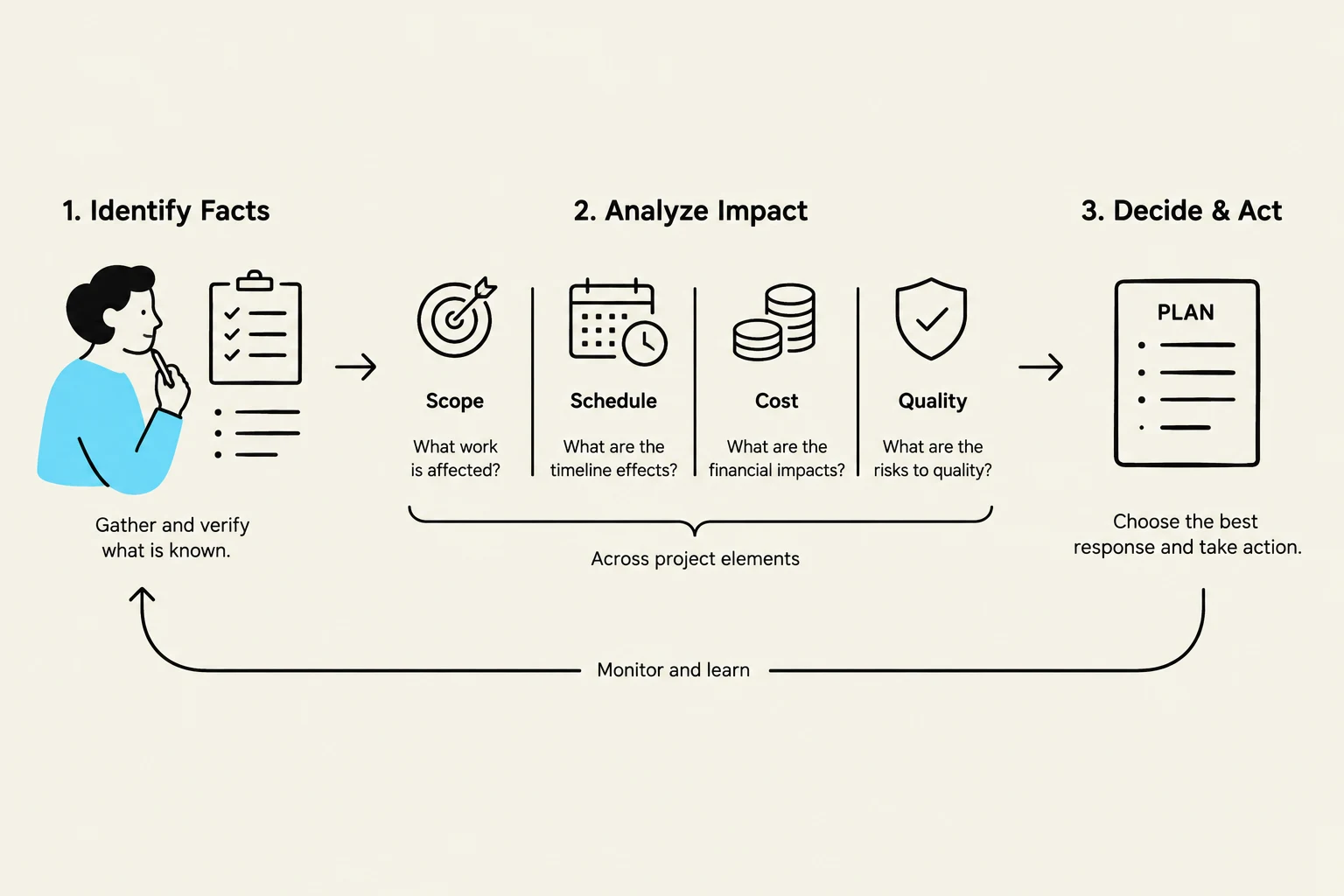
Evaluate connected impacts: How does this affect scope, time, cost, quality, and value?
Respect authority: Who is authorized to make this decision?
Choose the lightest effective action: What is the minimum necessary step to protect value and follow governance?
This diagram illustrates a three-step process for decision-making and action, involving identifying facts, analyzing impact across project elements like scope, schedule, cost, and quality, and finally deciding and acting, with a feedback loop for monitoring and learning.
From Business Need to Value Realization
A project exists because an organization wants something to become different. A common pitfall is confusing outputs with outcomes. An output is a deliverable (e.g., a new software portal), whereas an outcome is the change in behavior or capability resulting from that output (e.g., employees using the portal to reduce HR manual work).
The ultimate goal is Value: the overall worth created relative to the costs, risks, and strategic priorities of the organization. Success is therefore multi-dimensional, encompassing delivery performance, quality, stakeholder satisfaction, and long-term business impact.
Artifact Anatomy: Tools for Decision-Making
Artifacts are not bureaucracy; they are decision and coordination tools. A high-quality artifact must be current, distinguish assumptions from facts, and be tailored to its audience.
1. Strategy and Governance Artifacts
The foundation of a project is laid through artifacts that establish authority and direction.
Delivery Approach Decision Memo: This justifies the choice between predictive (plan-driven), adaptive (agile/iterative), or hybrid approaches based on the level of uncertainty and the cost of change.
Charter and Governance Map: The Charter formally authorizes the project and the PM's authority. The Governance Map defines the "rules of the game," including the thresholds for when a variance (in cost or time) requires escalation to a higher authority.
2. Planning and Execution Artifacts
As the project moves into execution, artifacts must manage the complexity of dependencies and requirements.
Requirements Pack + RTM/WBS: Effective requirement elicitation moves beyond vague requests (e.g., "make it easy") to testable, measurable needs. These are then decomposed into a Work Breakdown Structure (WBS) or a refined backlog to ensure traceability to business objectives.
Schedule Network + Recovery Plan: This manages logical dependencies. If a critical path activity slips, the PM evaluates recovery options such as crashing (adding resources) or fast-tracking (performing activities in parallel).
Risk Register + RAID: This tracks Risks (probabilistic future events), Issues (realized problems), Assumptions, Dependencies, and Change Requests.
This diagram illustrates a project management process for handling change requests, including risk assessment, planning, scheduling, budgeting, and stakeholder communication.
3. Performance and Quality Artifacts
To maintain control, the PM uses metrics to forecast health rather than just reporting history.
Budget + EVM Forecast: Using Earned Value Management (EVM), the PM calculates indices like the Cost Performance Index (CPI) to forecast the Estimate at Completion (EAC).
Quality Plan + Root-Cause Analysis: Rather than just detecting defects, the PM uses root-cause analysis to identify systemic issues and implement prevention practices.
Weekly Status Pack: A high-level integration tool that communicates overall health (RAG status), trends, and—most importantly—the decisions needed from stakeholders.
Managing Change, Sustainability, and Transition
Modern project management requires looking beyond the immediate "go-live" date.
Change Impact and Sustainability: When new technologies like AI are introduced, the PM must evaluate the change impact—considering data privacy, security, and long-term economic or environmental consequences (sustainability).
Transition and Benefits Handoff: A project is not successful simply because the code is written. The PM must ensure operational readiness—training users and preparing support teams—to ensure the intended benefits are actually realized after the project team disbands.
Exam Tip: The "First/Next/Best" Logic
When faced with a scenario, identify the sequence:
FIRST: Usually involves understanding, assessing, or gathering facts.
NEXT: The logical follow-up to a completed step.
BEST: The option that most effectively addresses the situation while respecting governance and value.
Comparison of a Task-Tracker focusing on individual task completion versus a Project Manager focusing on outcome and value, illustrating different project management approaches.
By mastering this mental model and treating artifacts as living tools for coordination, a project manager moves from being a person who "manages tasks" to a leader who "delivers value."
Keep reading for free.
Create an account to finish this reading and make it part of your study routine.