Explore the core principles of production, including capacity, speed, effectiveness, and efficiency. Learn about Total Quality Management (TQM) and its components, as well as forecasting and operational tools like MRP and JIT.
In the modern business landscape, the ability to transform raw resources into valuable products is the heartbeat of any successful organization. This process, known as production, is not merely about making things; it is a complex orchestration of resources, timing, and quality standards designed to satisfy human needs and wants. To master this, managers must understand the delicate balance between how much they can produce, how fast they can do it, and how well they can do it.
Understanding Production and Operations
At its core, production refers to the creation of goods and services intended to satisfy consumer needs. This entire process is governed by operations management, which represents the total set of managerial activities used by an organization to transform resource inputs into finished products, services, or both.
When evaluating how well a production system is functioning, managers look at several key metrics:
Capacity: This is the maximum amount of products or services that an organization is capable of producing.
Speed: This measures the time required to complete activities, spanning from the initial development and manufacturing stages to the final distribution of the product.
Study Tip: Think of Capacity as the "size of the bucket" (how much you can hold) and Speed as the "flow rate" (how fast you can fill it).
Measuring Performance: Effectiveness vs. Efficiency
To understand if a production process is truly successful, we must distinguish between doing the right things and doing things right. This is captured through the concepts of effectiveness and efficiency.
Performance effectiveness is an output measure. It focuses on whether the specific task or goal was actually accomplished. For example, if the goal was to produce 1,000 units, and you produced 1,000 units, you were effective.
Performance efficiency, on the other hand, is a measure of the resource costs associated with that goal accomplishment. If you produced those 1,000 units but used double the expected electricity and labor, you were effective but not efficient.
These two concepts combine to define Productivity. Productivity is the comprehensive measure of both the quantity and quality of work performance relative to the utilization of resources.
Total Quality Management (TQM)
While production focuses on the "how much" and "how fast," Quality focuses on the "how well." Quality is defined as the sum of all features and characteristics of a product or service that determine its ability to satisfy stated or implied needs.
To move beyond simple inspections, leading organizations adopt Total Quality Management (TQM). TQM is a meaningful, organization-wide commitment to making quality a guiding factor in every single activity the company performs.
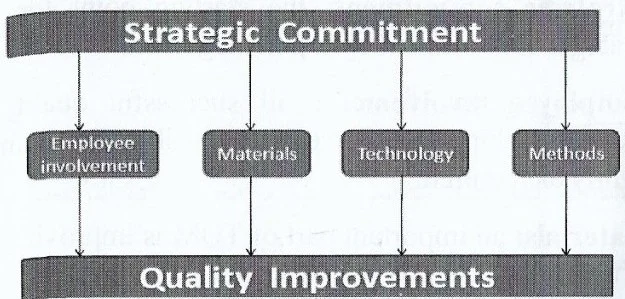
The major components of a TQM program are interconnected, as shown in the flowchart below:
This diagram illustrates the relationship between strategic commitment and quality improvements, highlighting key factors such as employee involvement, materials, technology, and methods.
To implement TQM successfully, organizations focus on five core elements:
Strategic Commitment: TQM must start at the top. It requires a strategic commitment from upper management to drive the culture.
Employee Involvement: Quality is everyone's job. Successful programs ensure that the individuals actually responsible for performing a task do it correctly and as required.
Materials: Organizations must constantly work to improve the quality of the raw materials they use as inputs.
Technology: Tools such as automation and robotics are vital, as they can often achieve higher precision and better quality than human labor alone.
Methods: This involves refining the operating systems and processes used during the actual transformation stage of production.
Maintaining Standards: Quality Control and ISO 9000
Even with TQM, organizations need mechanisms to catch errors. Quality control consists of a series of systematic inspections and tests designed to ensure that the planned quality is actually being achieved.
Furthermore, many organizations adhere to ISO 9000, which is a standardized set of quality criteria established by the International Organization for Standardization to ensure consistency across global industries.
Planning for the Future: Forecasting
Effective production requires looking ahead. Forecasting allows managers to predict demand so they can prepare their capacity and materials accordingly. Forecasting is generally categorized by the time horizon it covers:
Forecast Type
Time Horizon
Typical Use Case
Short-term
Next few weeks
Describing continuing demand for a product
Medium-term
3 months to 2 years
Planning to replace an old product with a new one
Long-term
Several years
Planning the construction of a new plant
Exam Note: Pay close attention to the distinction between medium-term and long-term. Medium-term is often about product lifecycles (replacing products), while long-term is about major infrastructure (building plants).
Operational Tools for Execution
Once a forecast is made, managers use several tools to organize the actual work:
Master Production Schedule: A detailed timetable for making products that ensures the aggregate plan is achieved efficiently.
Material Requirements Planning (MRP): This uses the master schedule to plan exactly when materials should arrive so they are available just when needed.
Just-in-Time (JIT) Systems: An organizational method where operations occur exactly as they are needed, which helps eliminate the need for large stocks of work-in-progress inventory.
Short-term Schedules: These provide granular details regarding specific jobs, people, and equipment, showing exactly what part of the process is happening at any given time.
Job Design: The process of defining the tasks, methods, and responsibilities of individuals to find the best possible way to perform a job.
Project Management: This involves the planning, organizing, staffing, and controlling of specific projects, led by a Project Manager.
Facilities Location: The strategic effort to find the best geographic locations for an organization's operations.
Keep reading for free.
Create an account to finish this reading and make it part of your study routine.