Explains the biological processes of mitosis and meiosis, detailing their roles in cell division, growth, repair, and reproduction, including genetic recombination and variation.
Cell division is a fundamental biological necessity, allowing organisms to grow, repair damage, and reproduce. While all cell division involves the replication and distribution of DNA, the methods and purposes vary significantly depending on whether the cell is a body cell or a reproductive cell. The two primary processes are mitosis and meiosis, which serve distinct biological functions and result in different genetic outcomes.
Mitosis: Growth and Repair
Mitosis is the process of cell division used for the growth, recovery, and repair of somatic (body) cells. When you scrape your knee or grow taller, your body relies on mitosis to create new cells that are identical to the ones they are replacing.
The process begins with a single round of chromosomal duplication. During the metaphase stage of mitosis, the sister chromatids—the two identical halves of a replicated chromosome—line up single file at the cell's equator. This precise alignment ensures that when the cell divides, each new daughter cell receives an exact copy of the genetic material.
In humans, mitosis results in two genetically identical daughter cells, each maintaining the diploid number of 46 chromosomes.
Exam Tip: Remember that mitosis is about consistency. The goal is to produce "clones" to maintain the same genetic blueprint in all body tissues.
Meiosis: The Path to Gametes
Unlike mitosis, meiosis is a specialized two-stage division process designed to produce gametes (egg and sperm cells). The primary goal of meiosis is to achieve two things: genetic reduction (reducing the chromosome number by half) and genetic recombination (ensuring offspring are genetically unique).
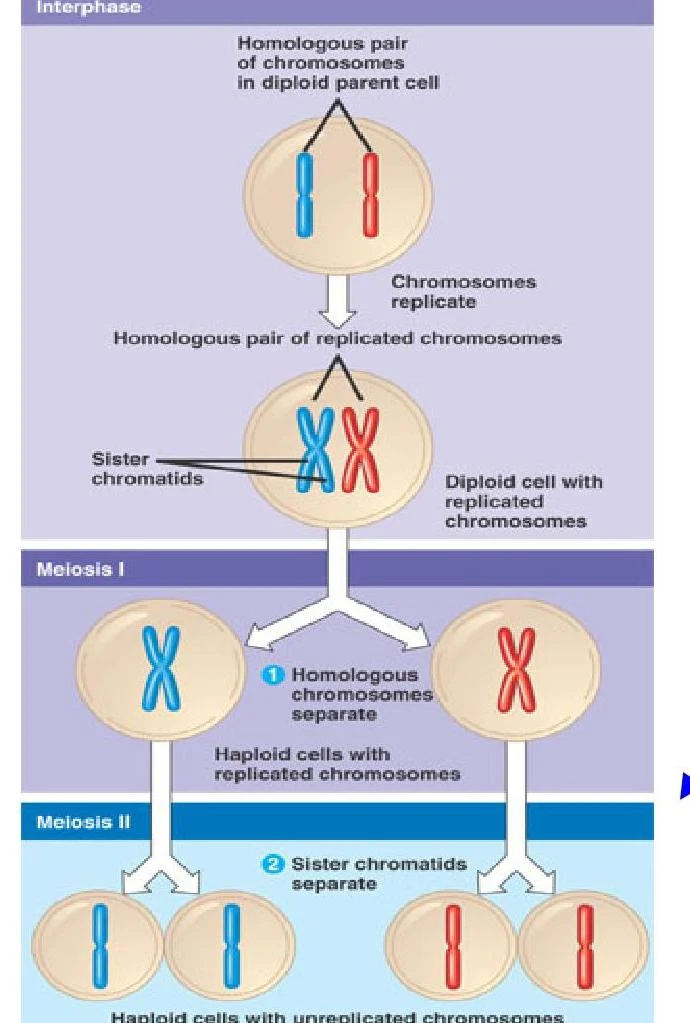
Meiosis involves one round of DNA replication followed by two successive divisions: Meiosis I and Meiosis II.
Diagram illustrating the process of meiosis, showing the separation of homologous chromosomes during Meiosis I and sister chromatids during Meiosis II, resulting in haploid cells.
Meiosis I: Separating Homologous Pairs
In the first stage, Meiosis I, the cell focuses on the separation of homologous pairs. Homologous chromosomes are pairs of chromosomes (one from each parent) that carry the same genes, though they may have different versions (alleles) of those genes. During metaphase I, these homologous chromosomes pair up at the mid-cell rather than lining up single file.
Meiosis II: Separating Sister Chromatids
No DNA is copied between Meiosis I and Meiosis II. Instead, Meiosis II functions much like mitosis, focusing on the separation of the sister chromatids that were created during the initial replication phase.
The end result of this two-step process is the production of four genetically different haploid cells. In humans, these haploid cells contain only 23 chromosomes, ensuring that when a sperm and egg combine during fertilization, the resulting embryo returns to the correct diploid number of 46.
Genetic Recombination and Variation
One of the most critical aspects of meiosis is genetic recombination, the process that drives biological diversity and evolution. This variation is achieved through two key mechanisms: crossing over and independent assortment.
1. Crossing Over
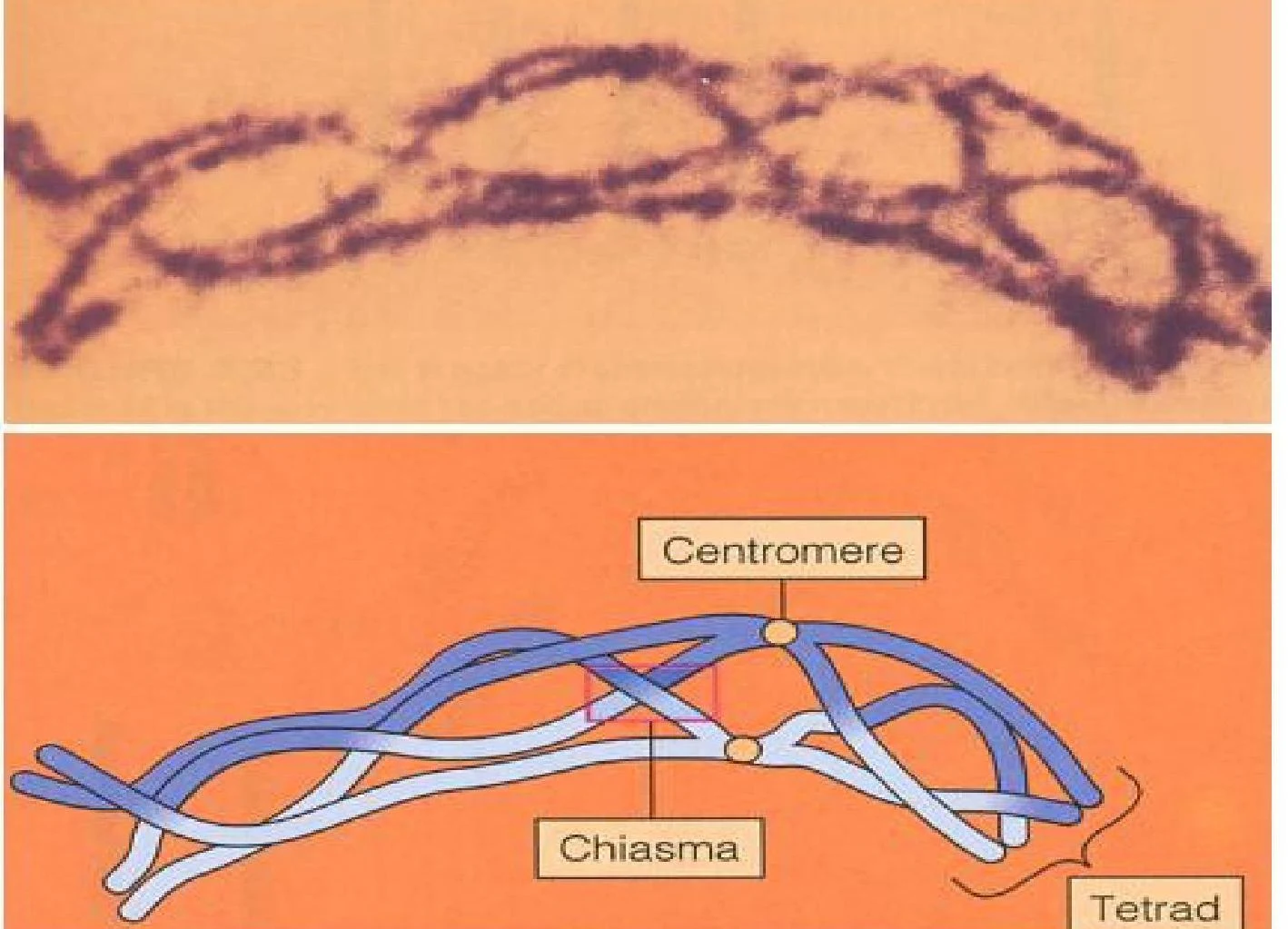
During the early stages of Meiosis I, a process called synapsis occurs, where homologous chromosomes line up closely to form a structure known as a tetrad. At specific points called chiasmata, the non-sister chromatids within the tetrad break and reunite, exchanging segments of genetic material.
Diagram illustrating a tetrad, chiasma, and centromere during meiosis.
This physical exchange of DNA means that the resulting chromatids are no longer identical to the original parental chromosomes, but are instead unique mosaics of maternal and paternal DNA.
2. Independent Assortment
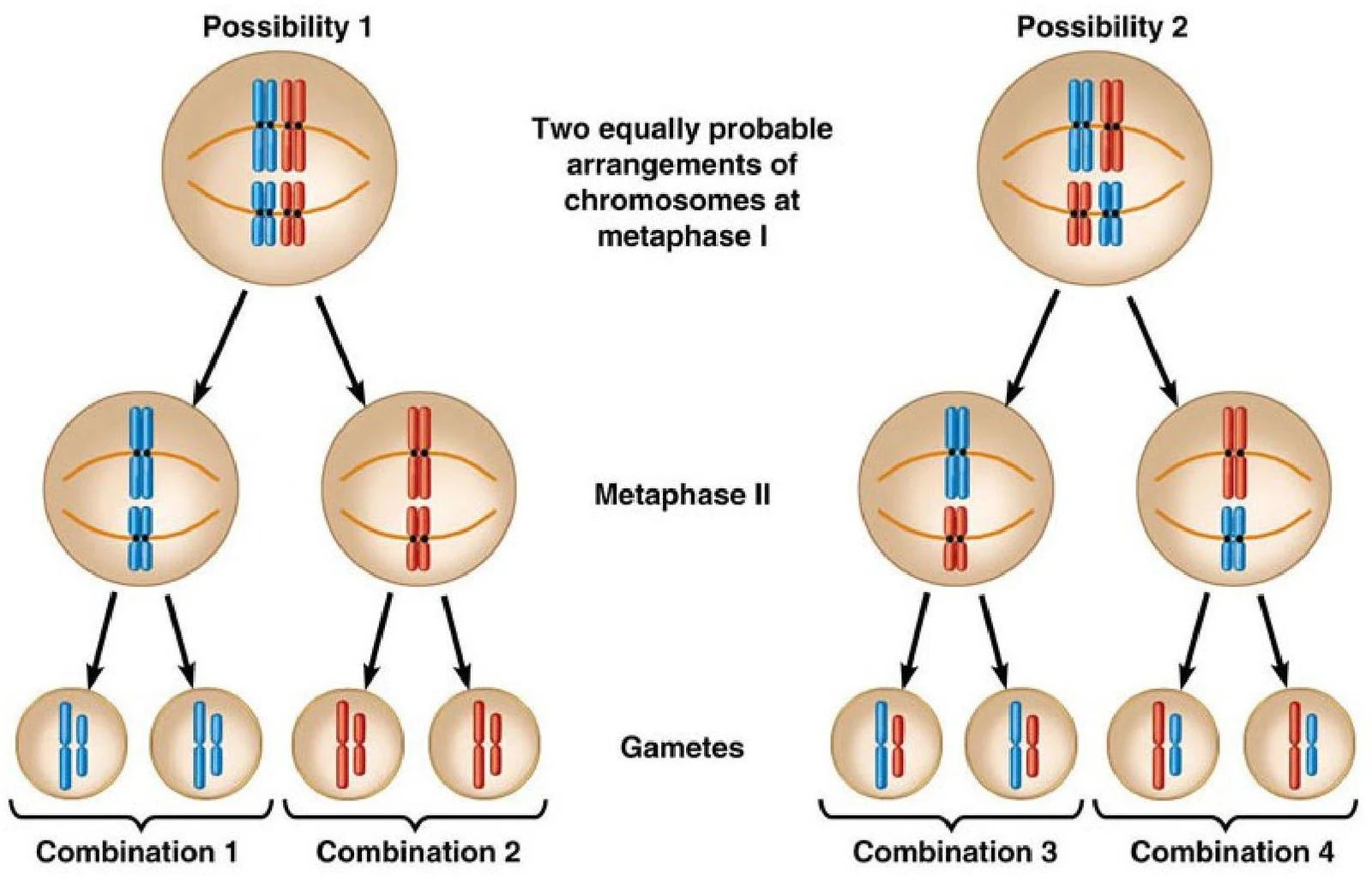
The second mechanism is independent assortment, which occurs during metaphase I. This refers to the random orientation of homologous pairs as they line up at the cell's equator. The way one pair of chromosomes aligns does not affect how another pair aligns; they are distributed independently.
In humans, this randomness creates a staggering number of possible chromosomal combinations in the resulting gametes. The number of possible combinations can be calculated using the formula:
Combinations=223×223=70,368,744,177,664
Diagram illustrating the two equally probable arrangements of chromosomes at metaphase I, leading to different combinations of gametes after meiosis.
Evolution and the Diversity of Life
The combination of crossing over and independent assortment ensures massive genetic variation within a population. This variation is the raw material for evolution—the process by which species change over time to adapt to their environments.
Without the genetic shuffling provided by meiosis, offspring would be much more genetically similar to their parents. By producing diverse offspring, meiosis allows species to possess a wide range of traits, increasing the likelihood that some individuals will survive and adapt to changing environmental pressures.
Summary Comparison
To help distinguish between these two vital processes, refer to the following comparison:
Feature
Mitosis
Meiosis
Primary Function
Growth, recovery, repair
Genetic recombination and reduction
Cell Type
Somatic (body) cells
Gametes (egg and sperm)
Divisions
One
Two
Daughter Cells
Two genetically identical
Four genetically different
Chromosome Count
Diploid (46 in humans)
Haploid (23 in humans)
Metaphase Alignment
Sister chromatids line up single file
Homologous pairs line up
Keep reading for free.
Create an account to finish this reading and make it part of your study routine.