An overview of Social Anxiety Disorder (SAD) and Process-Based Therapy (PBT), an idiographic approach that tailors interventions to individual needs, contrasting it with traditional diagnostic methods. Explores key PBT interventions like cognitive reappraisal, exposure, and emotion regulation.
While many people experience shyness or inhibition, Social Anxiety Disorder (SAD) represents a much more severe and debilitating condition. For the approximately 12% of the population affected, the simple act of interacting with others can provoke overwhelming terror. This fear often leads to significant impairment in career, education, and overall quality of life. Traditional approaches often rely on static DSM diagnoses to guide treatment, but a newer, more sophisticated paradigm is emerging: Process-Based Therapy (PBT).
Understanding Social Anxiety Disorder
Social anxiety is a ubiquitous human experience, ranging from normative nervousness during a presentation to severe clinical impairment. Individuals with SAD specifically fear and avoid situations where they might be evaluated by others, fearing they will act in a way that is embarrassing or humiliating.
The impact of SAD is profound. Research indicates that those with the disorder are more likely to drop out of school, hold jobs below their qualification levels, and experience lower income. Furthermore, there is a significant gender difference: women are more likely to suffer from SAD and report higher clinical severity, though men may seek treatment more frequently.
The Psychological Model of Maintenance
To treat SAD effectively, one must understand the circular processes that maintain the anxiety. A core driver is the discrepancy between high perceived social standards and low perceived social abilities. This leads to social apprehension, which triggers self-focused attention—a state where the individual turns their attention inward to monitor their own physiological symptoms (like blushing or trembling) and negative self-images.
This diagram illustrates the cyclical nature of social anxiety, starting with high social standards and progressing through negative self-evaluation, poor perceived ability, increased anxiety, and avoidance, which in turn reinforces negative self-evaluation.
This self-focus is often exacerbated by emotional processes such as:
Emotion Differentiation: Difficulty distinguishing between specific negative emotions.
Experiential Avoidance: Efforts to avoid unpleasant internal sensations or thoughts, which paradoxically increases the intensity of the emotion.
Emotion Regulation Difficulties: A reliance on expressive suppression rather than effective cognitive reappraisal.
From Static Diagnosis to Process-Based Therapy
Traditional cognitive-behavioral approaches have long been the gold standard for SAD, with Cognitive Behavioral Therapy (CBT) showing significant efficacy in both controlled trials and real-world settings. Other effective methods include Acceptance and Commitment Therapy (ACT) and Mindfulness-Based Stress Reduction (MBSR).
However, Process-Based Therapy (PBT) represents an evolution of these approaches. Rather than following a rigid manual that dictates "Session 1 is X, Session 2 is Y," PBT emphasizes an idiographic approach. This means treatment is tailored to the unique individual and the specific context in which their anxiety manifests.
Study Tip: In clinical exams, remember the distinction between nomothetic (applying general rules to everyone) and idiographic (tailoring to the individual). PBT is fundamentally idiographic.
The Three Stages of PBT
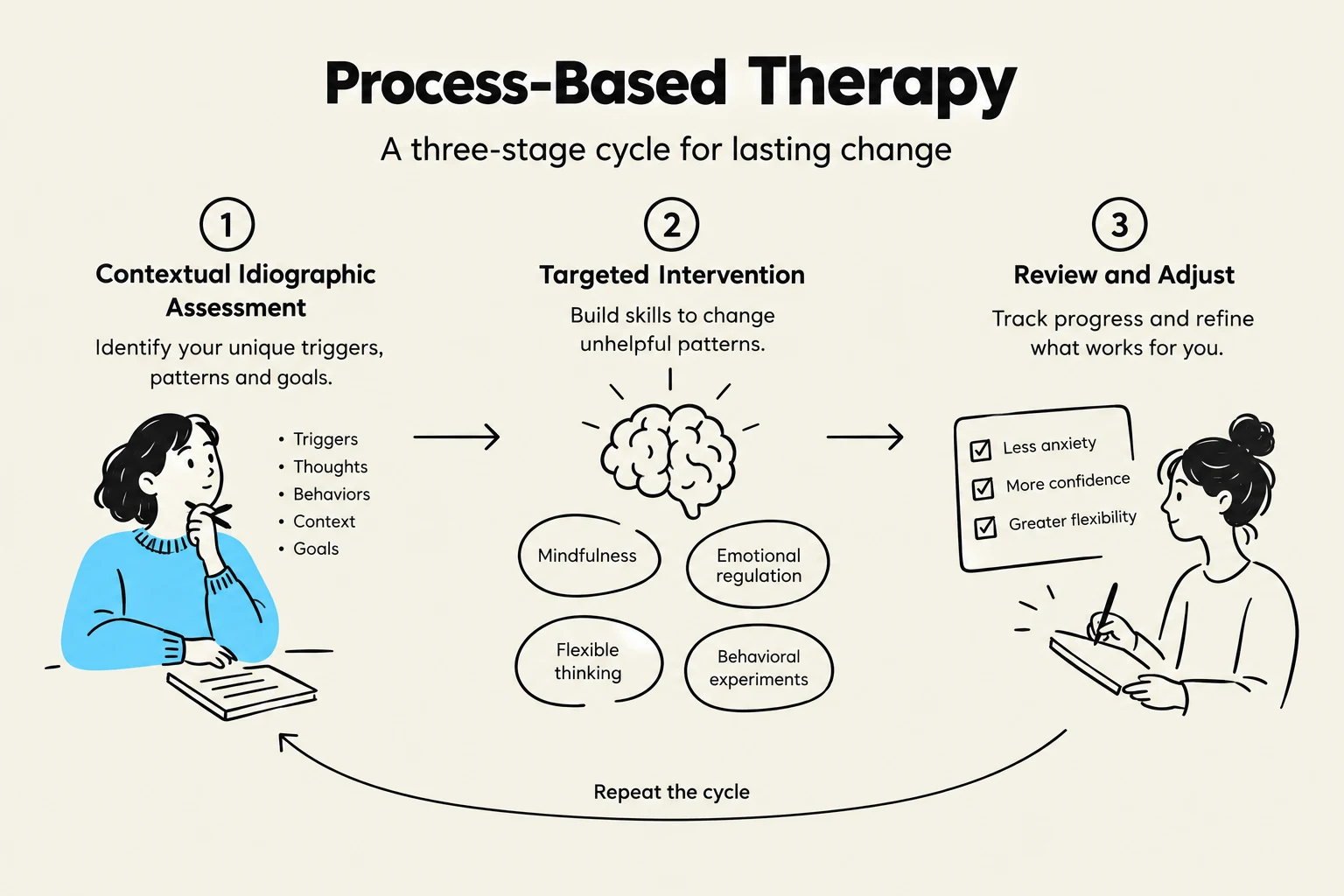
PBT operates through a continuous, repeating cycle of three stages:
Contextual Idiographic Assessment: The therapist and client collaboratively identify a specific target. This might involve a specific upcoming event (like a date) or a specific recurring pattern (like post-event rumination).
Intervention: Based on the assessment, the therapist selects a flexible range of psychological interventions.
Processing and Feedback: The therapist and client discuss what happened during the intervention, what was learned, and whether the approach needs to be adapted for the next cycle.
A three-stage cycle for lasting change in Process-Based Therapy, involving contextual assessment, targeted intervention, and review and adjustment.
Key Psychological Interventions
Because PBT is flexible, the "toolbox" of interventions is vast. However, three specific types are particularly relevant for SAD:
1. Cognitive Reappraisal
This involves changing the meaning of a stimulus to alter the emotional response. It follows three stages: identifying maladaptive thinking, evaluating that thinking (using curiosity rather than criticism), and modifying it to create a more balanced perspective.
Worked Example:
A client thinks, "I'll mess up this date and she'll hate me." Instead of trying to "delete" this thought, cognitive reappraisal helps the client incorporate new information: "It is possible I might mess up, but it is also possible we will get along. I won't know until I actually go." This moves the client from catastrophic thinking to multifaceted thinking.
2. Exposure and Behavioral Experiments
Exposure is a collaborative process where clients choose to enter situations that provoke fear. PBT utilizes three different rationales for exposure:
Behavioral: Aiming for habituation (the reduction of anxiety through repetition).
Cognitive: Using "behavioral experiments" to test whether a feared belief (e.g., "Everyone will laugh at me") is actually true.
Emotional: Focusing on experiencing and accepting emotions rather than fighting them.
3. Emotion Differentiation and Regulation
For clients whose anxiety is driven by an overwhelming "flood" of unnamed emotions, interventions focus on helping them name and distinguish between specific states. Improving this differentiation is a prerequisite for effective emotion regulation.
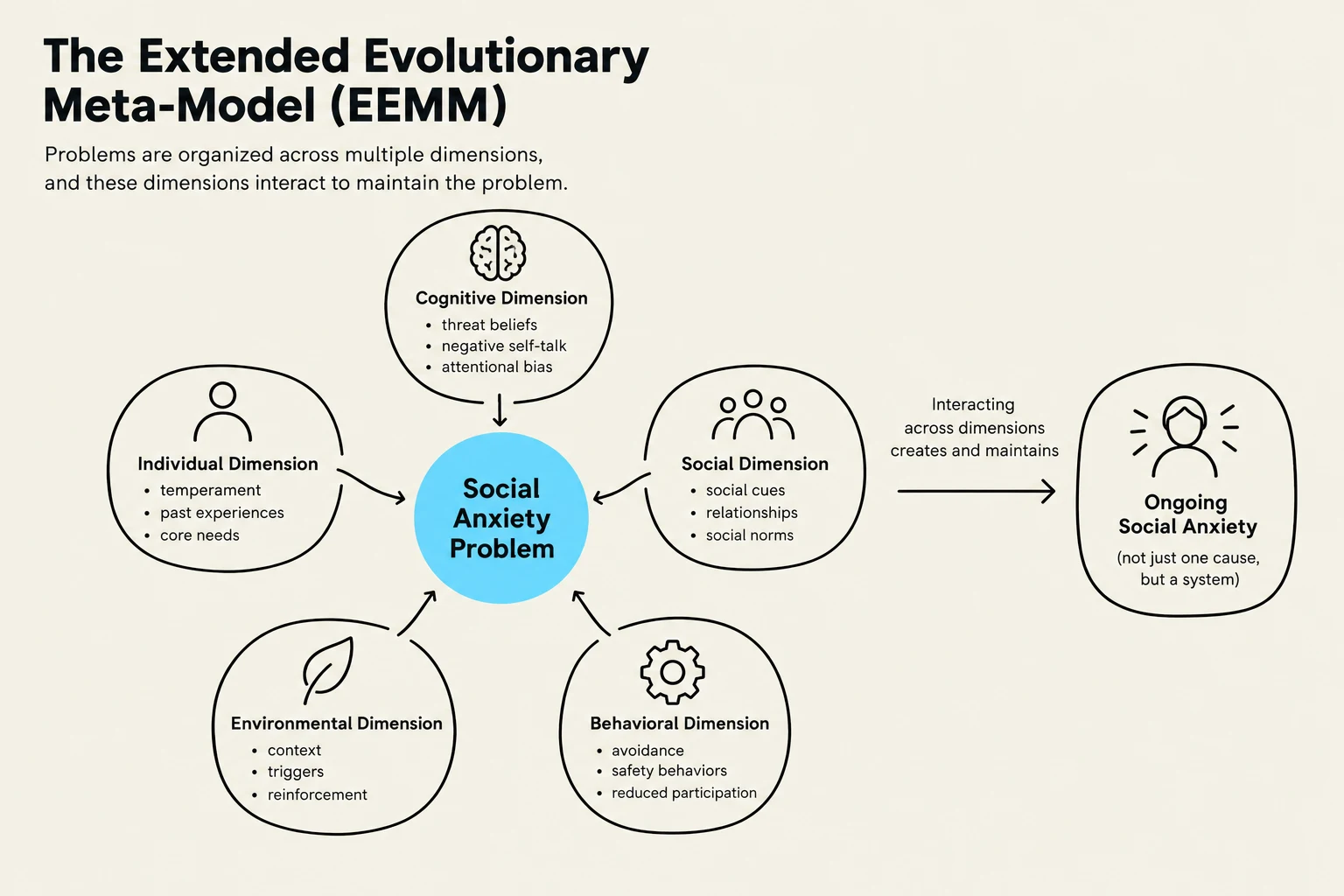
The Extended Evolutionary Meta-Model (EEMM) illustrates how social anxiety problems are maintained by the interaction of individual, cognitive, social, environmental, and behavioral dimensions.
By moving away from static labels and toward a dynamic understanding of the processes that maintain distress, Process-Based Therapy offers a more sophisticated and personalized way to treat the complex reality of social anxiety.
Keep reading for free.
Create an account to finish this reading and make it part of your study routine.