This article explores the fundamental principles of material and energy balances specifically applied to reactor unit operations, including total, elemental, and component balances, the extent of reaction, and reactive energy balances.
In chemical engineering, the reactor is the heart of a process where chemical transformations occur. To design and control these systems effectively, engineers must perform rigorous process analysis. This involves understanding how mass flows through the system and how energy is exchanged due to both temperature changes and the chemical reactions themselves. This article explores the fundamental principles of material and energy balances specifically applied to reactor unit operations.
Material Balances in Reactors
When analyzing a reactor, we cannot simply apply a single type of balance to every substance. Depending on what we are tracking, we use different conservation laws to ensure our calculations are physically accurate.
Total and Elemental Balances
A total mass balance is always valid; it states that the mass entering the reactor must equal the mass leaving (assuming no accumulation). However, when working with chemical species, we often use an elemental balance. An elemental balance tracks specific atoms (like Carbon, Hydrogen, or Oxygen) and is valid on either a mass or a mole basis. Because atoms are neither created nor destroyed in a chemical reaction, the total amount of a specific element entering the system must equal the amount leaving.
Component Balances and Stoichiometry
Unlike elemental balances, a component balance for a specific chemical species (like A or B) is more complex because the species may be consumed or generated by the reaction. To perform a component balance, we must account for the stoichiometry of the reaction—the fixed ratios in which reactants are consumed and products are formed.
For example, consider the reaction:
A(l)+3B(s)→2C(g)+D(s)
In this case, for every 1 mole of A consumed, 3 moles of B must also be consumed, and 2 moles of C must be produced. Because component balances involve these ratios, all quantities must be converted to a mole basis before calculation.
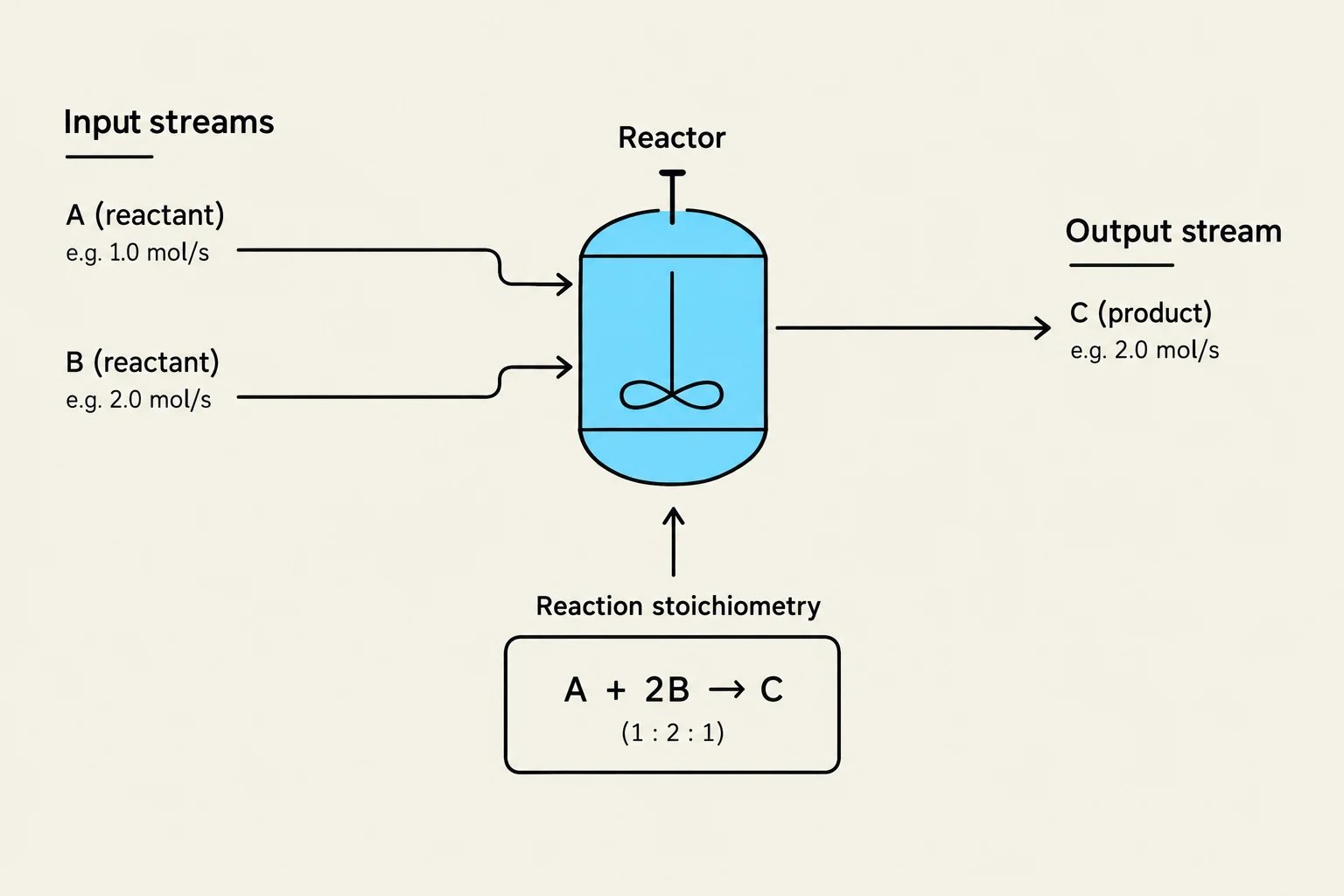
A diagram illustrating a chemical reactor with input streams of reactants A and B, and an output stream of product C, along with the reaction stoichiometry.
Exam Tip: Always remember that while a total mass balance is straightforward, a component balance must include the "Generation" and "Consumption" terms derived from the reaction stoichiometry.
The Extent of Reaction
To bridge the gap between the initial amounts of reactants and the final amounts of products, we use a concept called the extent of reaction, denoted by the Greek letter α (alpha).
The extent of reaction represents the amount of reaction that has occurred. It allows us to express the final moles of any species i (ni,out) based on its initial moles (ni,in), its stoichiometric coefficient (νi), and the extent of reaction (α):
ni,out=ni,in+νiα
In this convention, νi is negative for reactants (consumed) and positive for products (generated). This single variable, α, simplifies complex calculations by providing a unified way to track how much of the chemical transformation has taken place across all participating species.
Energy Balances and Reactive Energy
Beyond mass, we must account for the energy required to maintain reactor conditions. The general energy balance for a steady-state reactor is:
∑Hin+Q=∑Hout+ΔHR,0∘
Or, more commonly expressed in terms of enthalpy changes:
∑Hin+Q=∑Hout+αΔHR,0∘
where Q is the rate of heat exchange.
Exothermic vs. Endothermic Reactions
The direction of heat flow depends on the nature of the reaction:
Exothermic reactions: These release heat to the surroundings (ΔHR,0∘<0).
Endothermic reactions: These absorb heat from the surroundings (Δ:HR,0∘>0).
Reactive Energy Balance and Enthalpy
A reactive energy balance specifically accounts for the heat evolved or absorbed due to the chemical change. The heat of reaction at a reference temperature (usually 25∘C) is calculated using the standard enthalpies of formation (ΔHf∘) of the products and reactants:
ΔHR,0∘=∑ΔHf,prod∘−∑ΔHf,reac∘
.
When calculating the total enthalpy (H) of a stream, we must account for the sensible heat (temperature change) and the energy associated with phase changes.
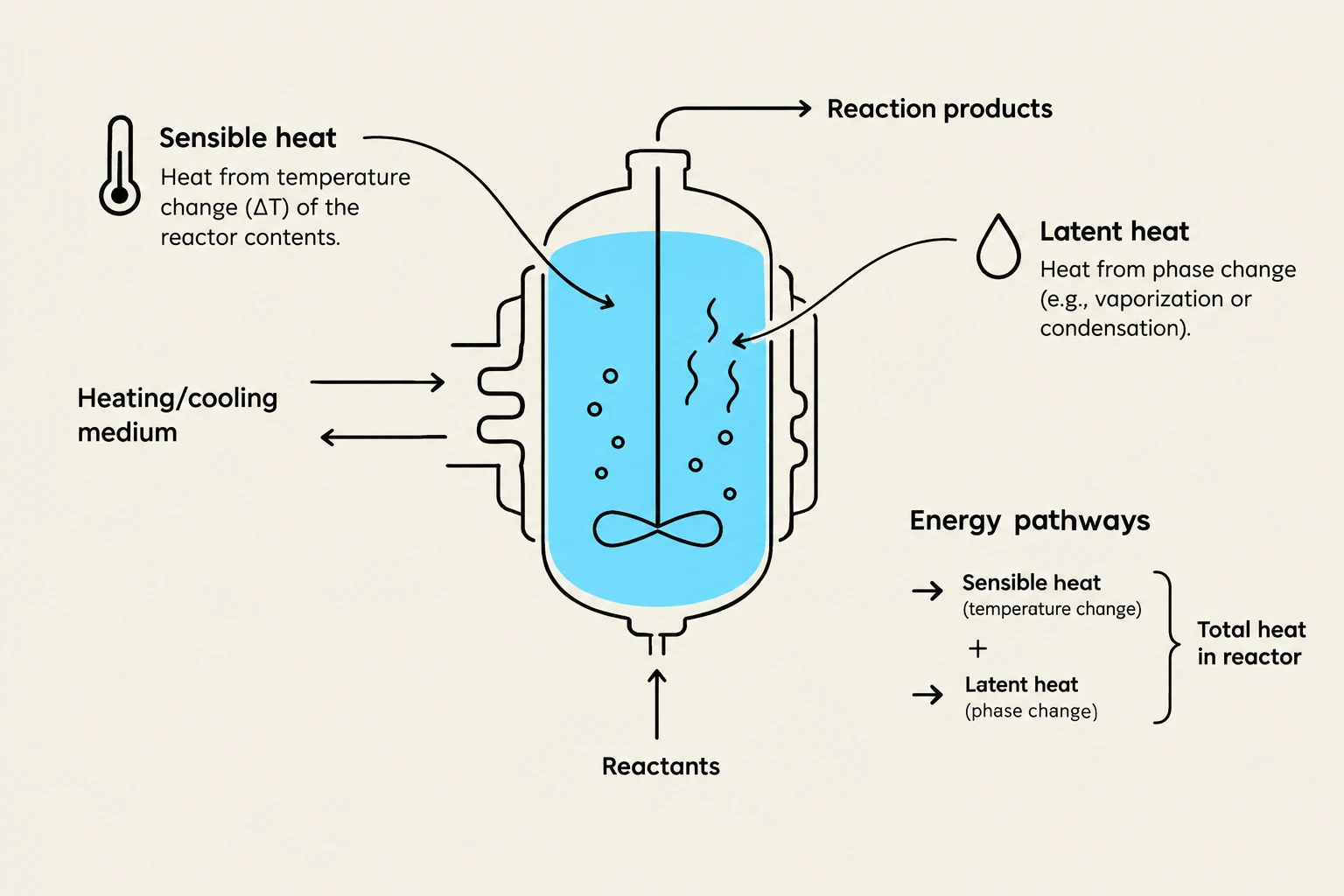
This diagram illustrates the energy pathways within a reactor, distinguishing between sensible heat (related to temperature changes) and latent heat (related to phase changes), and how they contribute to the total heat in the reactor.
Enthalpy Calculations and Latent Heat
To calculate the enthalpy of a stream at a specific temperature T2, we often use a reference temperature Tref=25∘C. The calculation involves several steps:
Sensible Heat: Integrating the heat capacity (Cp) from Tref to the target temperature.
Latent Heat: If a substance changes phase (e.g., liquid to gas), we must include the latent heat data (ΔHvap or ΔHfus) at the phase transition temperature.
For a complex stream, the enthalpy H2 is the sum of the enthalpies of all components, accounting for their specific states (solid, liquid, or gas) and the extent to which they have reacted:
H2=∑(ni,out)[∫TrefTtransCp,idT+ΔHphase+∫TtransT2Cp,idT]
Key Principle: When performing enthalpy calculations, the reference phases used for the stream enthalpies must match the phases used to calculate the standard enthalpy of reaction (ΔHR,0∘).
Summary of Analysis Rules
To ensure accuracy in reactor analysis, follow these three rules:
Isolate Inerts: Any material that does not participate in the reaction (like inerts or unreacted reactants) can be treated separately in the energy balance.
Use Extent of Reaction: The heat evolved due to a reaction should be based only on the amount of material actually taking part in the reaction, using α.
Account for Phase Changes: Always use latent heat data if the enthalpy pathway involves a change in phase.
Keep reading for free.
Create an account to finish this reading and make it part of your study routine.