Principles of Redox Reactions and Cellular Respiration
Explains the fundamental concepts of redox reactions and their crucial role in cellular respiration, detailing the stages of energy harvesting from glucose to ATP production, including glycolysis, the citric acid cycle, and oxidative phosphorylation. It also covers fermentation as an alternative energy pathway in the a
Living cells require a constant supply of energy to perform biological work. This energy is primarily harvested from organic molecules, such as glucose, through a series of metabolic pathways known as cellular respiration. At its core, cellular respiration is a process of controlled energy release, where the chemical energy stored in food is converted into ATP (adenosine triphosphate), the universal energy currency of the cell.
The Chemistry of Energy: Redox Reactions
The fundamental mechanism driving the breakdown of organic fuels is the transfer of electrons. When electrons move from one molecule to another, energy is released. These chemical reactions are called oxidation-reduction reactions, or redox reactions.
Redox reactions consist of two simultaneous processes:
Oxidation: A substance loses electrons (or is oxidized).
Reduction: A substance gains electrons (or is reduced), which results in a reduction of its positive charge.
In any redox reaction, there is an electron donor and an electron acceptor. The donor, which loses electrons, is known as the reducing agent. The acceptor, which gains electrons, is known as the oxidizing agent.
Exam Tip: To remember the difference, use the mnemonic OIL RIG: Oxidation Is Loss, Reduction Is Gain (of electrons).
A classic example of a redox reaction is the combustion of methane with oxygen, where methane acts as the reducing agent and oxygen acts as the oxidizing agent. In the context of cellular respiration, the fuel (glucose) is oxidized, while the oxygen we breathe is reduced to form water.
The Stages of Cellular Respiration
Cellular respiration is a multi-step process that harvests energy in a stepwise fashion, preventing a single, explosive release of heat and instead allowing for the efficient synthesis of ATP. The process can be summarized by the following chemical equation:
C6H12O6+6O2→6CO2+6H2O+Energy (ATP + heat)
The energy harvesting occurs in three main stages:
Glycolysis: The initial breakdown of glucose.
The Citric Acid Cycle: The completion of glucose breakdown.
Oxidative Phosphorylation: The primary stage for ATP production.
Glycolysis: The First Step
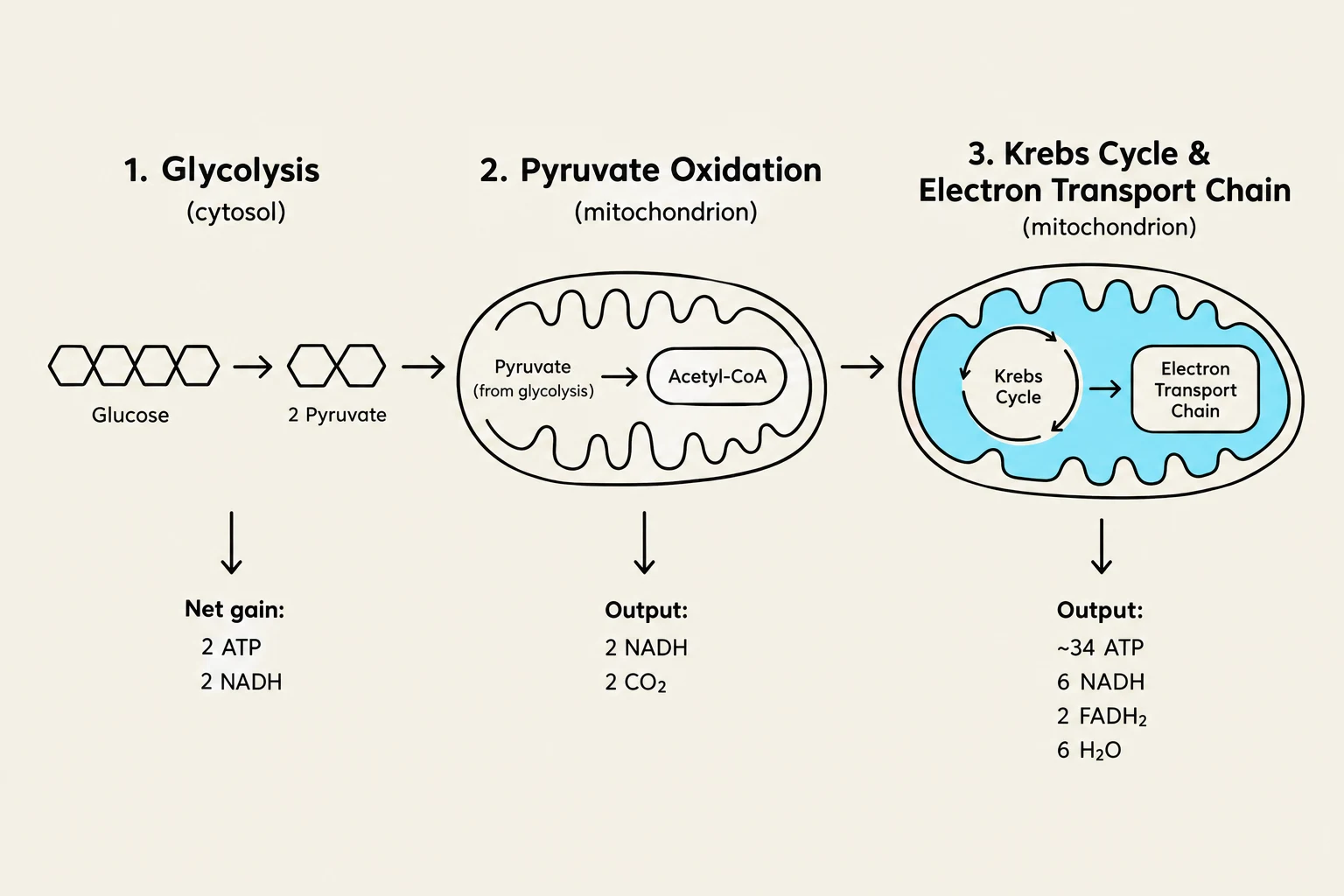
Glycolysis, which literally means "sugar splitting," occurs in the cytosol of the cell. It is a versatile process because it occurs whether or not oxygen is present. During glycolysis, one molecule of glucose is broken down into two molecules of pyruvate.
This process involves two distinct phases: an energy investment phase, where ATP is consumed to prime the glucose molecule, and an energy payoff phase, where ATP and NADH are produced. The net yield of glycolysis is:
2 Pyruvate molecules
2 ATP (via substrate-level phosphorylation)
2 NADH
The Citric Acid Cycle and Pyruvate Oxidation
If oxygen is present, the pyruvate produced in glycolysis enters the mitochondrion. Before entering the cycle, pyruvate must undergo pyruvate oxidation, where it is converted into acetyl CoA. This step links glycolysis to the next stage and releases CO2 while producing NADH.
The citric acid cycle (also known as the Krebs cycle) then completes the breakdown of the organic fuel. As the cycle turns, it oxidizes the acetyl group derived from pyruvate, releasing CO2 and generating small amounts of ATP, as well as high-energy electron carriers, NADH and FADH2.
This diagram illustrates the three main stages of cellular respiration: glycolysis, pyruvate oxidation, and the Krebs cycle with the electron transport chain, detailing the inputs, outputs, and cellular locations of each process.
ATP Synthesis: Two Different Pathways
Cells use two different methods to attach a phosphate group to ADP to create ATP.
Substrate-Level Phosphorylation
This is a direct method where an enzyme transfers a phosphate group from a substrate molecule directly to ADP. This occurs during glycolysis and the citric acid cycle. While important, it produces only a small fraction of the cell's total ATP.
Oxidative Phosphorylation
This is the most efficient method, accounting for approximately 90% of the ATP generated during cellular respiration. It is powered by the redox reactions of the electron transport chain (ETC).
The process works through two coupled mechanisms:
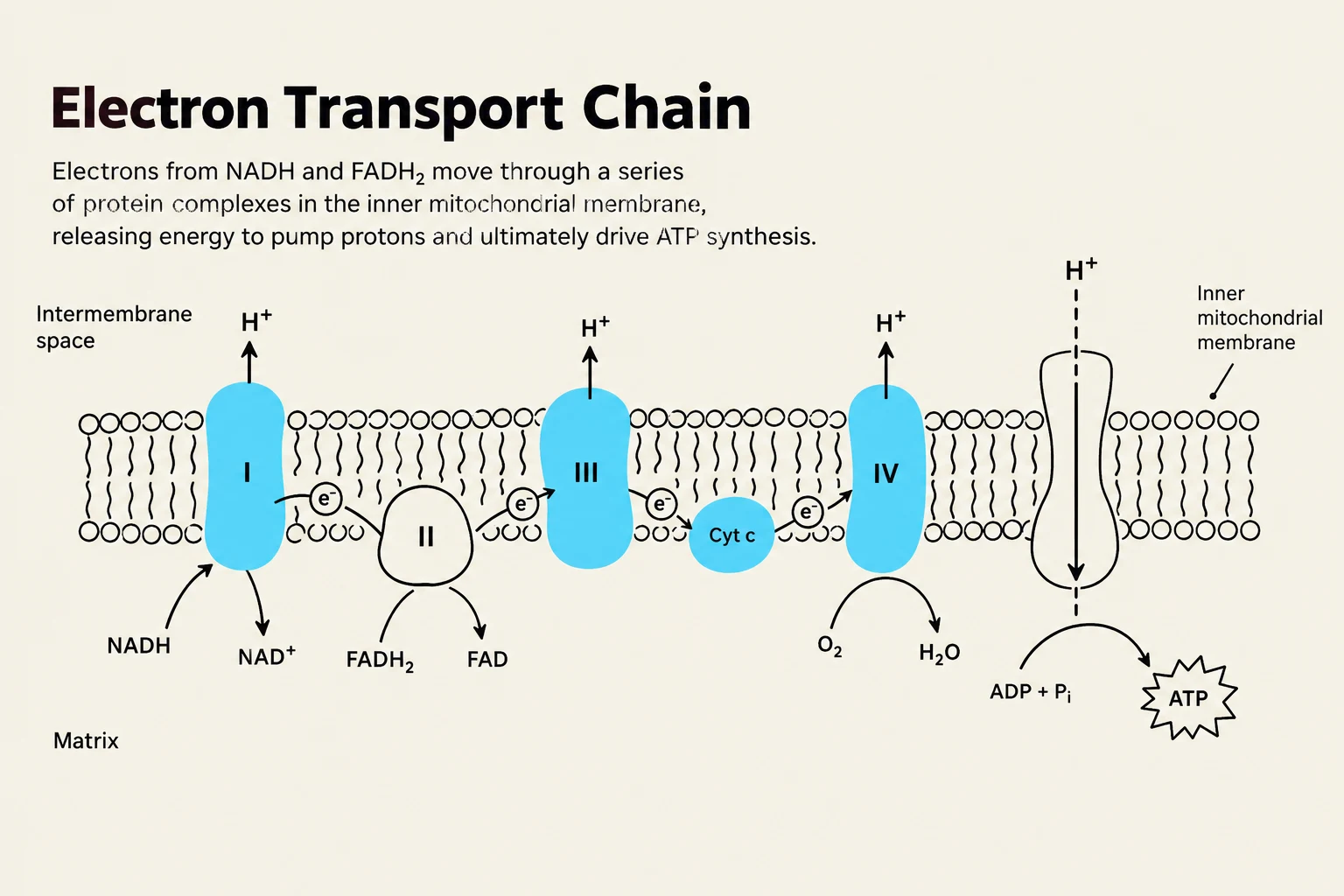
The Electron Transport Chain: NADH and FADH2 (the reduced forms of NAD+ and FAD) donate their high-energy electrons to a series of proteins embedded in the inner mitochondrial membrane. As electrons move down the chain, they lose free energy. This energy is used by the proteins to pump hydrogen ions (H+) from the mitochondrial matrix into the intermembrane space.
Chemiosmosis: The pumping of H+ creates a concentration gradient known as the proton-motive force. The H+ ions then flow back into the matrix through a specialized protein complex called ATP synthase. This flow of ions provides the energy necessary to drive the synthesis of ATP from ADP and inorganic phosphate.
At the end of the electron transport chain, oxygen acts as the final electron acceptor, combining with electrons and H+ to form water (H2O).
Diagram illustrating the electron transport chain, a series of protein complexes in the inner mitochondrial membrane that generates ATP.
Life Without Oxygen: Fermentation
When oxygen is unavailable, the electron transport chain ceases to function. To prevent the cell from running out of NAD+, which is required for glycolysis to continue, cells undergo fermentation.
Fermentation does not produce ATP itself; instead, it regenerates NAD+ so that glycolysis can continue to produce a small amount of ATP (2 per glucose) via substrate-level phosphorylation. Common types include:
Alcohol Fermentation: Pyruvate is converted to ethanol, releasing CO2.
Lactic Acid Fermentation: Pyruvate is reduced to lactate, with no release of CO2.
Summary Table: Energy Yield Comparison
Process
Final Electron Acceptor
ATP Yield (per glucose)
Aerobic Respiration
O2
~30–32 ATP
Fermentation
Organic molecule (e.g., pyruvate)
2 ATP
Through these complex redox pathways, cells efficiently manage the flow of electrons to ensure a steady supply of energy for life.
Keep reading for free.
Create an account to finish this reading and make it part of your study routine.