Principles of Property and Contract Law: Numerus Clausus vs. Numerus Apertus
This content explains the fundamental differences between property law and contract law, focusing on the principles of numerus clausus (closed number) and numerus apertus (open number) in civil law jurisdictions. It details the architecture of property rights, including primary and secondary rights, and contrasts them
In the study of civil law, the distinction between property law and contract law is not merely a matter of subject matter, but a fundamental difference in legal philosophy. At the heart of this distinction lie two opposing principles: numerus clausus (a closed number) and numerus apertus (an open number). While contract law empowers individuals to shape their own legal realities through private agreements, property law restricts the creation of rights to ensure stability and public order within the legal system.
The Architecture of Property Rights
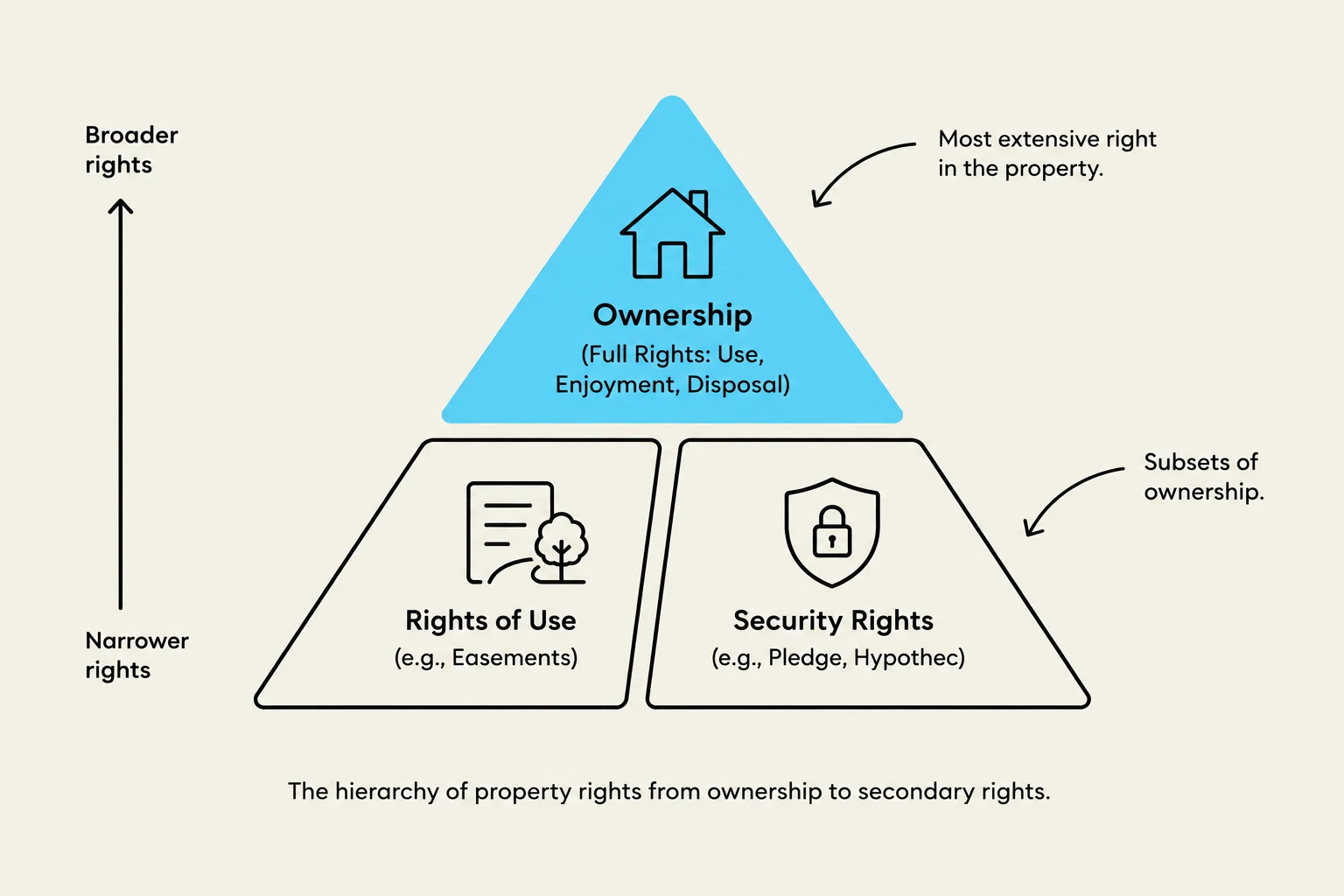
The hierarchy of property rights from ownership to secondary rights, illustrating broader and narrower rights.
Property rights are not monolithic; they exist in a hierarchy based on the extent of the power they grant the holder over an object.
Primary Property Rights
The most extensive and significant right is the right of ownership. An owner possesses the most comprehensive legal relationship with a thing, allowing for use, enjoyment, and disposal within the bounds of the law.
Secondary Property Rights
Secondary rights are lesser interests that do not constitute full ownership but grant specific powers over a thing. These can be categorized into two main groups:
Rights of Use/Service: These allow a person to use an object or benefit from its service (e.g., an easement or a right of use).
Security Rights: These are used to guarantee the fulfillment of an obligation. A common example is the right of pledge, where a movable object is delivered to a creditor as security. Another major security right is the hypothec (often referred to as a mortgage), which typically burdens immovable property like a house.
The Principle of Numerus Clausus
This illustration contrasts "Numerus Clausus" (closed property rights) with "Numerus Apertus" (open contract law flexibility), showing examples of each.
In most jurisdictions, property law is governed by the principle of numerus clausus. This principle dictates that parties cannot invent new types of property rights; they may only establish those rights that are specifically recognized and regulated by the state.
This restriction is necessary for several reasons:
Legal Certainty: Because property rights are often "enforceable against the world" (erga omnes), third parties must be able to know exactly what rights are attached to a piece of land or an object by consulting public registries.
Public Interest: The creation of arbitrary property rights could complicate commerce and make it difficult for people to trade assets if every contract created a unique, unrecognised type of property burden.
Exam Tip: Specificity and Possession
Remember that property rights generally require a specific object. For example, if you give a bank money, you no longer own specific coins; you hold a "credit right" (a contract right) to claim that amount back. However, if you leave a specific gold ring in a bank vault, you retain a property right over that specific object.
The Principle of Numerus Apertus and Freedom of Contract
In sharp contrast, contract law operates under the principle of numerus apertus, driven by freedom of contract and party autonomy. This principle allows individuals to create any terms or types of agreements they desire, provided the content does not violate the law or public policy.
Key Characteristics of Contracts
Non-exhaustive Nature: While civil codes provide templates for common contracts (like sale, lease, or donation), these lists are not exhaustive. Parties can create unnamed contracts that combine elements of different types to meet modern business needs.
Relativity (Inter Partes): Unlike property rights, contracts are generally inter partes, meaning they create obligations only between the specific parties involved in the agreement.
Validity: A contract is binding if there is a "meeting of the minds" and it is free from grounds for nullity, such as mistake, fraud, or lack of capacity.
Comparative Summary: Property vs. Contract
The following table summarizes the fundamental differences discussed in the lecture:
Feature
Property Law (Numerus Clausus)
Contract Law (Numerus Apertus)
Source of Rights
Defined and limited by law
Created by the parties' will
Scope of Rights
Can be created against the world (erga omnes)
Primarily between the parties (inter partes)
Publicity
Requires publicity (e.g., Land Registry)
Often relies on confidentiality
Flexibility
Low; cannot invent new types of rights
High; allows for unnamed/hybrid contracts
Worked Example: The Burdened House
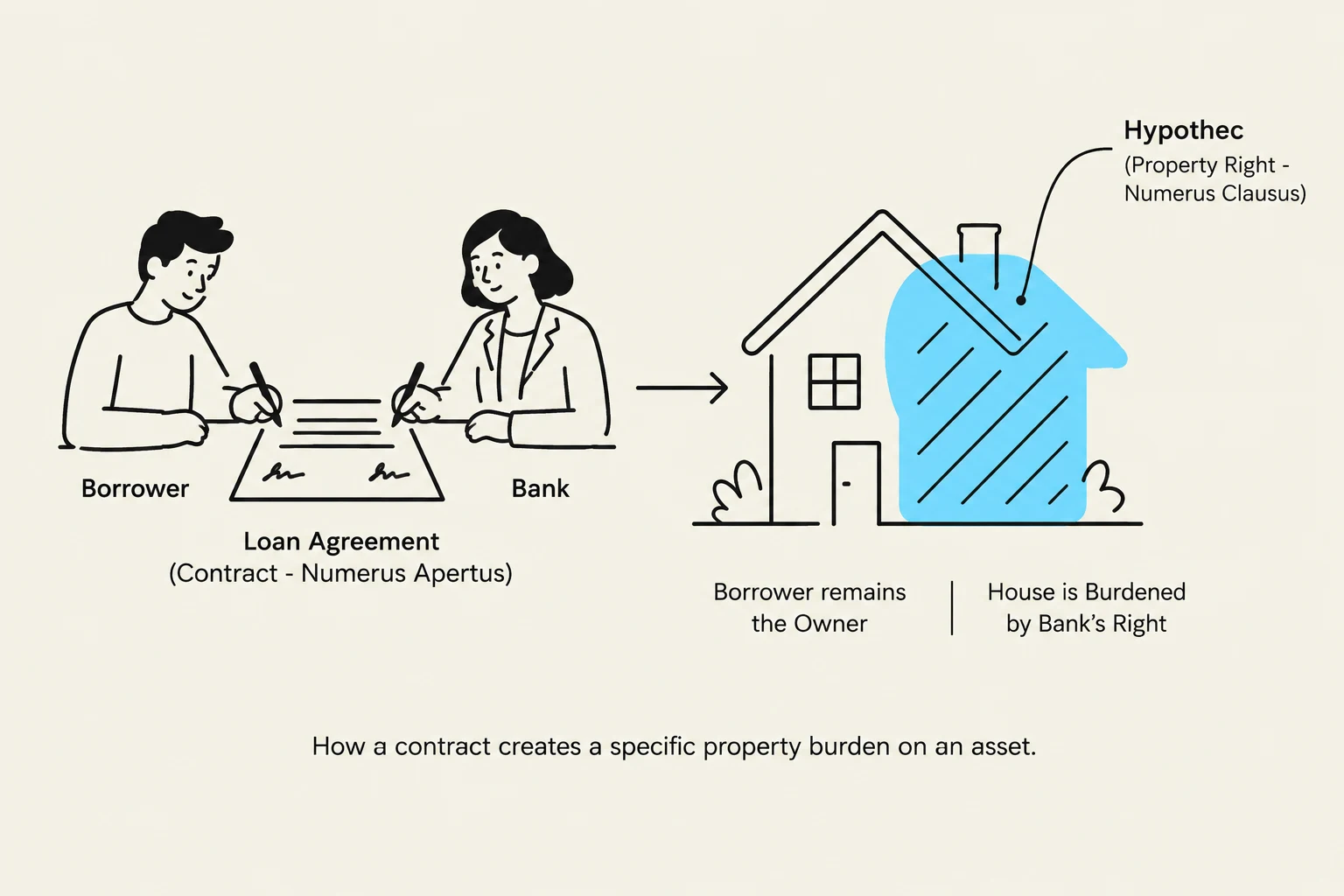
This illustration depicts how a loan agreement, also known as a hypothec, creates a property burden on an asset, where the borrower remains the owner but the house is burdened by the bank's right.
To understand how these principles interact, consider a person buying a house with a bank loan.
The Contract: The borrower and the bank sign a loan agreement. This is a contract governed by numerus apertus. The parties agree on the interest rate, repayment schedule, and terms.
The Property Right: To secure the loan, the borrower grants the bank a right of hypothec (a security right) over the house. This is a property right governed by numerus clausus. The bank cannot invent a "new" type of security; it must use the legally recognized hypothec.
The Result: The borrower remains the owner of the house, but their ownership is "burdened" by the bank's security right. If the borrower fails to pay, the bank can trigger a judicial sale of the house to recover the debt.
Critical Distinction: Security Right vs. Transfer of Ownership
Be careful with the term "mortgage." In some jurisdictions, a mortgage is a security right (the owner keeps the house). In other jurisdictions, it might involve a transfer of ownership for security purposes (the creditor technically becomes the owner until the debt is paid). Always check the specific legal definition in your jurisdiction.
Keep reading for free.
Create an account to finish this reading and make it part of your study routine.