This content explores the fundamental principles of pharmacology, including pharmacokinetics (ADME), pharmacodynamics (drug-receptor interactions), and pharmacotherapeutics. It details the application of the nursing process in safe medication administration, covering assessment, diagnosis, planning, implementation (the
Pharmacology is a foundational science in nursing that explores how drugs interact with living organisms. For a nurse, understanding pharmacology is not merely about memorizing drug names; it is about understanding the complex journey a medication takes through the body, how it produces a desired effect, and how to apply the nursing process to ensure patient safety during administration.
The Nursing Process in Medication Administration
To provide safe care, nurses must view medication administration through the lens of the five-step nursing process. This iterative cycle ensures that drug therapy is tailored to the individual patient's needs.
Assessment: The systematic collection and analysis of patient data to identify health priorities. Before giving a drug, a nurse must assess relevant baseline data (e.g., blood pressure, heart rate, or lab values).
Nursing Diagnosis: Identifying medication-related risks. For example, if a patient experiences dizziness after an antihypertensive, the nurse might identify a "Risk for injury (falls) related to antihypertensive-induced hypotension".
Planning: Developing patient-centered, measurable goals and outcome criteria based on evidence-informed practice.
Implementation: The actual administration of the medication. This must be guided by clinical judgment and adheres to the "Ten Rights" of medication administration (e.g., Right Patient, Right Drug, Right Dose, Right Route, Right Time, Right Reason, Right Education, Right Documentation, Right to Refuse, and Right Assessment).
Evaluation: Monitoring the patient's response to the drug, including therapeutic effects, expected side effects, or toxic reactions.
Exam Tip: Medication errors are preventable events that occur when the "Ten Rights" are compromised. Always distinguish between a medication error (a preventable mistake) and an adverse drug reaction (an unexpected, undesirable response that occurs despite correct administration).
Pharmacokinetics: What the Body Does to the Drug
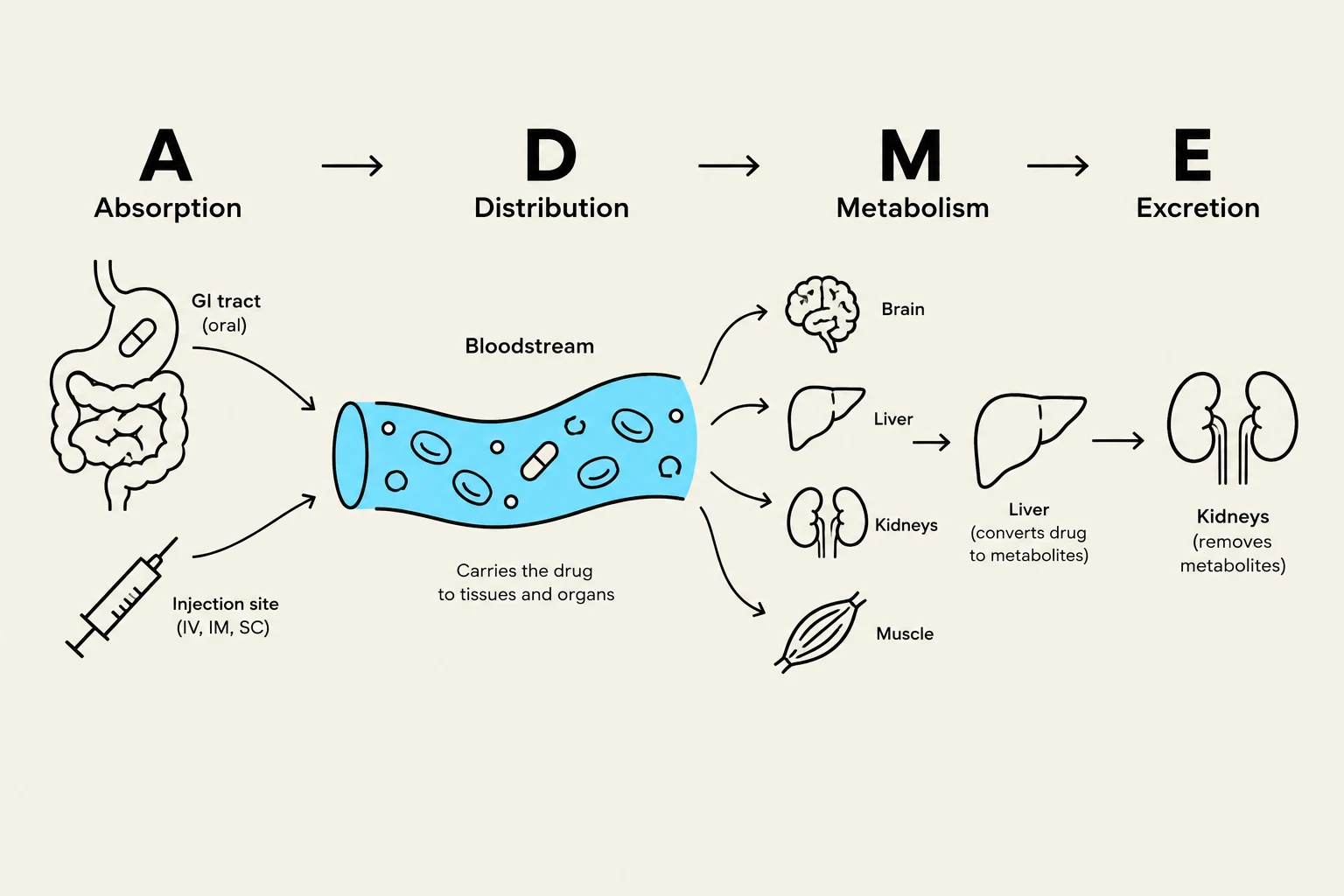
Pharmacokinetics describes the movement of a drug through the body from the moment it enters until it is eliminated. This is commonly understood through the ADME model: Absorption, Distribution, Metabolism, and Excretion.
Absorption
Absorption is the movement of a drug from its site of administration to the bloodstream. The route of administration significantly impacts the rate and extent of absorption. For instance, drugs taken orally must pass through the GI tract and often undergo the first-pass effect, where the liver modifies a large percentage of the drug before it reaches systemic circulation. In contrast, parenteral (injected) routes bypass this initial liver metabolism.
Distribution
Once in the bloodstream, the drug is transported to its site of action. Drugs are typically distributed first to highly vascularized tissues like the heart, liver, and kidneys. A critical concept here is protein binding: many drugs travel bound to proteins like albumin. Only "free" (unbound) drugs are pharmacologically active.
Metabolism and Excretion
Metabolism (biotransformation) is the biochemical alteration of a drug, primarily occurring in the liver via cytochrome P450 enzymes. The goal is often to make the drug more water-soluble for easier removal. Excretion is the final elimination of the drug and its metabolites, with the kidneys serving as the primary organ for this process.
Diagram illustrating the ADME process: Absorption, Distribution, Metabolism, and Excretion of a drug in the body.
Clinical Calculation: Drug Half-Life
The half-life (t1/2) is the time required for the serum concentration of a drug to reduce by 50%.
Example: If a drug has a peak level of 160 mg/L and a half-life of 4 hours, how long until it reaches 20 mg/L?
After 4 hours (1st half-life): 160→80 mg/L
After 8 hours (2nd half-life): 80→40 mg/L
After 12 hours (3rd half-life): 40→20 mg/LAnswer: 12 hours.
Pharmacodynamics: What the Drug Does to the Body
Pharmacodynamics focuses on the biochemical and physiological interactions of drugs at their sites of activity. Most drugs produce their effects through receptor interactions, where a drug mimics or blocks natural substances at a reactive site (usually a protein).
Drug-Receptor Interactions
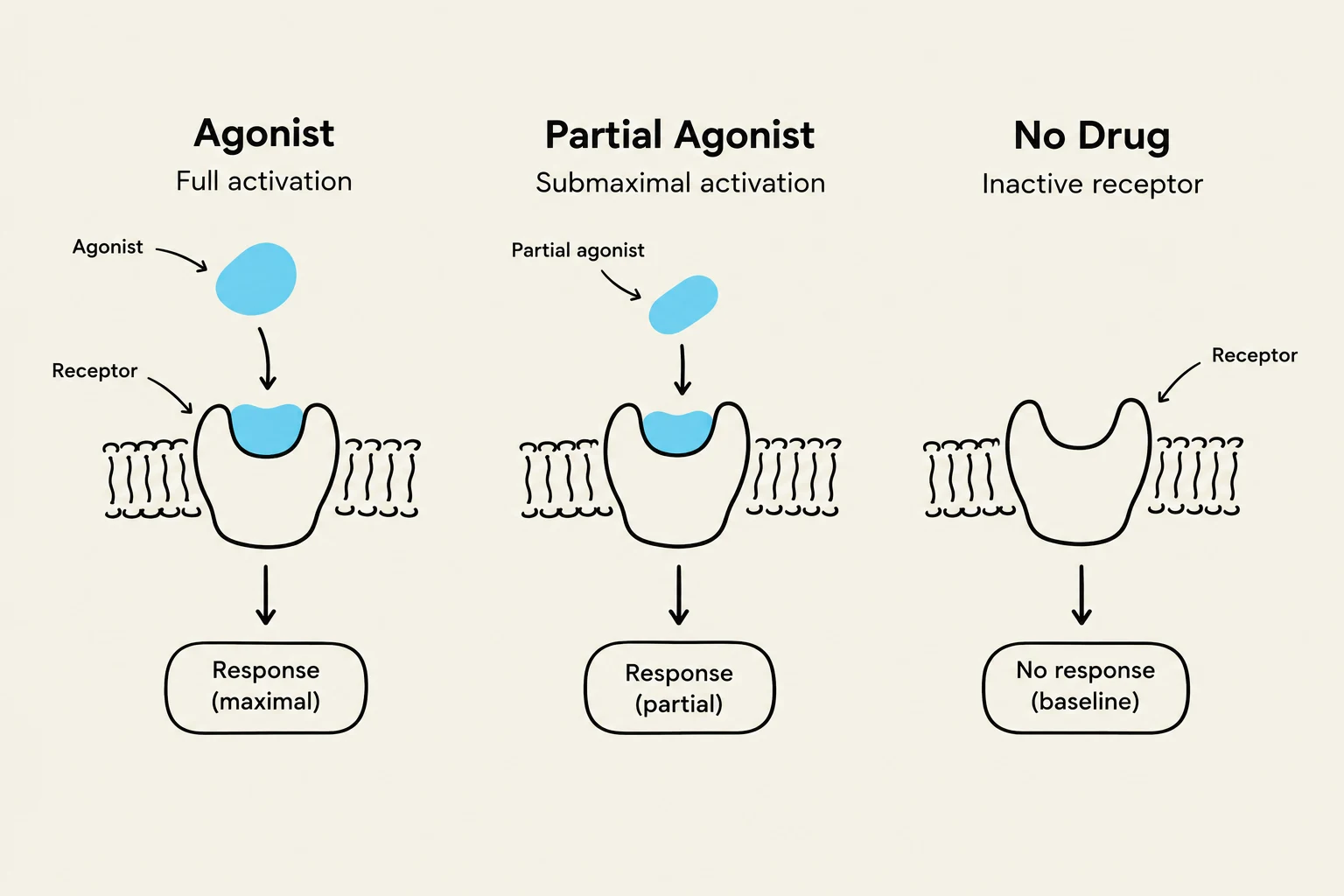
Agonist: A drug that mimics a natural substance to produce a biological response.
Partial Agonist: An agonist that produces a submaximal response even when all receptors are occupied.
Antagonist: A drug that blocks a receptor, preventing a response.
Competitive Antagonist: Competes with an agonist for the same receptor site.
Non-competitive Antagonist: Binds to a different site or binds irreversibly, preventing the agonist from working regardless of concentration.
Diagram illustrating the effects of agonists, partial agonists, and no drug on receptor activation and cellular response.
Pharmacotherapeutics and Types of Therapy
Pharmacotherapeutics is the clinical use of drugs to prevent or treat pathological conditions. Depending on the clinical goal, therapy can be categorized into several types:
Acute Therapy: Used for the rapid treatment of a sudden, severe condition.
Maintenance Therapy: Used to manage a chronic condition and prevent deterioration.
Supplemental Therapy: Used to replace a substance that the body is not producing adequately (e.g., insulin).
Prophylactic Therapy: Used to prevent a disease or condition from occurring.
Supportive Therapy: Used to support body functions or alleviate symptoms without curing the underlying disease.
Palliative Therapy: Used to relieve symptoms and improve quality of life in terminal or end-stage illness.
Safety and Monitoring
A key concept in therapeutic safety is the Therapeutic Index (TI), which is the ratio between the toxic dose and the dose that provides a therapeutic effect:
TI=ED50TD50
Drugs with a narrow therapeutic index (like Warfarin) require much more intensive monitoring than drugs with a wide therapeutic index (like Penicillin) because the margin between a beneficial dose and a toxic dose is very small.
The therapeutic index illustrates the difference between the effective dose and the toxic dose of a drug. A wide therapeutic index indicates a larger margin of safety, while a narrow therapeutic index suggests a higher risk of toxicity.
Keep reading for free.
Create an account to finish this reading and make it part of your study routine.