Principles of Pharmacokinetics and Pharmacodynamics
An overview of pharmacokinetics (what the body does to the drug) and pharmacodynamics (what the drug does to the body), covering absorption, distribution, metabolism, excretion, routes of administration, receptor interactions, and therapeutic ranges.
Understanding how drugs interact with a living organism is a fundamental pillar of pharmacology. To achieve a successful clinical outcome, a practitioner must master two distinct but interconnected concepts: pharmacokinetics, which describes what the body does to the drug, and pharmacodynamics, which describes what the drug does to the body.
Pharmacokinetics: The Journey Through the Body
Pharmacokinetics is the study of how a drug moves into, through, and out of the body. This process is traditionally divided into four essential stages: absorption, distribution, metabolism, and excretion.
1. Absorption
Absorption is the movement of a drug from its site of administration to the systemic circulation (the blood/plasma). The efficiency of this process is measured by bioavailability (F), which is the percentage of the drug that actually enters the systemic circulation. For example, intravenous (IV) drugs have a bioavailability of 1 (F=1), whereas other routes typically have a bioavailability of less than 1.
Several factors influence how well a drug is absorbed:
Drug Factors: Solubility, pH, and molecular size.
Physiological Factors: Blood supply to the area (perfusion), surface area of absorption, and the "First Pass Effect".
The First Pass Effect occurs when drugs absorbed through the gastrointestinal tract pass through the liver via the hepatic portal system before reaching general circulation. The liver often identifies these drugs as toxins and metabolizes them extensively, significantly reducing their bioavailability.
Mechanisms of Movement
At the cellular level, drugs move across membranes via three primary mechanisms:
Passive Diffusion: The random movement of molecules "down" a concentration gradient.
Facilitated Diffusion: A passive mechanism that uses a special carrier molecule but does not require cellular energy.
Active Transport: A process where the cell expends energy to move a molecule across a membrane or to "reset" a carrier molecule.
2. Distribution
Once in the bloodstream, the drug undergoes distribution—the movement from the systemic circulation to the various tissues. The goal is to reach the target tissue (the intended site of action).
Key factors affecting distribution include:
Membrane Permeability: This is often the most significant factor. For instance, the Blood-Brain Barrier (BBB) consists of continuous capillary walls and glial cells that prevent most drugs from entering the Central Nervous System (CNS). Only lipophilic drugs can typically cross this barrier.
Tissue Perfusion: Highly perfused organs like the brain, heart, and kidneys receive drugs rapidly, while poorly perfused tissues like fat receive them more slowly.
Protein Binding: Many drugs bind to large proteins in the blood, such as albumin. Because these proteins are too large to leave the capillaries, only the "free" or unbound drug can exit the vessels to reach the tissues.
Volume of Distribution (Vd): This concept describes how widely a drug is distributed throughout the body's compartments. A larger volume of distribution results in a lower concentration of the drug in the blood.
This illustration compares two solutions. The left beaker contains 10 L of solution with 100 mg of salt, resulting in a concentration of 0.01 mg/mL. The right beaker contains 1 L of solution with 100 mg of salt, resulting in a concentration of 0.1 mg/mL.
3. Metabolism (Biotransformation)
Metabolism is the chemical alteration of a drug by the body into a metabolite. While most metabolism occurs in the liver via cytochrome P-450 enzymes, it can also occur in the lungs, skin, or intestines.
Metabolites can be:
Inactive: The drug is neutralized and prepared for excretion.
Active: The drug remains functional (e.g., Prednisone is converted to the more active Prednisolone in the liver).
Toxic: The alteration creates a harmful substance.
Clinical Note: Species differences significantly impact metabolism. For example, cats metabolize certain drugs like Aspirin and NSAIDs differently than dogs, which can lead to toxicity.
4. Excretion
Excretion is the final removal of the drug from the body. The primary routes are:
Renal (Kidneys): Excretion into the urine.
Hepatic (Liver): Excretion into the bile, which then enters the feces.
Other routes: Lungs, saliva, milk, or sweat.
A critical concept in excretion is Half-Life (T1/2), which is the time required for the drug concentration to decrease by 50%. This measurement is essential for determining drug withdrawal times in food-producing animals to ensure no residues remain in meat or milk.
Routes of Administration
How a drug enters the body dictates its absorption rate and bioavailability.
Parenteral Routes
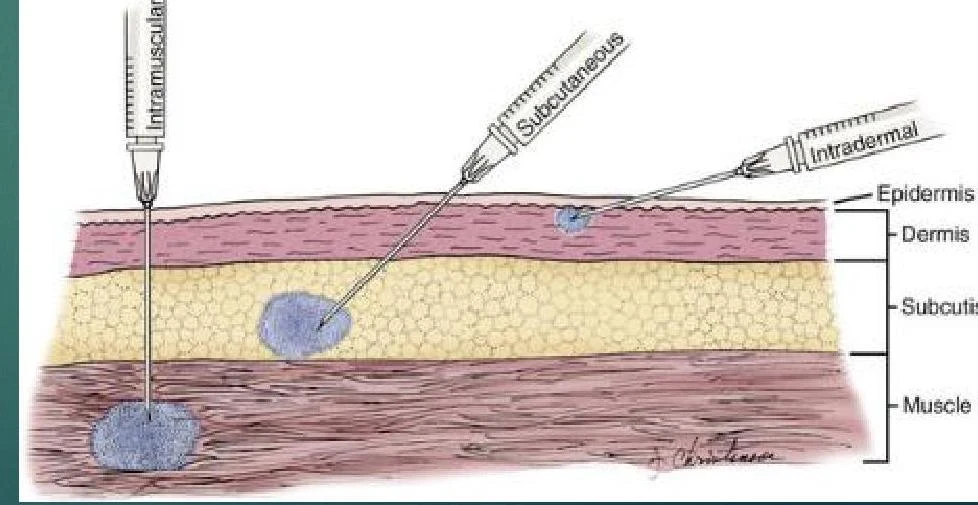
Parenteral administration refers to drugs injected into the space between the skin and the intestinal tract. These routes typically bypass the first-pass effect and offer faster onset.
IV (Intravenous): Directly into the vein.
IM (Intramuscular): Into the muscle (absorbed faster than subcutaneous).
SC/SQ (Subcutaneous): Under the skin.
ID (Intradermal): Into the dermis.
IP (Intraperitoneal): Into the abdominal cavity.
Diagram illustrating intramuscular, subcutaneous, and intradermal injection depths into skin layers: epidermis, dermis, subcutis, and muscle.
Nonparenteral Routes
These involve administration through natural body openings or surfaces:
Per os (PO): Oral administration (by mouth).
Per rectum: Suppositories.
Topical: Applied to the skin surface.
Aerosol: Delivered into the lungs via air or gas.
Pharmacodynamics: The Mechanism of Action
Pharmacodynamics explores how drugs produce their effects. Most drugs work by interacting with specific proteins called receptors.
The Lock and Key Model
A common way to visualize this is the "Lock and Key" analogy: the drug is the key and the receptor is the lock. For a drug to work, it must have the correct shape and charge to fit into the receptor. A drug that binds strongly to a receptor is said to have a high affinity.
Based on their action, drugs are categorized as:
Agonists: Drugs that bind to a receptor and trigger a cellular response (e.g., epinephrine).
Antagonists: Drugs that bind to a receptor but block the response, preventing other molecules from acting (e.g., famotidine).
The Therapeutic Goal: Maintaining the Window
The ultimate goal of drug therapy is to maintain drug concentrations within the therapeutic range (or therapeutic window). This is the range of concentrations that produces beneficial effects without causing significant toxicity.
Key Concentration Terms
Minimum Effective Concentration (MEC): The lower limit of the therapeutic range; below this, the drug is ineffective.
Maximum Effective Concentration: The upper limit of the normal therapeutic range.
Peak Concentration: The highest concentration of the drug in the blood.
Trough Concentration: The lowest concentration of the drug in the blood.
Dosage Regimens
To keep a patient within the therapeutic window, clinicians use different dosing strategies:
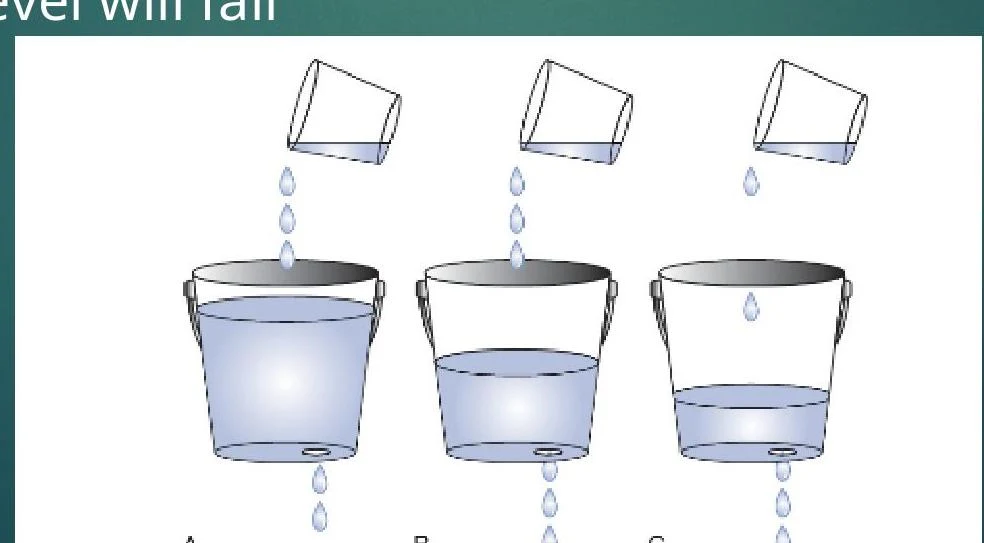
Loading Dose: A large initial dose used to "load the bucket" (rapidly reach therapeutic levels).
Maintenance Dose: Smaller, regular doses that match the body's rate of elimination to keep levels stable.
Exam Tip: Be wary of drugs with a narrow therapeutic index (TI). A narrow TI means the dose required for a beneficial effect is very close to the dose that causes toxicity. For these drugs, clinicians must avoid wide swings between peak and trough concentrations to prevent accidental overdose.
The relationship between inflow (dosing) and outflow (metabolism/excretion) can be understood using the bucket analogy: if the rate of water poured in equals the rate of water leaking out, the level remains stable.
Three buckets are shown, each with water being poured into it from a tilted cup. The amount of water in each bucket and the rate at which it is draining differs.
Keep reading for free.
Create an account to finish this reading and make it part of your study routine.