Principles of Microeconomics: Scarcity, Supply, Demand, and Market Structures
An overview of microeconomic principles, covering scarcity, choice, supply and demand, consumer behavior, production costs, market structures (perfect competition, monopoly, oligopoly), and market failures like externalities and public goods.
Economics is often misunderstood as merely the study of money, finance, or complex mathematics. In reality, it is a much broader discipline: it is the study of how humans make decisions in the face of scarcity. Whether we are deciding how to spend our limited monthly budget, how a business should price its products, or how a government should allocate resources to combat climate change, we are engaging in economic reasoning.
The Principles of Microeconomics 3e textbook provides a comprehensive framework for understanding these decisions. By balancing theoretical models with real-world applications—including contemporary data on the COVID-19 pandemic and insights from sources like the Federal Reserve Economic Data (FRED)—the text offers a practical lens through which to view the world.
The Core Problem: Scarcity and Choice
At the heart of all economic thought lies the concept of scarce resources. Scarcity exists because human wants for goods, services, and resources are virtually infinite, while the resources required to produce them—such as labor, land, tools, and raw materials—are limited. Even time itself is a finite resource; every individual has only 24 hours in a day to allocate between work, sleep, and leisure.
Because we cannot have everything we want, we must make choices. Every choice involves a tradeoff, often expressed through the concept of opportunity cost—the value of the next best alternative foregone when making a decision.
The Engine of the Market: Supply and Demand
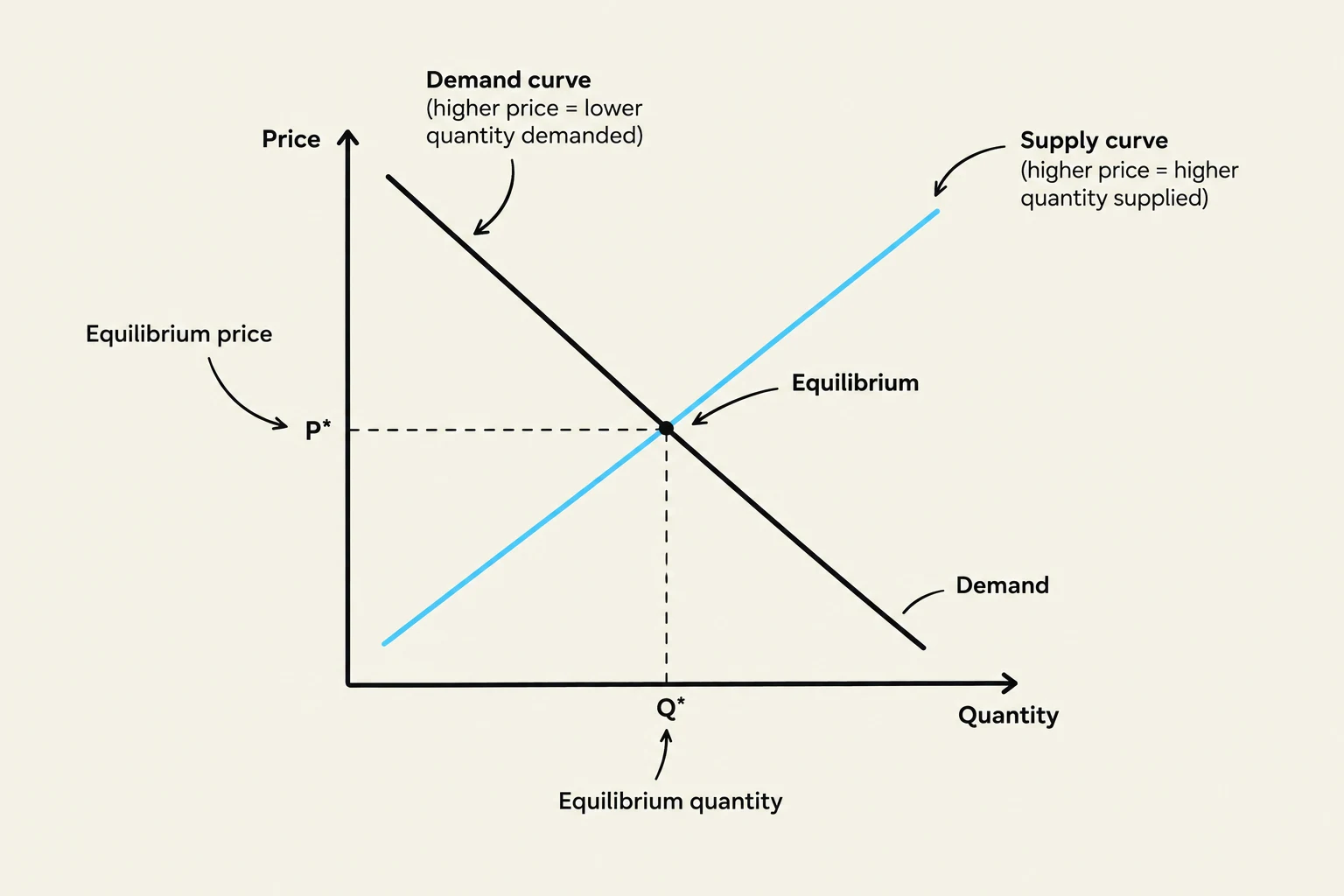
To understand how markets function, economists rely on the fundamental model of supply and demand. This model explains how buyers and sellers interact to determine the price and quantity of goods and services in a market.
Demand refers to the quantity of a good that consumers are willing and able to purchase at various prices.
Supply represents the quantity that producers are willing and able to sell at various prices.
Equilibrium occurs at the specific price point where the quantity demanded by consumers exactly equals the quantity supplied by producers.
At equilibrium, the market is "cleared," meaning there is neither a shortage nor a surplus.
A graph illustrating the economic principles of supply and demand, showing the intersection of the demand curve and supply curve at the equilibrium price and quantity.
Exam Tip: When analyzing shifts in the market, remember that a change in "demand" refers to a shift of the entire curve, whereas a change in "quantity demanded" refers to a movement along a fixed curve caused by a change in the price of the good itself.
Microeconomic Theory: Consumers and Firms
Once the basic mechanics of markets are understood, microeconomics dives deeper into the behavior of individual actors.
Consumer Behavior
Economists study consumer behavior to understand how individuals allocate their limited income to maximize their satisfaction, or "utility". This involves analyzing how changes in income or the prices of related goods (substitutes and complements) influence consumption patterns.
Production, Costs, and Market Structure
On the other side of the market are firms. To maximize profit, firms must understand production and costs. This includes distinguishing between explicit costs (out-of-pocket expenses) and implicit costs (the opportunity costs of using resources owned by the firm).
Furthermore, the way firms compete depends heavily on their market structure. These structures range from:
Perfect Competition: Many small firms selling identical products, where no single firm can influence the market price.
Monopoly: A single seller with significant market power and high barriers to entry.
Oligopoly and Monopolistic Competition: Markets with a few large firms or many firms selling differentiated products.
In certain strategic environments, such as an oligopoly, firms may use game theory to predict how competitors will react to their decisions, treating the market like a strategic game where one player's outcome depends on the choices of others.
This illustration compares four market structures: perfect competition, monopolistic competition, oligopoly, and monopoly, detailing their characteristics and graphical representations of price and quantity.
Policy and the Global Dimension
Microeconomics is not just about theoretical models; it is a vital tool for evaluating public policy.
Market Failures and Public Goods
Sometimes, markets fail to allocate resources efficiently on their own. This can occur through:
Public Goods: Goods that are non-excludable and non-rival, such as national defense, which the private market may under-provide.
Externalities: When a transaction affects a third party who is not involved in the exchange. Positive externalities (like education or innovation) provide benefits to society, while negative externalities (like pollution) impose costs.
To address these issues, governments may implement competition and antitrust policies to prevent monopolies from harming consumers, or environmental regulations to mitigate pollution.
International Economics
Finally, microeconomics extends to the global stage. The study of international trade examines how countries gain from specialization through absolute and comparative advantage. However, governments often intervene in global markets through protectionism—using tools like tariffs or quotas to restrict imports and protect domestic industries.
By mastering these principles, students gain the ability to navigate and analyze the complex web of decisions that shape our modern economy.
Keep reading for free.
Create an account to finish this reading and make it part of your study routine.