Understanding why people buy what they buy is the cornerstone of successful marketing. While traditional marketing perspectives once focused heavily on cognitive rationality—the idea that consumers make logical, calculated decisions—modern marketing recognizes that behavior is driven by a complex interplay of psychological, social, and situational factors. To master marketing, one must distinguish between the different types of markets and the intricate stages of the decision-making process.
The Two Faces of Marketing: B2C and B2B
Marketing strategies differ significantly depending on who the target audience is. Generally, the field is divided into two primary sectors:
Business-to-Consumer (B2C): This targets individual end-users for personal use. Examples include purchasing a meal at a restaurant, buying a new car from a dealership, or getting a haircut at a barber shop.
Business-to-Business (B2B): This involves marketing to other organizations. B2B markets often involve fewer buyers who make much larger purchases. A key concept here is derived demand, where the demand for a product is determined by the demand for a related product. For example, the demand for education drives the demand for textbooks, which in turn drives the demand for paper and forestry products.
Exam Tip: When analyzing a case study, identify if the buyer is an individual (B2C) or an organization (B2B). If the demand is driven by another industry's needs, look for the term "derived demand".
The Consumer Decision-Making Process
Consumers do not simply "buy"; they move through a series of stages to resolve a need or desire.
1. Problem Recognition
The process begins when a consumer perceives a discrepancy between their actual state and a desired state. The intensity of this process exists on a continuum:
Habitual Decision-Making: Routine, low-involvement purchases, such as buying milk.
Limited Problem Solving: Requiring some thought, such as looking for new shoes.
Extended Problem Solving: High-involvement, high-risk purchases that require significant research, such as buying a laptop.
2. Information Search
Once a problem is recognized, the consumer seeks solutions. They utilize an internal search (relying on memory and past experiences) and an external search. External searches can include:
Experimental trials: Trying a sample.
Personal sources: Asking friends or family.
Independent sources: Reading third-party reviews.
Company-oriented sources: Marketing materials.
In the digital age, search marketing is vital. This includes SEO (Search Engine Optimization), SEM (Search Engine Marketing), and Social Media Marketing to ensure products appear when consumers are searching for solutions.
3. Evaluation of Alternatives
Consumers use specific criteria to narrow down their choices into an evoked set (the group of brands a consumer actually considers). They typically use one of two methods:
Attribute-based choice: Evaluating products based on specific features (e.g., battery life, price, or size).
Attitude-based choice: Evaluating products based on overall feelings or brand perceptions.
4. Purchase
The actual transaction is influenced by convenience, price, and merchandise quality. Interestingly, many purchases are unplanned. These can be triggered by simple reminders (like Amazon suggesting "you may also need...") or pure impulse (like buying a piece of gum at the checkout). The rise of mobile payment systems like Apple Pay and Square has further streamlined this stage.
5. Post-Purchase Evaluation
After the purchase, the consumer experiences either satisfaction or dissatisfaction. A critical psychological phenomenon to watch for is cognitive dissonance—the feeling of tension or anxiety a consumer may feel after a major purchase (e.g., "Did I make the right choice with this house?").
Influences on Consumer Behavior
Why do two people with the same income make different choices? The answer lies in three categories of influence.
Social and Cultural Influences
Culture and society provide the "rules" for behavior.
Norms: The formal or informal societal rules that govern behavior.
Authority: The tendency for people to automatically defer to symbols of authority, such as titles or specific clothing.
Reference Groups: Groups that people use to decide how to act. These can be membership groups (groups you belong to) or aspirational/dissociative groups (groups you want to join or avoid).
Cultural Dimensions: Concepts like individualism vs. collectivism help marketers understand how different national cultures prioritize personal goals versus group goals.
Individual Influences
These are the unique characteristics of the person:
Personality: Traits such as being confident, adaptable, or dominant. Marketers often use the "Big 5" model to categorize these traits.
Lifestyle and Values: How a person lives (fashion, travel) and what they believe in (religion, sustainability).
Psychological Influences
This is the internal processing of the world.
Perception: The process of selecting, organizing, and interpreting sensory stimuli (sensation). Perception is subjective and influenced by prior experience. It involves three "filters":
Selective Attention: Only noticing stimuli that are relevant to us.
Selective Distortion: Interpreting information in a way that fits our existing beliefs.
Selective Retention: Remembering only the information that supports our feelings and beliefs.
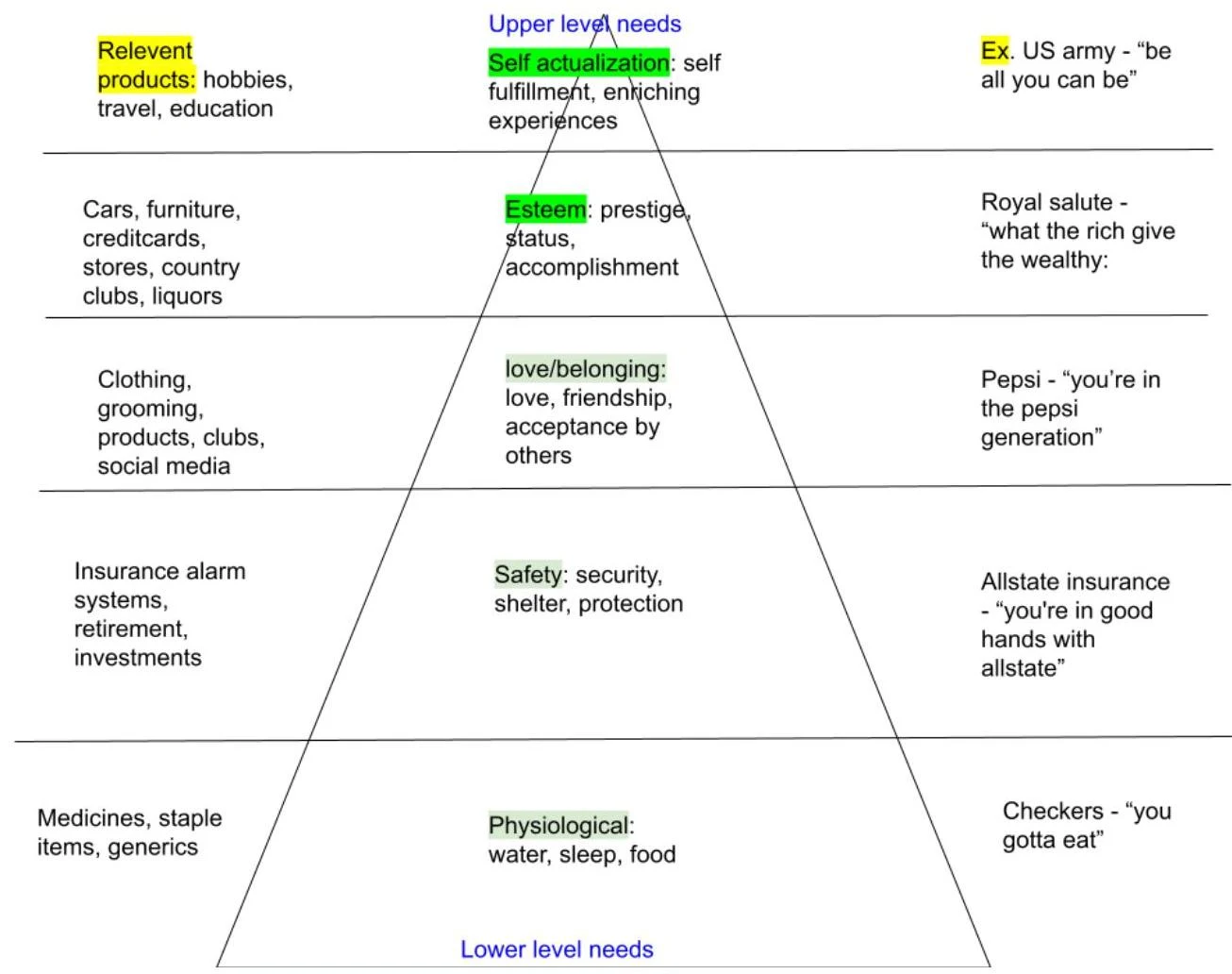
Motivation: The drive to satisfy a need. This is often mapped using Maslow's Hierarchy of Needs.
Maslow's Hierarchy of Needs illustrated with examples of products and services.
Attitude: A lasting evaluation of an object or idea, comprised of three components:
Affect: Feelings and emotions.
Behavior: Past experiences and actions.
Cognition: Beliefs and thoughts.
Situational Influences
Finally, the immediate context matters. Situational influences include factors like time (how much time a consumer has to decide) and physical surroundings (the atmosphere of a store or the layout of a website).
Summary Table: The Three Components of Attitude
Component
Description
Example
Affect
Emotional response
"I love the way this car looks."
Behavior
Action/Experience
"I have driven this brand for years."
Cognition
Belief/Knowledge
"I believe this brand is the safest."
By integrating these psychological, social, and situational insights, marketers can move beyond simple transactions to build meaningful, long-term relationships with their customers.
Keep reading for free.
Create an account to finish this reading and make it part of your study routine.