This content explains the fundamental process of inheritance, how genetic information is transmitted from parents to offspring, and the concepts of alleles, genotypes, and phenotypes. It also covers sex determination, pedigree analysis, and provides a case study on cystic fibrosis inheritance.
Inheritance is the fundamental process by which genetic information is transmitted from parents to their offspring. This transmission ensures that characteristics—ranging from eye color to complex physiological functions—are passed down through generations via genes, which are specific segments of DNA located on chromosomes. By studying how these alleles (different versions of a gene) combine, scientists and genetic counselors can predict the likelihood of specific traits or disorders appearing in a family.
Sex Determination and the XY Phenotype
In humans, biological sex is determined by a specific pair of chromosomes known as the sex chromosomes. While most chromosomes (autosomes) come in identical pairs, the 23rd pair dictates whether an individual is male or female.
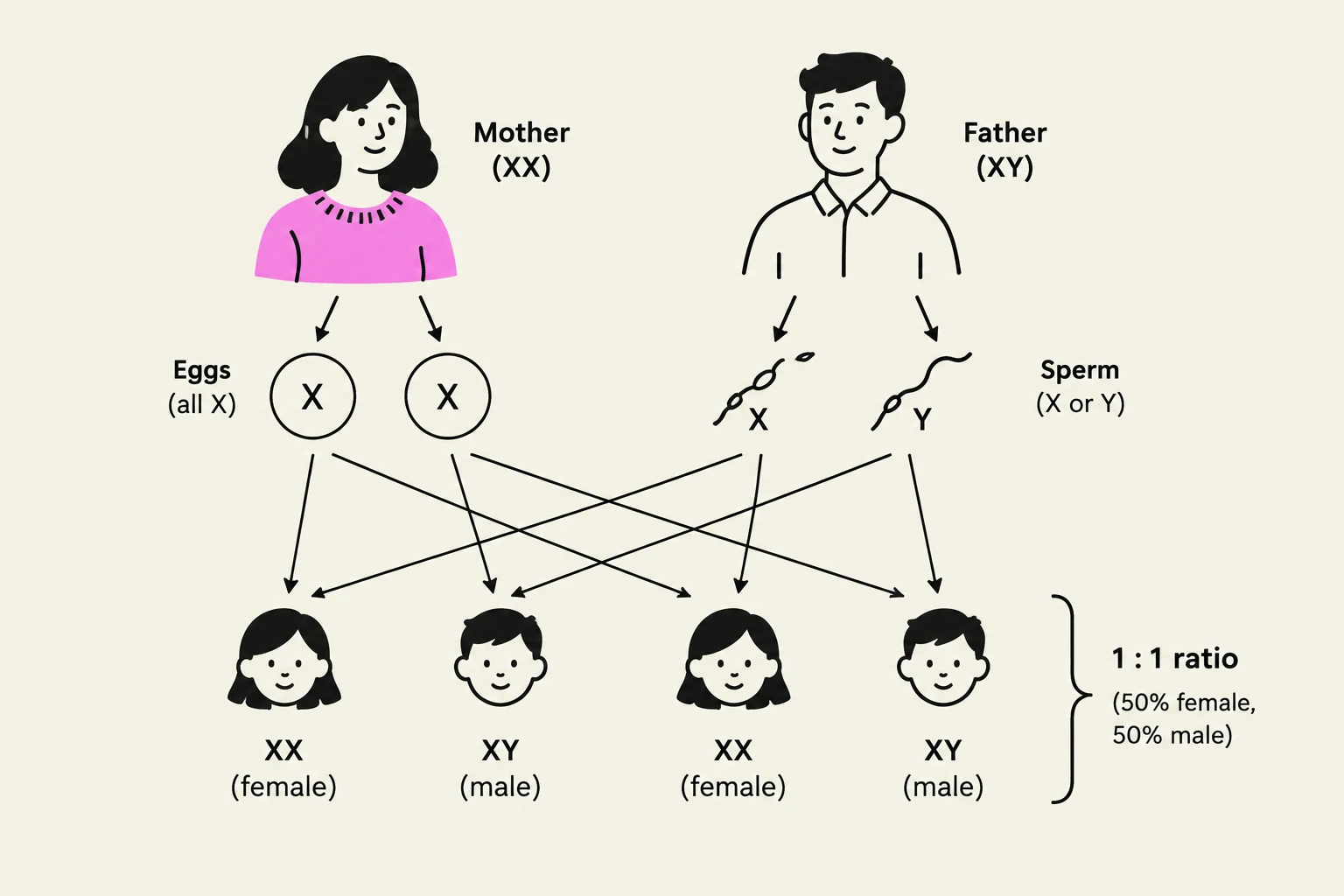
Females possess two X chromosomes (XX), while males possess one X and one Y chromosome (XY). Because the Y chromosome is significantly smaller than the X chromosome, they can be easily distinguished in a human karyotype. During reproduction, a mother always contributes an X chromosome, but the father can contribute either an X or a Y.
This results in a predictable probability for each pregnancy:
An X from the mother and an X from the father results in a female (XX).
An X from the mother and a Y from the father results in a male (XY).
On average, the probability of having a male or female offspring is $50%$ each.
This diagram illustrates the inheritance of sex chromosomes. A mother with XX chromosomes produces eggs with an X chromosome. A father with XY chromosomes produces sperm, half carrying an X chromosome and half carrying a Y chromosome. The combination of these chromosomes determines the sex of the offspring: XX results in a female, and XY results in a male, with a 1:1 ratio of males to females.
Understanding Alleles: Dominant, Recessive, and Genotypes
To understand how traits are expressed, we must distinguish between an organism's genetic makeup and its physical appearance. The genotype refers to the specific alleles an organism possesses (e.g., AA, Aa, or aa), while the phenotype is the observable physical characteristic resulting from those genes.
Alleles exist in two primary forms:
Dominant Alleles: These are expressed even if only one copy is present. They are typically represented by a capital letter (e.g., A).
Recessive Alleles: These are "masked" by dominant alleles and are only expressed if the individual possesses two copies of the recessive allele (e.g., aa).
Based on their allele combinations, we categorize genotypes into two groups:
Homozygous: The two alleles are identical (either AA for dominant or aa for recessive).
Heterozygous: The two alleles are different (e.g., Aa).
Exam Tip: When performing a genetic cross, always write the dominant allele first (e.g., write Aa, not aA) to maintain standard scientific notation.
Pedigree Analysis: Mapping Family History
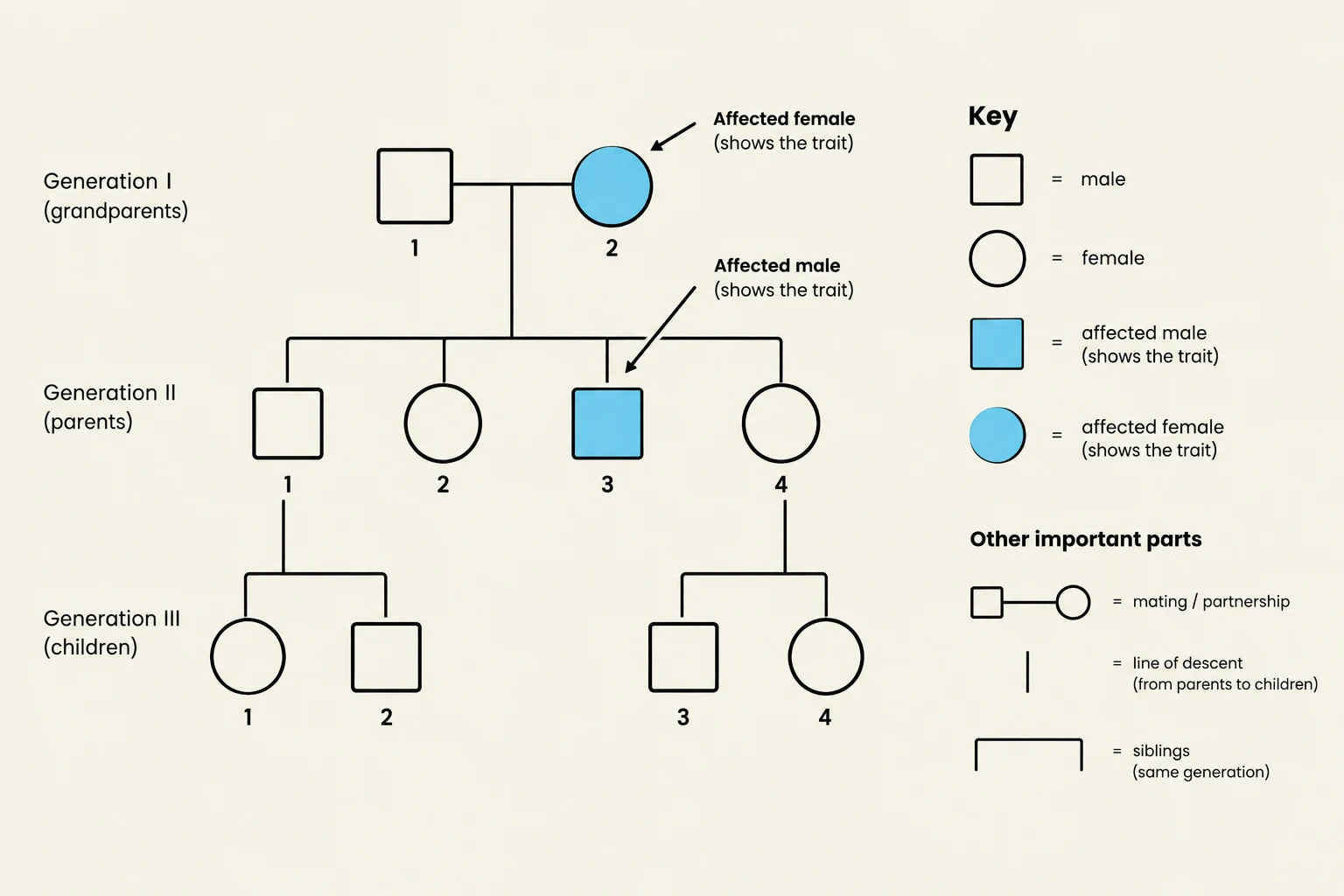
When families are concerned about the inheritance of a specific condition, genetic counselors use pedigree analysis. A pedigree is a visual diagram that maps out the relationships and phenotypes of individuals across multiple generations.
Standard symbols in a pedigree include:
Squares: Represent males.
Circles: Represent females.
Horizontal Lines: Connect a male and female to indicate mating/offspring production.
Color Coding: Typically, red is used to indicate "affected" individuals (those showing the trait/disorder), while blue indicates "unaffected" individuals.
By observing these patterns, one can determine if a disorder is dominant, recessive, or sex-linked.
This is a pedigree chart illustrating the inheritance of a trait across three generations. Squares represent males and circles represent females. Filled shapes indicate individuals affected by the trait, while unfilled shapes represent unaffected individuals. The chart shows mating relationships, lines of descent, and siblings within each generation.
Case Study: Cystic Fibrosis
Cystic fibrosis serves as a primary example of an autosomal recessive disorder. It is caused by a faulty recessive allele located on chromosome 7.
Causes and Symptoms
The disorder affects the cell membranes, leading to the production of excessive, thick, and sticky mucus. This mucus clogs the lungs and the digestive system (including the pancreas, liver, and intestines), making breathing difficult and potentially causing long-term organ damage.
Inheritance and Carrier Status
Because it is a recessive condition, an individual must inherit two copies of the faulty allele to manifest the disease. This introduces the concept of carrier status:
Homozygous Dominant (FF): Unaffected; does not carry the faulty allele.
Heterozygous (Ff): A carrier. The individual does not show symptoms because the dominant allele masks the recessive one, but they can pass the faulty allele to their children.
Homozygous Recessive (ff): Affected; the individual has cystic fibrosis.
Calculating Probability
We can use Punnett squares to predict the probability of inheritance for cystic fibrosis.
Example 1: Two Heterozygous Carriers (Ff×Ff)
If two parents are both carriers, the possible offspring combinations are:
& \text{Genotypic Ratio: } 1 FF : 2 Ff : 1 ff \\
& \text{Phenotypic Probability: } 25\% \text{ unaffected (non-carriers), } 50\% \text{ carriers, } 25\% \text{ affected}
\end{aligned}$$
Thus, there is a $25\%$ chance (or 1 in 4) that a child will have the disorder.
**Example 2: One Carrier and One Homozygous Dominant ($Ff \times FF$)**
If one parent is a carrier and the other is unaffected and not a carrier:
$$\begin{aligned}
& \text{Genotypic Ratio: } 1 FF : 1 Ff \\
& \text{Phenotypic Probability: } 50\% \text{ unaffected, } 50\% \text{ carriers, } 0\% \text{ affected}
\end{aligned}$$
In this scenario, there is a $0\%$ chance of the child having the disorder, though there is a $50\%$ chance the child will be a carrier.
> **Summary Note:** Probability in genetics is based on the random nature of fertilization; while we can calculate the *likelihood* of an outcome, the actual result of any single pregnancy is never guaranteed.
$$$
$$$
Keep reading for free.
Create an account to finish this reading and make it part of your study routine.