This content explains the fundamental principles of ecology, including the nature of ecological systems, the scientific method used in ecological research, and the challenges involved in studying complex ecological phenomena.
Ecology is the scientific study of how organisms—ranging from microscopic bacteria to massive plants and animals—interact with one another and with their physical environments. While we often perceive nature as a static or "balanced" backdrop, ecological reality is far more complex. It is a science of patterns, processes, and mechanisms, seeking to understand not just what is happening in the natural world, but why and how it occurs.
The Nature of Ecological Systems
To study ecology effectively, we must first understand the fundamental nature of the systems involved. Ecological systems are not merely collections of living things; they are physical entities that exist within dynamic steady states.
A "steady state" does not mean that nothing is changing. Rather, it implies that while individual components (like the number of organisms or the amount of nutrients) may fluctuate, the system maintains a certain level of stability through continuous processes. However, this stability is not free. A core principle of biology is that the maintenance of these living systems requires a constant expenditure of energy. Whether it is a plant capturing sunlight to create organic matter or an animal moving to find food, energy must flow through the system to prevent it from breaking down.
Furthermore, these systems are never truly finished. They are subject to continuous evolutionary change. Adaptations in organisms result from natural selection, which links the survival of an individual to the broader evolutionary history of its population.
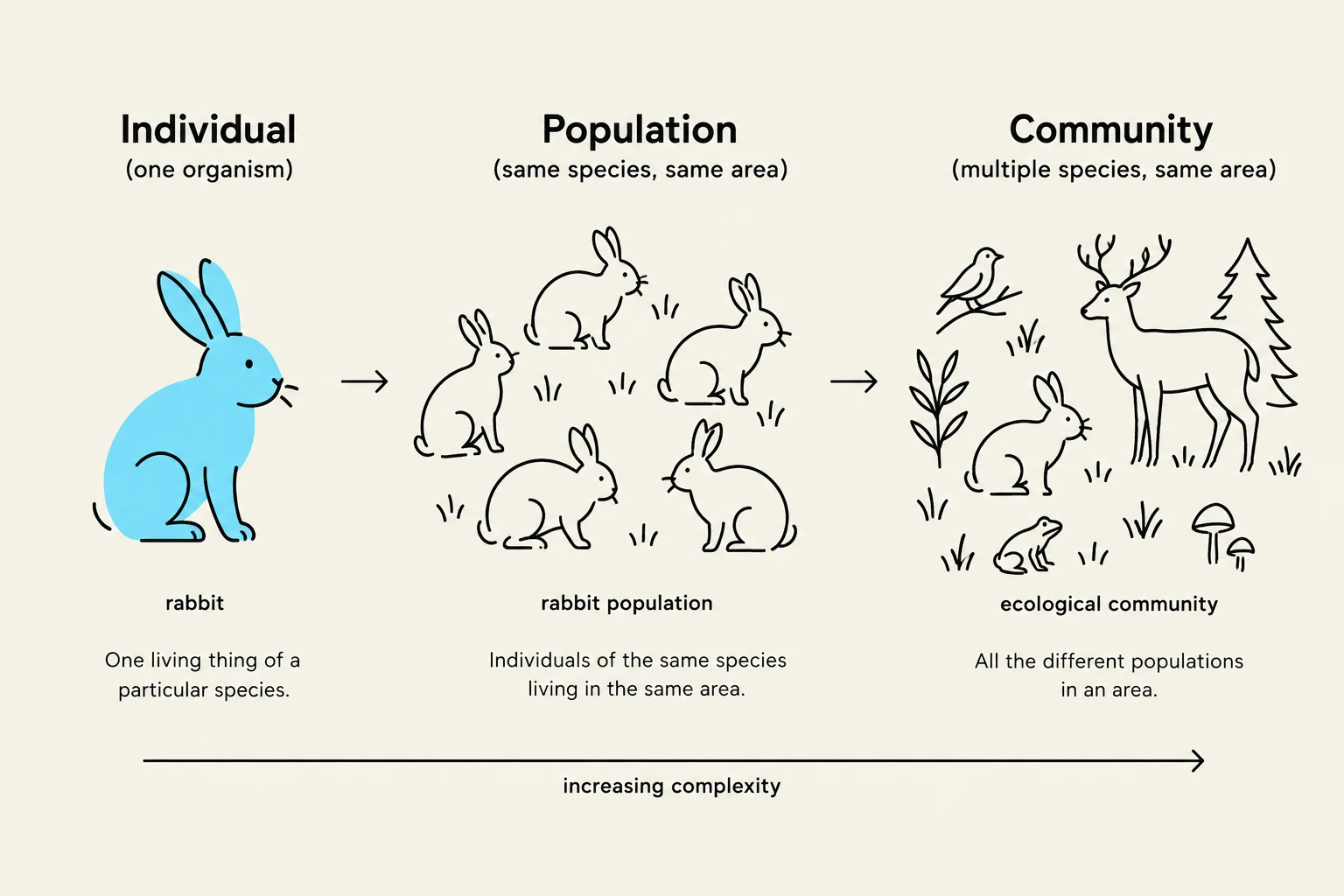
This diagram illustrates the ecological concepts of individual, population, and community, showing increasing complexity from a single organism to a group of different species in an area.
The Scientific Method in Ecology
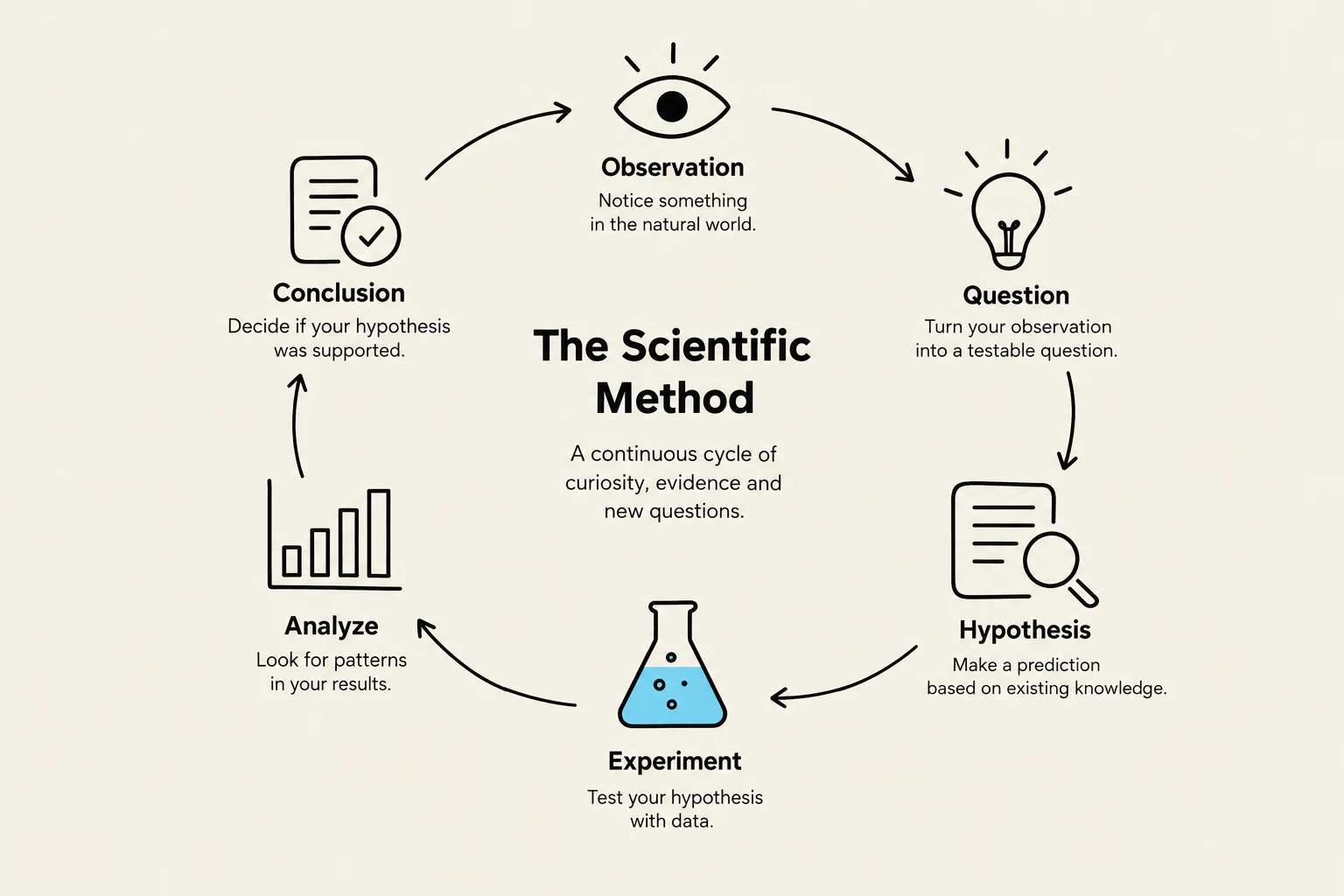
Because ecological systems are complex and involve many moving parts, ecologists cannot rely on intuition alone. They employ the scientific method, a structured, cyclical process of inquiry. This process typically moves through several stages: observation, hypothesis formulation, prediction, and experimentation.
Logic Pathways: Induction and Deduction
Ecologists use two primary logical pathways to navigate this cycle:
Induction: This involves observing specific patterns in nature and deriving general principles from them. For example, observing that several different ponds all have high predator counts and low prey counts might lead an ecologist to induce a general rule about predation.
Deduction: This is the reverse process. It involves taking a general principle and predicting a specific outcome. If we know the general rule that "predators reduce prey populations," we can deduce that if we introduce wolves to a specific deer population, the deer numbers will drop.
Hypothesis and Prediction
At the heart of this method is the hypothesis—a proposed idea regarding how the natural world functions. A hypothesis is not a guess, but a testable explanation, such as: "Fish presence reduces frog population size".
Once a hypothesis is established, it must generate predictions. A prediction is the specific, measurable outcome you expect to see if your hypothesis is true.
Exam Tip: Remember that in science, we never "prove" a hypothesis to be 100% certain. If empirical observations confirm a prediction, the hypothesis is strengthened. If observations fail to confirm it, the hypothesis is weakened or rejected.
Experimental Design: Variables and Controls
The most robust way to test a hypothesis is through a controlled experiment. The goal of an experiment is to isolate cause-and-effect relationships within a messy, dynamic environment.
To do this, researchers must independently manipulate one or a few specific variables. In a classic experiment, the variable being changed is the "treatment." For example, if testing the effect of fish on frogs, the presence or absence of fish is the variable.
Crucially, an experiment must also establish appropriate controls. A control group is a set of subjects that is treated exactly like the experimental group, except it does not receive the specific treatment being tested (e.g., a pond with frogs but no fish). This allows the researcher to ensure that any observed change is actually caused by the variable in question and not by some other environmental factor.
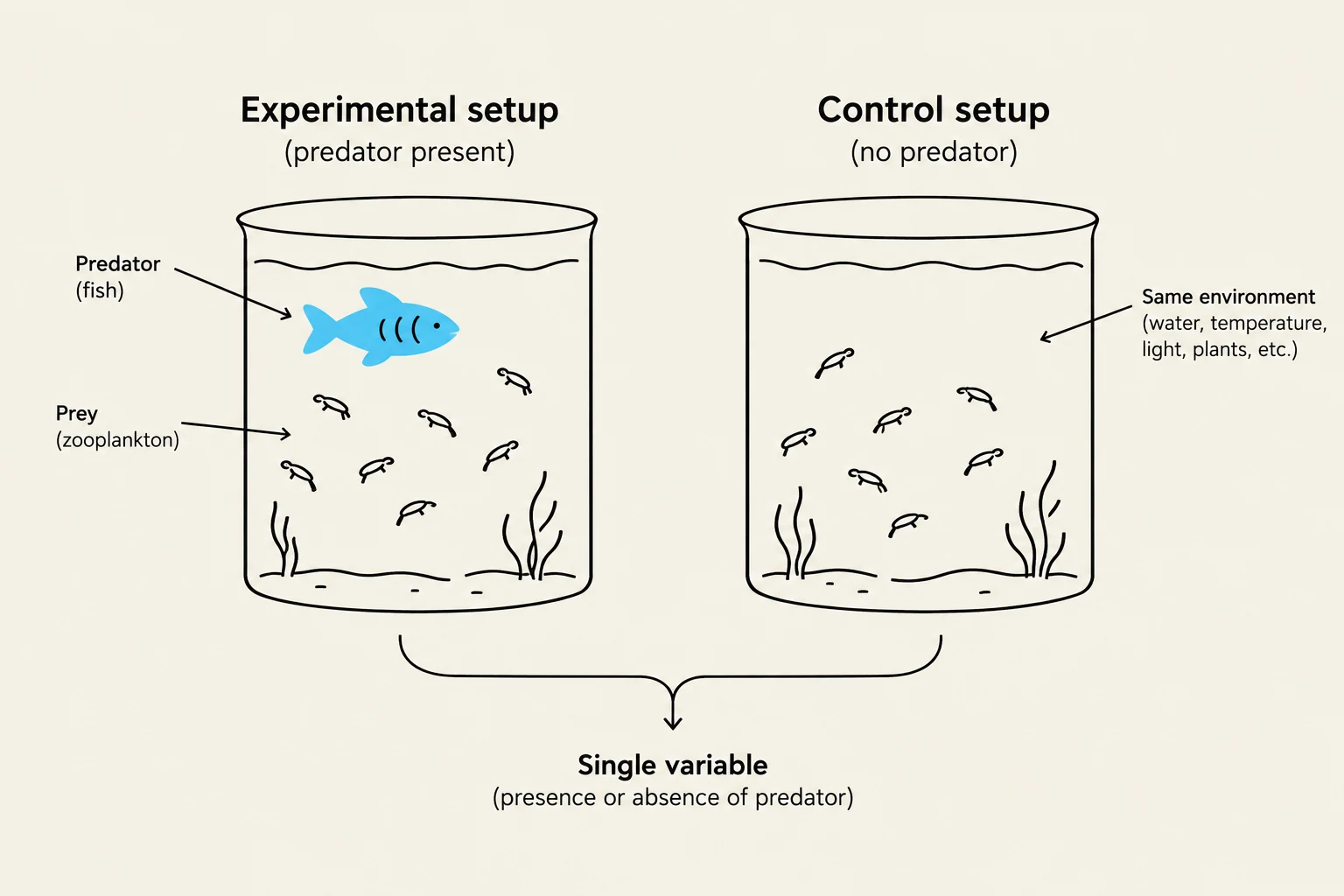
This diagram illustrates an experimental setup comparing a control group (no predator) with an experimental group (predator present) to study the effect of predators on prey populations. The single variable being tested is the presence or absence of the predator.
A Worked Example: Fish and Frogs
Imagine an ecologist observes that ponds with fish seem to have fewer frogs. They might propose the hypothesis: Fish presence reduces frog population size.
To test this, they design an experiment using multiple ponds:
Treatment Group: Ponds containing 10 frogs and 2 fish.
Control Group: Ponds containing 10 frogs and 0 fish.
By replicating this setup across many ponds and using statistical analysis, the researcher can determine if the difference in frog numbers is "significant" (meaning it is unlikely to have happened by chance).
Challenges in Ecological Research
Ecological study is not without its pitfalls. One major difficulty is that correlation does not equal causation; just because two things happen at the same time does not mean one caused the other.
Additionally, many ecological phenomena occur at scales that are too large for traditional manipulation. For instance, you cannot easily manipulate the global climate to test a hypothesis about carbon cycles. In these cases, ecologists turn to alternative tools:
Microcosms: Small-scale versions of a system that replicate essential features in a lab or field setting.
Mathematical Models: Using equations to represent a system and predict its behavior.
For example, a simple model for population size (N) can account for gains and losses through births (B), deaths (D), immigration (I), and emigration (E):
N=B+I−D−E
The Scientific Method is a continuous cycle of curiosity, evidence, and new questions, involving observation, question formulation, hypothesis generation, experimentation, analysis, and conclusion.
By combining these physical principles with rigorous scientific methodology, ecologists can begin to solve the complex environmental problems facing our planet today.
Keep reading for free.
Create an account to finish this reading and make it part of your study routine.