Explore the foundational techniques of recombinant DNA technology, molecular cloning, and DNA sequencing. Understand how mutations in coding and noncoding regions of DNA can alter gene expression and lead to diverse phenotypic outcomes, including loss-of-function and gain-of-function alleles.
Understanding the blueprint of life requires more than just reading the genetic code; it requires the ability to manipulate, replicate, and interpret it. From the foundational techniques of recombinant DNA technology to the complex ways in which mutations alter biological function, DNA analysis is a cornerstone of modern genetics. This article explores how scientists use molecular tools to study the genome and how changes in DNA sequences—whether in coding or nonencoding regions—can lead to diverse phenotypic outcomes.
Recombinant DNA Technology and Molecular Cloning
At the heart of genetic engineering is recombinant DNA technology, which involves combining DNA from different sources to create new genetic combinations. A primary application of this is molecular cloning, the process of making many identical copies of a specific DNA fragment by inserting it into a host organism, such as bacteria.
The process typically follows two main steps:
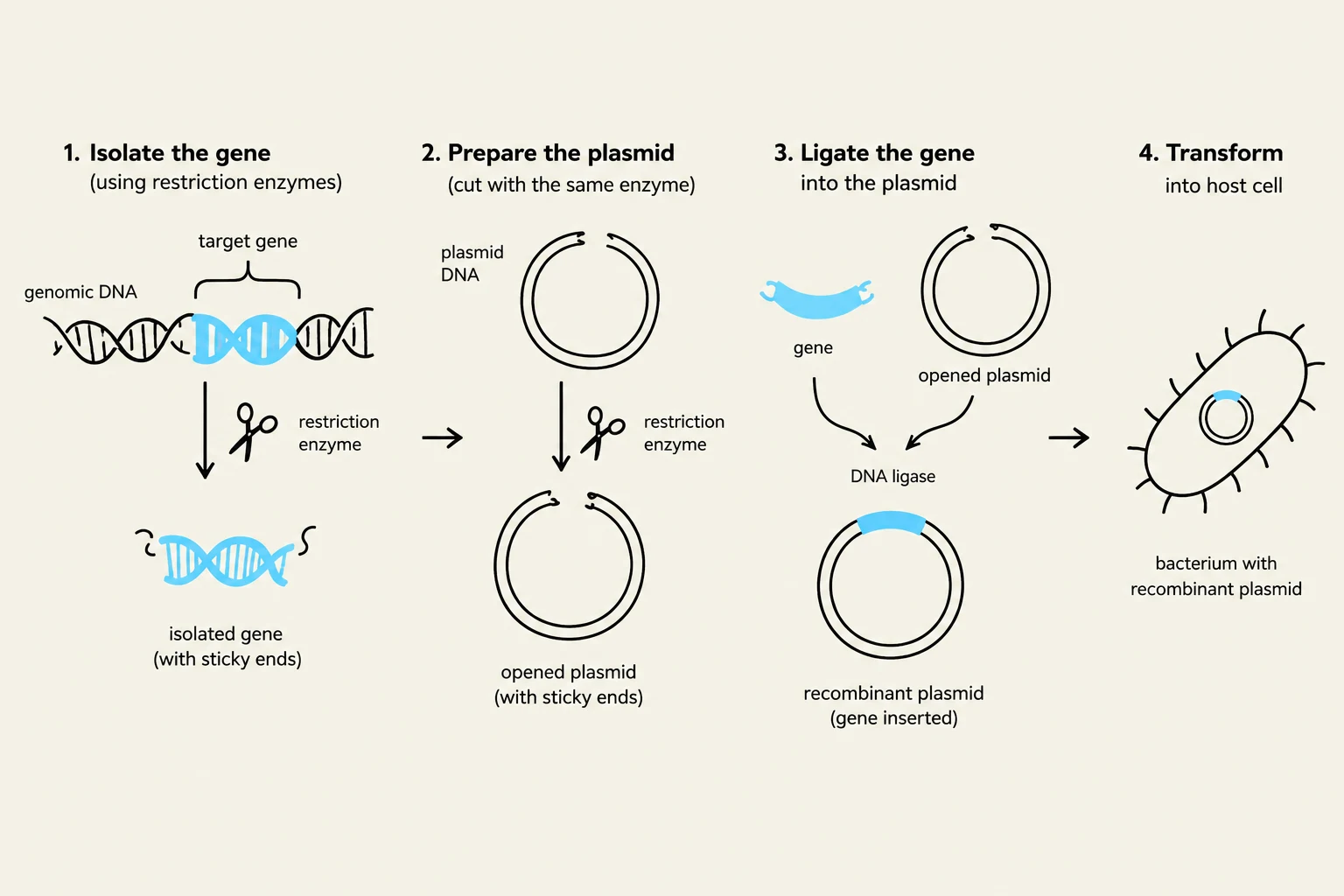
Insertion into a Vector: A target DNA fragment is isolated using restriction enzymes and inserted into a cloning vector, such as a plasmid.
Transformation: The recombinant vector is introduced into a host cell (usually bacteria) through a process called transformation.
A successful cloning vector, or plasmid, must possess three essential features: an origin of replication, a selectable marker (like antibiotic resistance), and a synthetic polylinker containing multiple restriction enzyme sites.
Exam Tip: Remember that "transformation" refers to the host cell taking up foreign DNA, while "transfection" is often used in animal cells. In bacteria, this is achieved via heat shock or electroporation.
Diagram illustrating the process of gene cloning, including isolating a gene, preparing a plasmid, ligating the gene into the plasmid, and transforming a host cell with the recombinant plasmid.
Tools of the Trade: Restriction Enzymes and Electrophoresis
To manipulate DNA, scientists use restriction enzymes to perform a "digestion," cutting the DNA at specific, palindromic recognition sites. These cuts can result in blunt ends (straight cuts) or sticky ends (overhangs). Sticky ends are highly preferred in cloning because they increase ligation efficiency by allowing complementary overhangs to base-pair before the DNA ligase seals the backbone.
Once DNA is cut, it must be analyzed. Gel electrophoresis is used to separate DNA fragments based on their size. Because DNA is negatively charged, it migrates through an agarose gel toward a positive electrode; smaller fragments move faster and further than larger ones.
Genome Sequencing and Assembly
The scale of DNA analysis reached a milestone with the Human Genome Project, which aimed to provide an accurate sequence of the entire human genome. The general strategy for DNA sequencing and genome assembly involves four logical steps:
Fragmenting the genome into manageable pieces.
Cloning these fragments.
Sequencing the individual fragments.
Reconstructing the original genome sequence by overlapping the fragments.
The Impact of Mutations on Gene Expression
A mutation is any change in the DNA sequence that can alter gene expression or the resulting protein's function. These changes can occur in two primary locations:
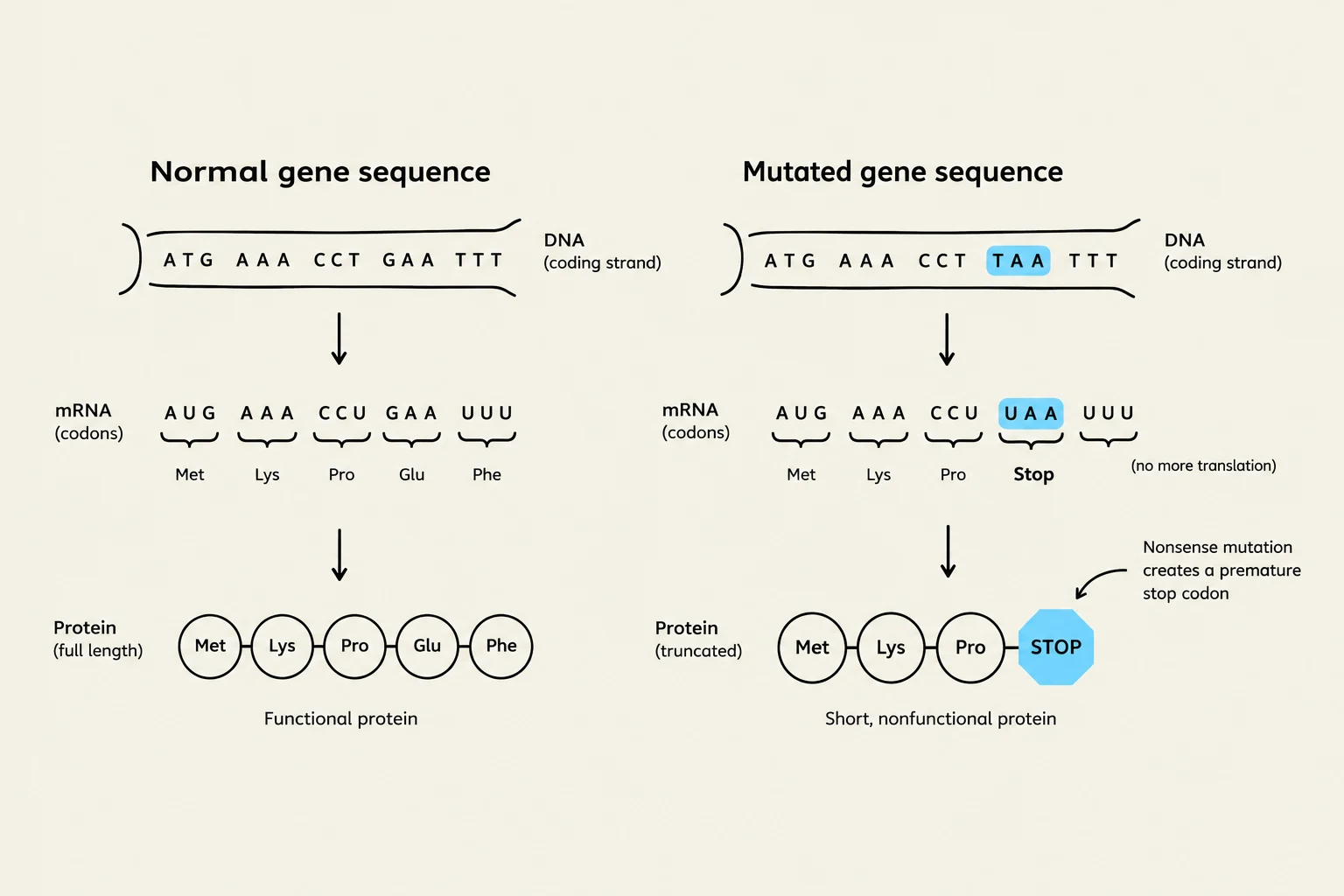
Coding Sequence Mutations: These occur within the regions that directly translate into proteins. For example, a nonsense mutation introduces a premature stop codon, resulting in a truncated and often nonfunctional protein.
Nonencoding Genes: Mutations can also occur in genes that do not encode proteins but instead encode the machinery of expression, such as rRNAs, tRNAs, or snRNAs. Because these components are used globally by the cell, mutations here can have massive phenotypic effects and are often homozygous lethal.
This diagram illustrates the process of gene mutation, comparing a normal gene sequence that results in a functional protein with a mutated sequence that leads to a premature stop codon and a truncated, nonfunctional protein.
Classifying Mutations by Function
Mutations are broadly categorized into Loss-of-Function and Gain-of-Function alleles.
Loss-of-Function Alleles
These alleles result in reduced or abolished protein activity and are typically recessive to the wildtype. They are further classified as:
Amorphic (or Null) Alleles: The gene product has no function at all.
Hypomorphic (or Leaky) Alleles: The gene produces a reduced amount of normal protein or a less efficient version of the protein.
While most loss-of-function mutations are recessive, they can appear dominant in cases of haploinsufficiency, where a single wild-type allele is insufficient to produce enough gene product to maintain a normal phenotype. This is also seen in incomplete dominance, where the phenotype varies continuously depending on the amount of functional product present.
Gain-of-Function Alleles
These mutations are typically dominant and result in increased or novel activity.
Hypermorphic Mutations: These increase the amount of gene product or create a more efficient version of the protein.
Neomorphic Mutations: These create a protein with a completely new function or cause the protein to be expressed at an inappropriate time or place.
Antimorphic (Dominant Negative) Alleles: These are a special type of mutation where the altered protein actively interferes with the function of the normal protein produced by the wild-type allele.
Mutation Type
Classification
Commonality
Dominance Relation
Amorphic
Loss-of-Function
Common
Usually recessive
Hypomorphic
Loss-of-Function
Common
Can be incompletely dominant or dominant (haploinsufficiency)
Hypermorphic
Gain-of-Function
Rare
Usually dominant
Neomorphic
Gain-of-Function
Rare
Usually dominant
Antimorphic
Gain-of-Function
Rare
Usually dominant
Keep reading for free.
Create an account to finish this reading and make it part of your study routine.