Before the mid-19th century, the scientific understanding of how traits were passed from parents to offspring was remarkably vague. Many scientists adhered to the theory of "pangenesis," a concept suggesting that mysterious particles from various body parts melded into the sperm and egg cells to form new individuals. It was Gregor Mendel, through his meticulous study of pea plants, who overturned these incomplete theories and established the foundational principles of modern genetics.
Mendel’s Hybridization Experiments
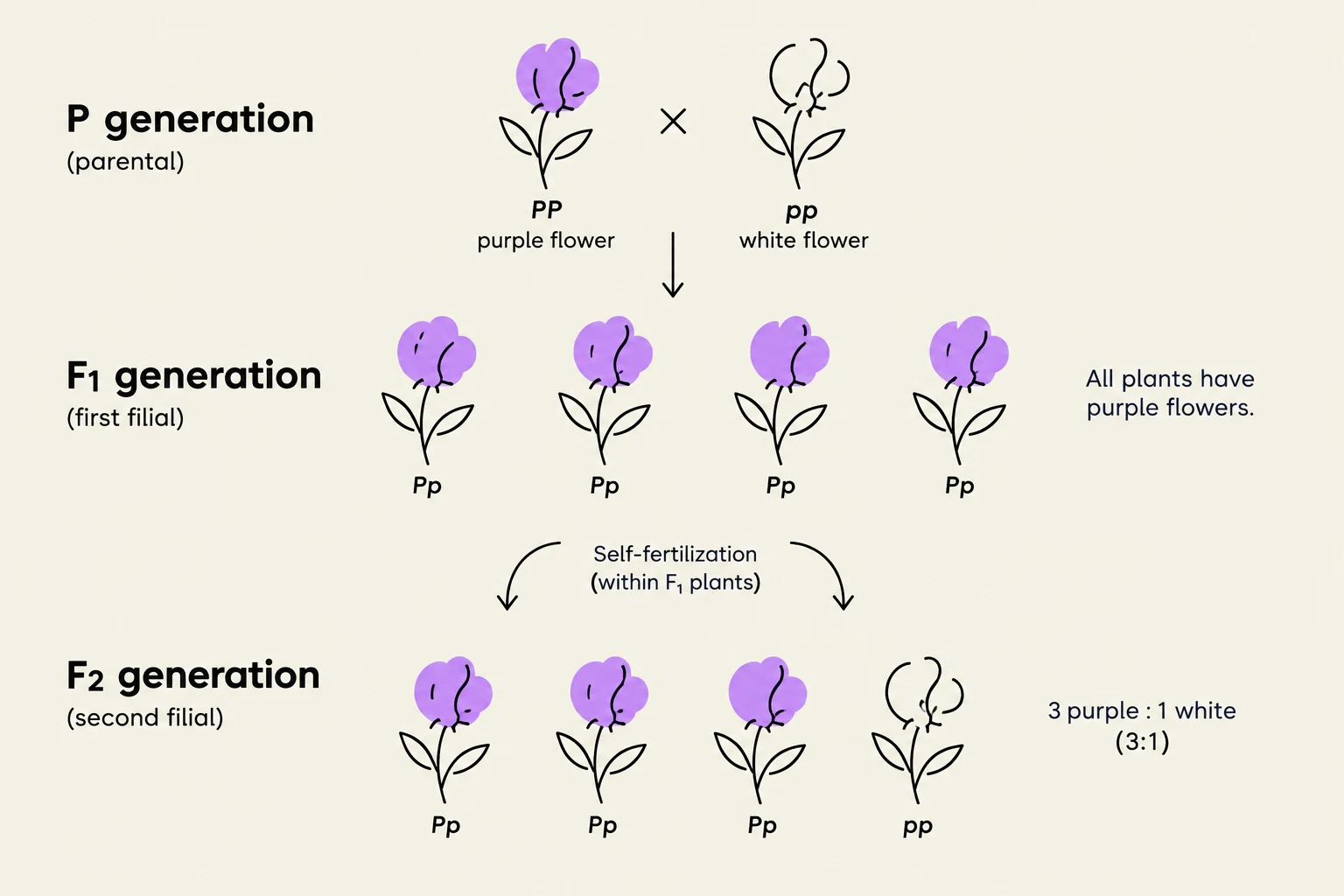
This diagram illustrates Mendelian genetics, showing the inheritance of flower color through generations. A cross between a homozygous dominant purple flower (PP) and a homozygous recessive white flower (pp) results in all heterozygous purple flowers (Pp) in the F1 generation. Self-fertilization of the F1 generation yields a 3:1 ratio of purple to white flowers in the F2 generation.
Mendel’s success was rooted in his disciplined approach to breeding. Between 1856 and 1861, he raised approximately 10,000 pea plants, ensuring they were "purebred" (or true-breeding) through two years of testing. A true-breeding plant is one that, when allowed to self-fertilize, always produces offspring identical to the parent.
Mendel chose pea plants because they were easy to breed and possessed several distinct, heritable characters with clear variations, such as flower color (purple vs. white) or seed shape (round vs. wrinkled). To study inheritance, he performed hybridization (or genetic crosses), which involves the cross-fertilization of two different varieties.
The Monohybrid Cross and Segregation
In a typical monohybrid cross, Mendel looked at a single character, such as flower color. He crossed a true-breeding purple plant with a true-breeding white plant (the P generation).
The results were striking:
F1 Generation: All offspring were purple. The white trait seemed to disappear entirely.
F2 Generation: When the F1 plants were allowed to self-fertilize, the white trait reappeared in a predictable ratio: approximately 43 of the plants were purple and 41 were white.
This led Mendel to propose several hypotheses that form the basis of his laws:
Alleles: Multiple versions of a single gene exist.
Diploid Inheritance: Each organism inherits two alleles for each gene (one from each parent). If the alleles are identical, the organism is homozygous; if they are different, it is heterozygous.
Dominance: In a heterozygote, the dominant allele determines the physical appearance (phenotype), while the non-contributing allele is called recessive.
Segregation: A gamete (sperm or egg) contains only one of the two alleles.
Key Terminology Check
Genotype: The specific pair of alleles present (e.g., PP, Pp, or pp).
Phenotype: The observable physical trait (e.g., Purple or White).
Mendel’s Law of Segregation
This diagram illustrates the Law of Segregation during gamete formation, showing how a heterozygous cell (Pp) produces gametes with either the P allele or the p allele.
The Law of Segregation explains how the F2 generation recovers the recessive trait. During the formation of gametes, the two alleles for a character separate so that each gamete receives only one. For example, a heterozygous F1 plant (Pp) produces two types of gametes in equal proportions: P and p. When these gametes combine during fertilization, they recreate the $1:2:1$ genotypic ratio ($1\ PP : 2\ Pp : 1\ pp$) and the $3:1$ phenotypic ratio (3purple:1white).
Dihybrid Cross and Independent Assortment
Mendel expanded his research to dihybrid crosses, which involve mating parental varieties that differ in two different characters—for example, seed shape (round vs. wrinkled) and seed color (yellow vs. green).
In his experiments, the F1 generation of a cross between round-yellow seeds and wrinkled-green seeds resulted in all round-yellow seeds. However, the F2 generation produced new combinations of traits that were not present in the parents, such as yellow-wrinkled and green-round seeds.
Mendel’s Law of Independent Assortment
Mendel concluded that the inheritance of one character does not affect the inheritance of another. This is known as the Law of Independent Assortment. This principle is physically rooted in the behavior of chromosomes during meiosis:
Metaphase I: Homologous chromosomes align in different possible arrangements.
Metaphase II: The separation of sister chromatids ensures that each gamete receives a unique combination of alleles.
When calculating the expected outcomes of a dihybrid cross (e.g., RrYy×RrYy), we can use Punnett squares to predict the 169:163:163:161 phenotypic ratio.
Tools for Prediction: Punnett Squares
A Punnett square is a visual tool used to predict the genotypes and phenotypes of offspring from a particular cross. By placing the gametes of one parent on one side and the gametes of the other parent on the top, you can fill in the squares to see every possible combination of alleles resulting from fertilization.
Variations on Mendel’s Laws
While Mendel's laws provide a fundamental framework, many biological traits do not follow simple dominant/recessive patterns.
Non-Mendelian Inheritance Patterns
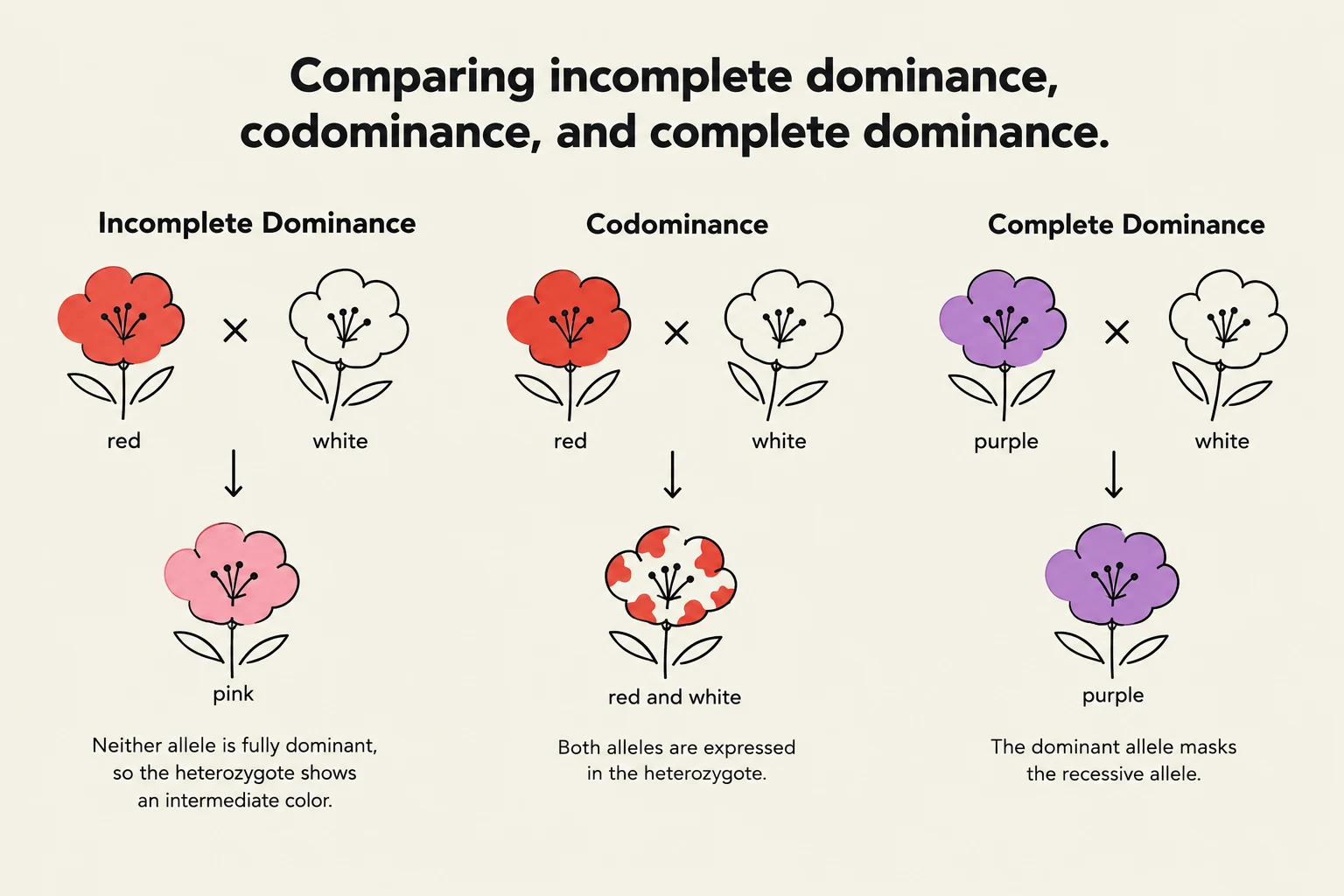
This diagram illustrates the concepts of incomplete dominance, codominance, and complete dominance using flower color as an example. Incomplete dominance results in an intermediate color (pink), codominance shows both parental colors (red and white patches), and complete dominance results in the dominant color (purple).
Incomplete Dominance: Neither allele is completely dominant, resulting in an intermediate phenotype in heterozygotes (e.g., red and white flowers producing pink offspring).
Codominance: Both alleles are expressed equally and distinctly in the heterozygote (e.g., AB blood type, where both A and B carbohydrates are present on red blood cells).
Multiallelic Genes: While an individual only has two alleles, a population may have more than two versions of a gene (e.g., the ABO blood group system).
Pleiotropy: A single gene influences multiple, seemingly unrelated phenotypic characters (e.g., sickle-cell disease affecting hemoglobin, organs, and mental function).
Polygenic Inheritance: One characteristic is influenced by many different genes, often resulting in a continuous range of phenotypes (e.g., human skin color).
Environmental and Chromosomal Factors
Nature vs. Nurture: The environment can influence how genes are expressed, such as sunlight affecting skin color.
Linked Genes: Some genes are located close together on the same chromosome and tend to be inherited together, defying independent assortment. However, crossing over during meiosis can sometimes swap these genes, creating "recombinant" offspring.
Sex-Linked Traits: Genes located on the X chromosome are subject to different inheritance patterns because males (XY) are hemizygous for these genes, meaning they only have one copy. Other traits may be sex-influenced (showing different dominance in males vs. females) or sex-limited (expressed in only one sex).
Exam Tip: Distinguishing Dominance
If the offspring looks like a "blend" (e.g., pink), it is Incomplete Dominance. If the offspring shows both parental traits distinctly (e.g., spots), it is Codominance.
Keep reading for free.
Create an account to finish this reading and make it part of your study routine.