


Biological oceanography is the study of how living organisms interact with the physical and chemical properties of the ocean. To understand these complex interactions, scientists use specific frameworks to categorize how organisms live, how they reproduce, and how energy flows through the marine food web. By mastering these fundamental principles—ranging from reproductive strategies to trophic control—we can better predict how marine ecosystems respond to environmental changes.
Reproductive Strategies: r and K Selection
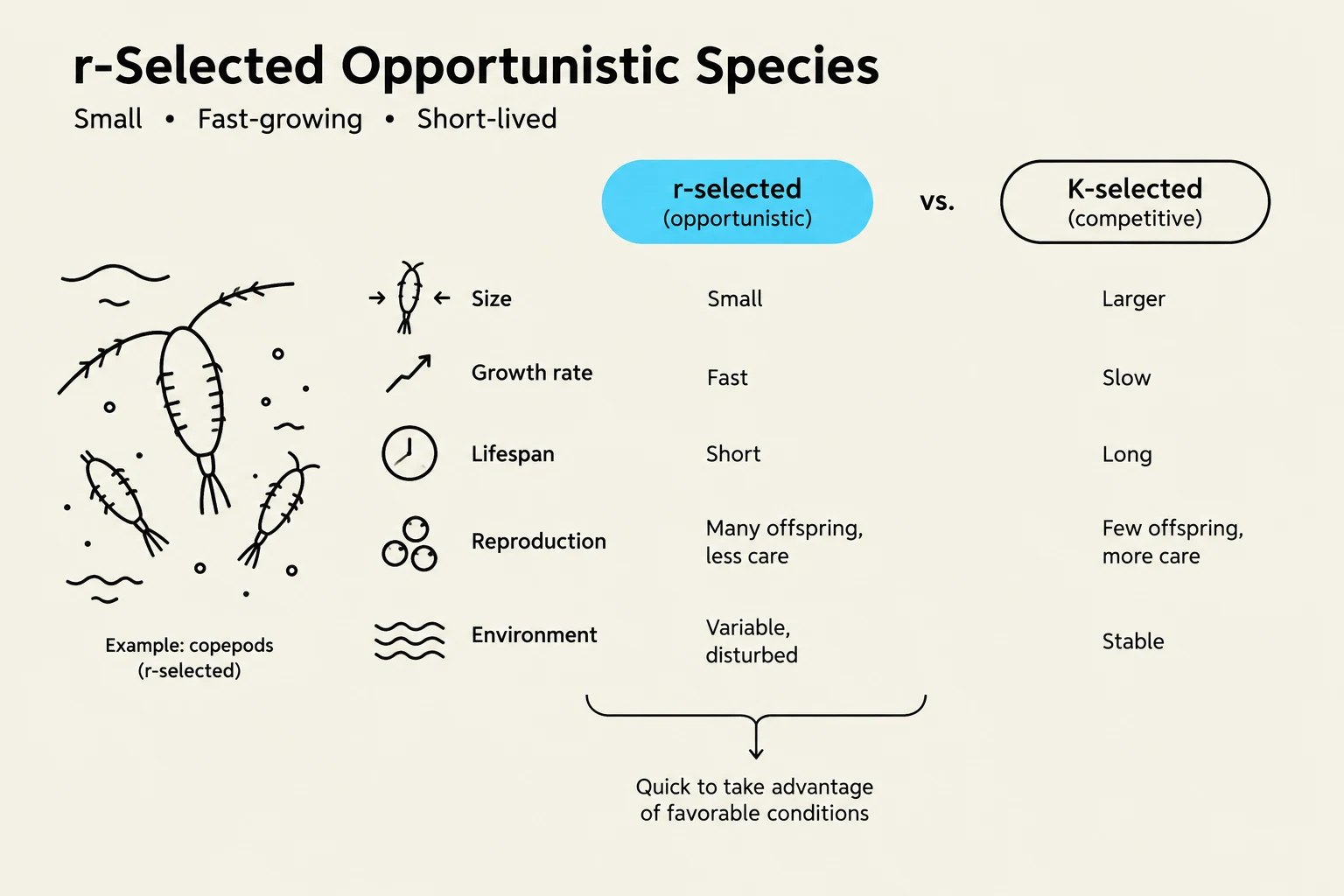
In any ecosystem, organisms face different pressures regarding survival and reproduction. Ecologists use the concepts of r-selection and K-selection to describe these divergent evolutionary paths.
r-selected Species (Opportunistic)
r-selected species are "opportunists." They are typically found in variable or unpredictable environments where they must exploit resources quickly before conditions change. Key characteristics include:
- Small size and rapid growth rates.
- Early sexual maturity and high reproductive output.
- Short lifespans and high mortality rates that are often independent of population density. In the ocean, many microbes and small plankton exhibit these traits, allowing them to bloom rapidly when nutrients become available.
K-selected Species (Equilibrium)
K-selected species are "equilibrium" species. They thrive in constant, predictable environments where competition for resources is high. Their characteristics include:
- Larger body size and slower growth rates.
- Late sexual maturity and fewer, more well-developed offspring.
- Long lifespans and mortality rates that are often density-dependent (linked to how crowded the population is). Large marine vertebrates, such as whales or certain sharks, are classic examples of K-selected organisms.
Keep reading for free.
Create an account to finish this reading and make it part of your study routine.
Continue reading freeAlready have an account? Log in
Updated