Explores the rule of legality in American criminal law, including constitutional prohibitions against bills of attainder and ex post facto laws, and the requirements of statutory clarity and equal protection.
In the American democratic system, the power of the government to enact criminal statutes is not absolute. The Founding Fathers, influenced by the perceived tyranny of British colonial rule, designed a constitutional framework intended to protect individual rights against the "political passions and intolerance of democratic majorities". This framework creates a delicate balance: the government must maintain social order and stability, yet it is strictly limited in how it can define crimes and punish citizens. At the heart of this balance lies the concept of legality.
The Rule of Legality: The First Principle
The "first principle" of American criminal law and jurisprudence is the rule of legality. This principle ensures that the state cannot exercise its power to punish arbitrarily. Under this rule, an individual cannot be held criminally liable for an act that was not clearly defined and condemned by statute before the act was committed.
This doctrine is famously encapsulated in the Latin maxim:
nullum crimen sine lege, nulla poena sine lege
which translates to "no crime without law, no punishment without law".
This maxim is split into two essential protections:
Nullum crimen sine lege: There is no crime without a pre-existing law. The government cannot decide after the fact that your behavior was criminal.
Nulla poena sine lege: There is no punishment without a pre-existing law. Even if an act is deemed harmful, the state cannot impose a penalty that was not legally established for that specific offense at the time of the act.
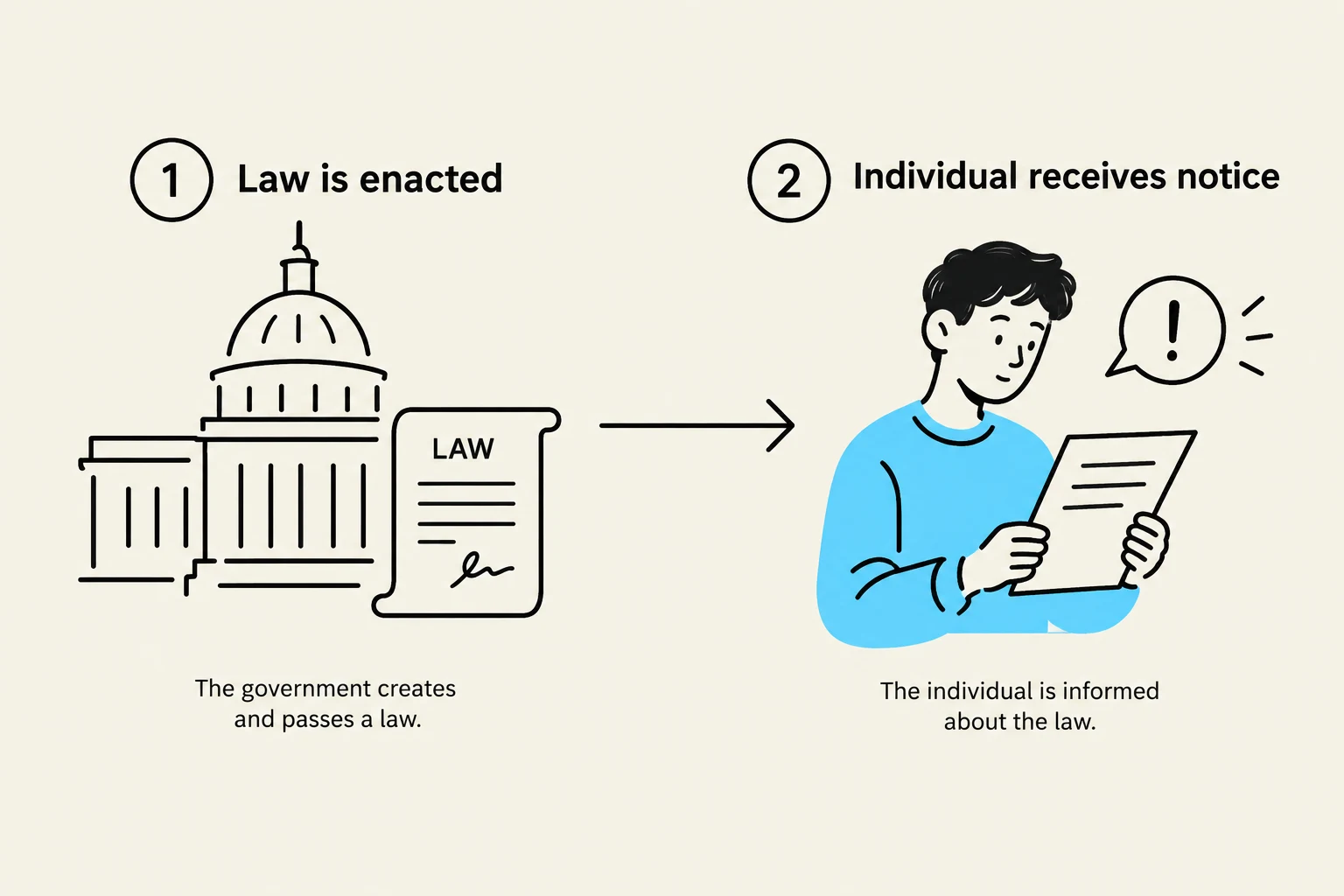
This illustration depicts the process of a law being enacted by the government and an individual receiving notice about it.
Exam Tip: If a question asks whether a person can be punished for an act that was legal when they did it, but became illegal a week later, the answer is No. This violates the rule of legality and the prohibition against ex post facto laws.
Constitutional Prohibitions: Bills of Attainder and Ex Post Facto Laws
To reinforce the rule of legality, the U.S. Constitution (Article I, Sections 9 and 10) provides specific prohibitions against two types of legislative overreach: bills of attainder and ex post facto laws. James Madison described these protections as a "bulwark in favor of personal security and personal rights".
Bills of Attainder
A bill of attainder is a legislative act that declares a specific person or group of people guilty of a crime and imposes punishment without the benefit of a judicial trial. In a constitutional democracy, only the judiciary—not the legislature—has the authority to determine guilt and assign punishment.
Ex Post Facto Laws
An ex post facto law is a law that retroactively criminalizes conduct that was legal at the time it was performed, or increases the punishment for a crime after the crime has been committed. This prevents the government from "moving the goalposts" on citizens.
Statutory Clarity and Equal Protection
Even if a law is prospective (enacted before the act), it must meet certain qualitative standards to be considered valid under American jurisprudence.
Statutory Clarity
For a law to be valid, it must possess statutory clarity. This means the law must be written clearly enough that a reasonable person can understand exactly what conduct is prohibited. If a statute is so vague that citizens cannot discern the line between legal and illegal behavior, it fails to provide the "fair notice" required by the rule of legality.
Equal Protection
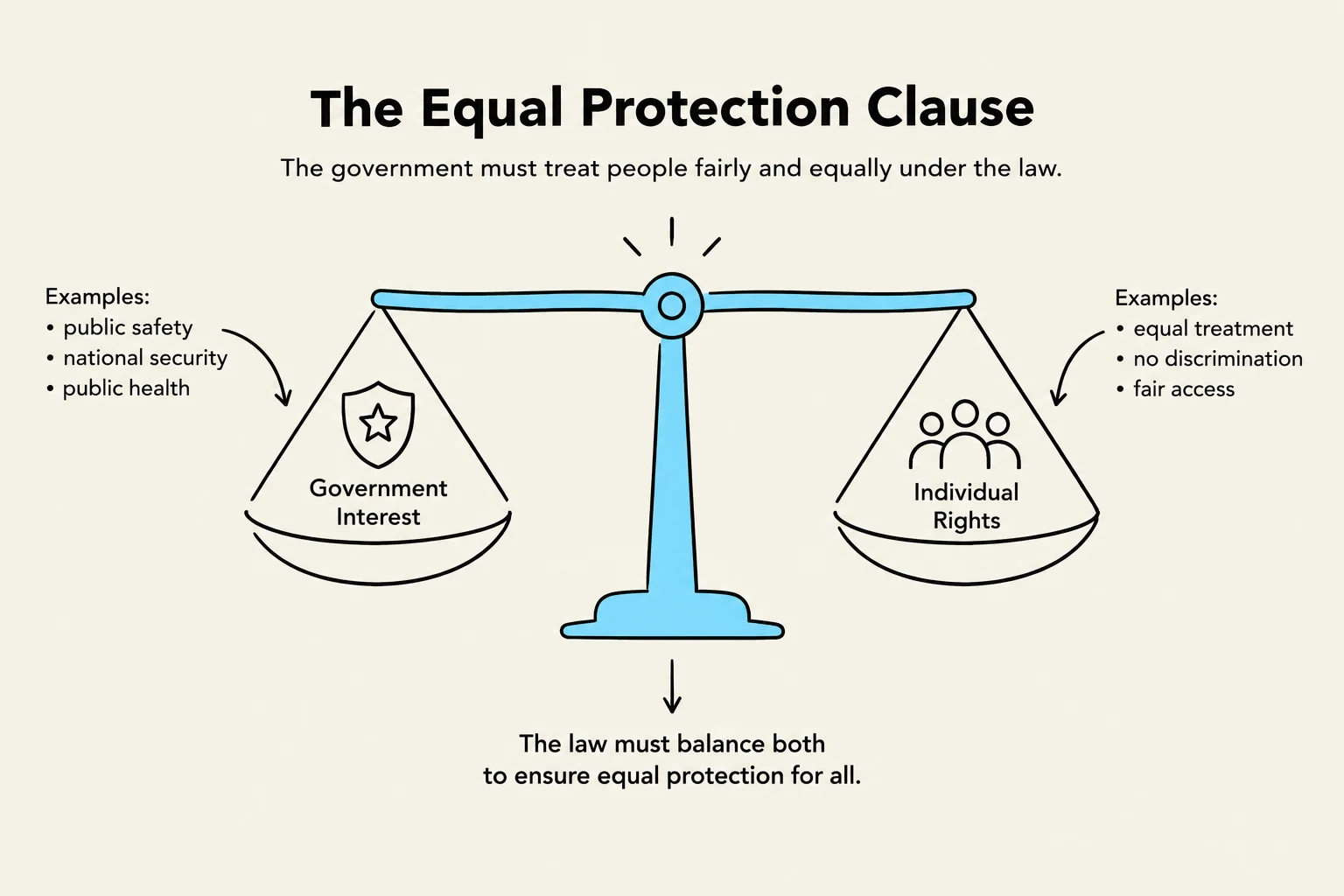
The Equal Protection Clause mandates that the law must be applied consistently and without arbitrary discrimination. The government cannot create laws that treat individuals differently based on arbitrary classifications without a compelling reason.
For example, in People of the Virgin Islands v. Lake, the defendant challenged a statute that applied different penalties for assault based on the gender of the victim and the accused. The court had to determine if the statute was discriminating based on gender or if it was a valid distinction based on physical size disparities to protect smaller individuals from larger aggressors.
The Equal Protection Clause illustrates the balance between government interests like public safety and individual rights such as equal treatment and non-discrimination, emphasizing that the law must balance both to ensure equal protection for all.
Fundamental Constitutional Freedoms
Beyond the mechanics of how laws are written and applied, the American legal system protects specific spheres of individual liberty that the government may not infringe upon, even through validly enacted statutes.
Freedom of Speech: The First Amendment protects expression, though it is not absolute; certain "unprotected" categories of speech may still be regulated.
The Right to Privacy: While the U.S. Constitution does not explicitly use the phrase "right to privacy," the courts recognize constitutional protections for certain private activities that the government cannot unconstitutionally regulate.
The Right to Bear Arms: The Second Amendment protects the right of individuals to keep and bear arms, a protection that includes the right to possess firearms within the home.
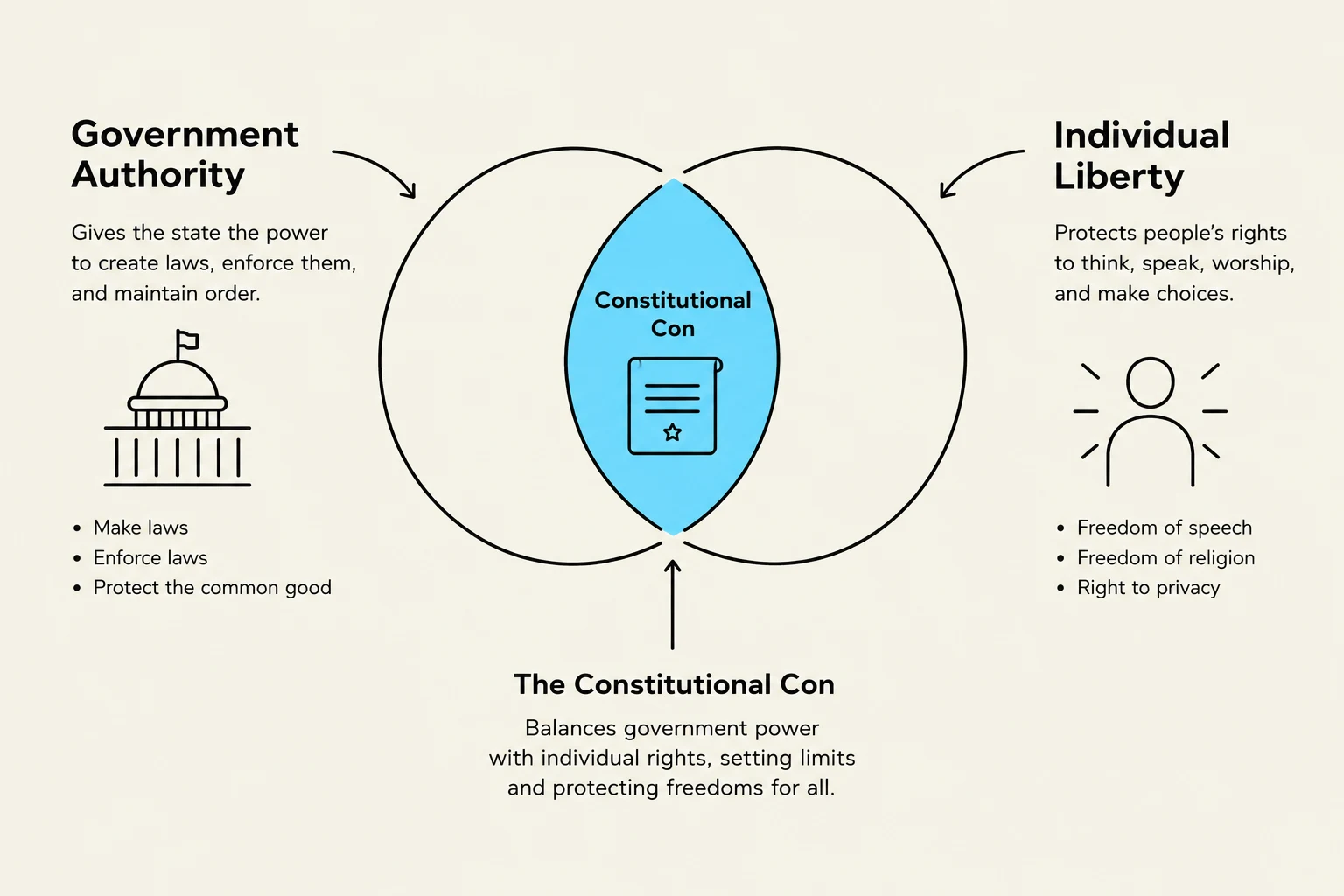
This diagram illustrates the relationship between government authority and individual liberty, mediated by a constitutional framework that balances power and protects freedoms.
By requiring that laws be clear, prospective, and non-discriminatory, American jurisprudence seeks to ensure that the exercise of criminal justice remains within established constitutional boundaries, protecting the individual from the potential tyranny of the state.
Keep reading for free.
Create an account to finish this reading and make it part of your study routine.