


In a free market, the interaction of supply and demand determines the price and quantity of goods traded. This point of intersection is known as the equilibrium. At equilibrium, the amount buyers want to purchase exactly matches the amount sellers want to sell, ensuring that resources are allocated efficiently.
However, governments sometimes intervene in markets through legal restrictions known as price controls or quantity controls. While these interventions are often well-intentioned—aiming to help consumers afford essentials or to ensure producers receive a fair income—they frequently distort market signals and lead to unintended economic consequences.
Price Ceilings: Capping the Maximum Price
A price ceiling is a legal maximum price that sellers are allowed to charge for a good or service. For a price ceiling to have any impact on the market, it must be "binding" or "effective," meaning it is set below the equilibrium price. If a ceiling is set above the equilibrium, it is "nonbinding" and has no effect because the market is already trading at a price lower than the limit.
When a binding price ceiling is imposed, it creates a shortage. Because the price is artificially low, the quantity demanded by consumers increases, but the quantity supplied by producers decreases.
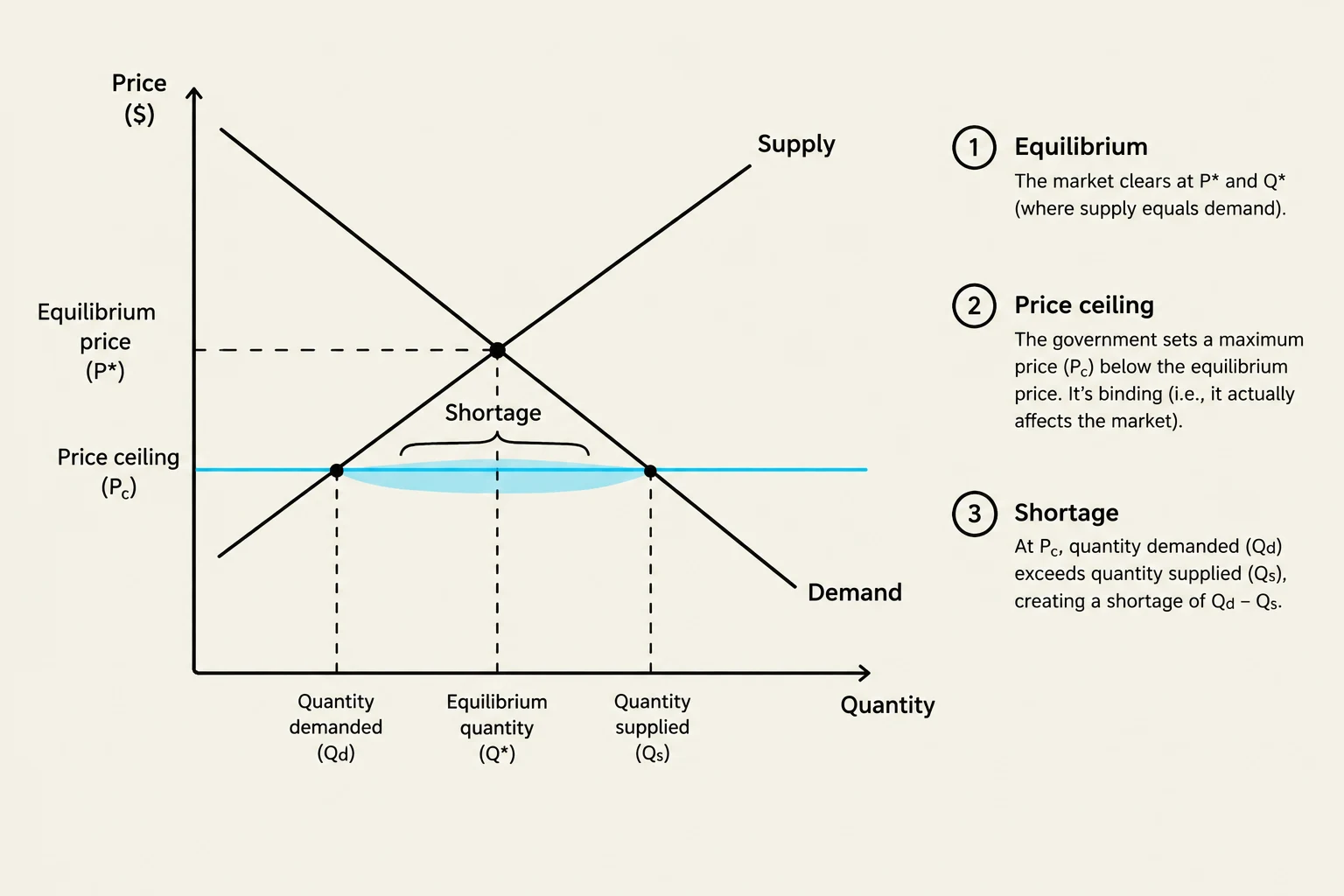
The consequences of price ceilings extend beyond simple shortages:
- Inefficient Allocation: Goods may not go to those who value them most; instead, they might go to those who are best at waiting in lines or those who can offer bribes.
- Wasted Resources: Time spent waiting in long lines (like the famous bread lines in the former USSR) is a resource that provides no economic value.
- Inefficiently Low Quality: Since sellers have more customers than they have goods, they cannot compete on price. Instead, they may reduce the quality of the product or service to save costs.
- Black Markets: Illegal markets often emerge where goods are traded at prices higher than the legal ceiling.
Keep reading for free.
Create an account to finish this reading and make it part of your study routine.
Continue reading freeAlready have an account? Log in
Updated