Price Controls and Quantity Quotas: Market Intervention Effects
Examines how government interventions like price controls (ceilings and floors) and quantity quotas distort market signals, leading to shortages, surpluses, deadweight loss, and other unintended consequences.
In a free market, prices act as vital signals that coordinate the behavior of buyers and sellers. When prices are allowed to fluctuate freely, they communicate information about scarcity and desire, ensuring that resources flow to where they are most valued. However, governments sometimes intervene in these markets through price controls or quantity restrictions. While these interventions are often well-intentioned—aiming to make essentials more affordable or to protect producers—they frequently distort these signals, leading to inefficiencies, wasted resources, and unintended social consequences.
Price Controls: Ceilings and Floors
Price controls are legal restrictions on how high or low a market price may go. There are two primary types: price ceilings and price floors.
Price Ceilings
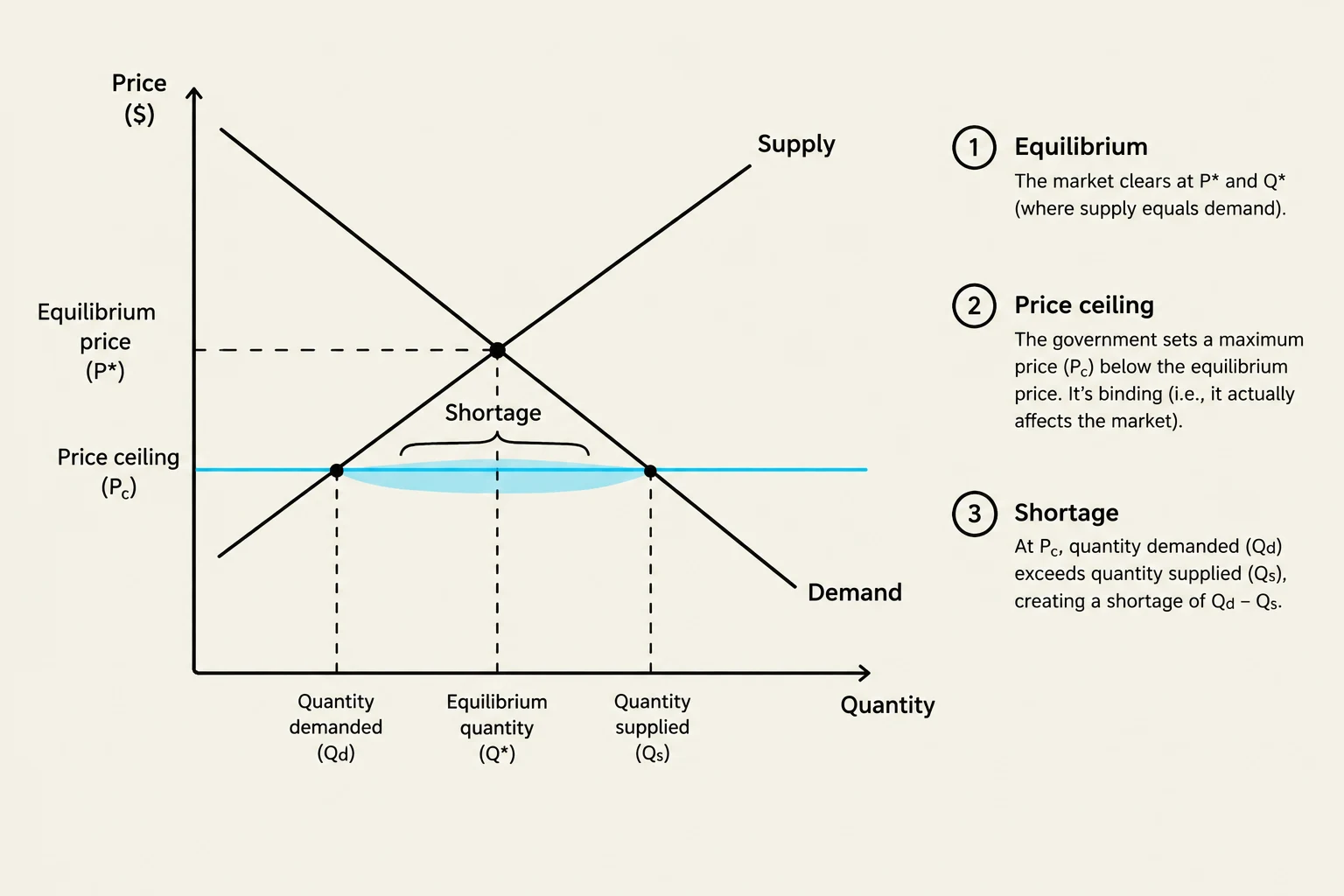
A price ceiling is a maximum price that sellers are legally allowed to charge for a good or service. To have any effect on the market, a ceiling must be binding (or effective), meaning it is set below the natural market equilibrium price. If a ceiling is set above the equilibrium price, it is nonbinding and has no impact on market behavior.
When a binding price ceiling is imposed, it creates a shortage. Because the price is artificially low, the quantity demanded by consumers increases, but the quantity supplied by producers decreases.
This graph illustrates the economic concept of a price ceiling, showing how setting a maximum price below the equilibrium price leads to a shortage where quantity demanded exceeds quantity supplied.
Exam Tip: Always check if the control is "binding." If a question says the maximum legal price is $10, but the market equilibrium is $7, the ceiling is nonbinding and the market will stay at $7.
Price Floors
Conversely, a price floor is a minimum price that buyers are required to pay. Like ceilings, a floor is only binding if it is set above the equilibrium price. A binding price floor creates a surplus, where the quantity supplied by producers exceeds the quantity demanded by consumers. A classic example is the minimum wage; if set too high, it can lead to a surplus of labor, commonly known as unemployment.
The Inefficiency of Intervention
Every time a government interferes with the equilibrium price, it creates deadweight loss—the loss in total surplus that occurs because the policy reduces the quantity transacted below the efficient market equilibrium level.
The Side Effects of Price Ceilings
When a price ceiling causes a shortage, several negative outcomes typically follow:
Inefficient Allocation: Goods do not necessarily go to those who value them most; instead, they may go to those who are first in line or have better connections.
Wasted Resources: Because buyers cannot compete on price, they compete through other, less efficient means, such as waiting in long lines or offering bribes.
Inefficiently Low Quality: Since sellers have more customers than they have goods, they have no incentive to compete on quality. Instead, they may reduce service or the quality of the product to save costs.
Black Markets: When the legal market cannot meet demand, illegal markets often emerge where goods are traded at prices higher than the legal ceiling.
The Side Effects of Price Floors
Price floors also distort the market, leading to:
Inefficiently High Quality: To justify higher prices, sellers may provide more quality than buyers actually want or are willing to pay for.
Wasted Resources: In agriculture, governments often have to buy back excess surpluses created by price floors, only to destroy or donate them.
Inefficient Allocation of Sales: Floors can allow high-cost, inefficient firms to stay in business while preventing low-cost, efficient firms from entering the market.
Quantity Controls: Quotas
Instead of controlling the price, governments sometimes control the amount of a good that can be traded through a quota. A quota is an upper limit on the quantity of a good that can be legally bought or sold.
To manage a quota, the government may issue a license, which is the legal right to supply the good. The total amount allowed under the quota is known as the quota limit.
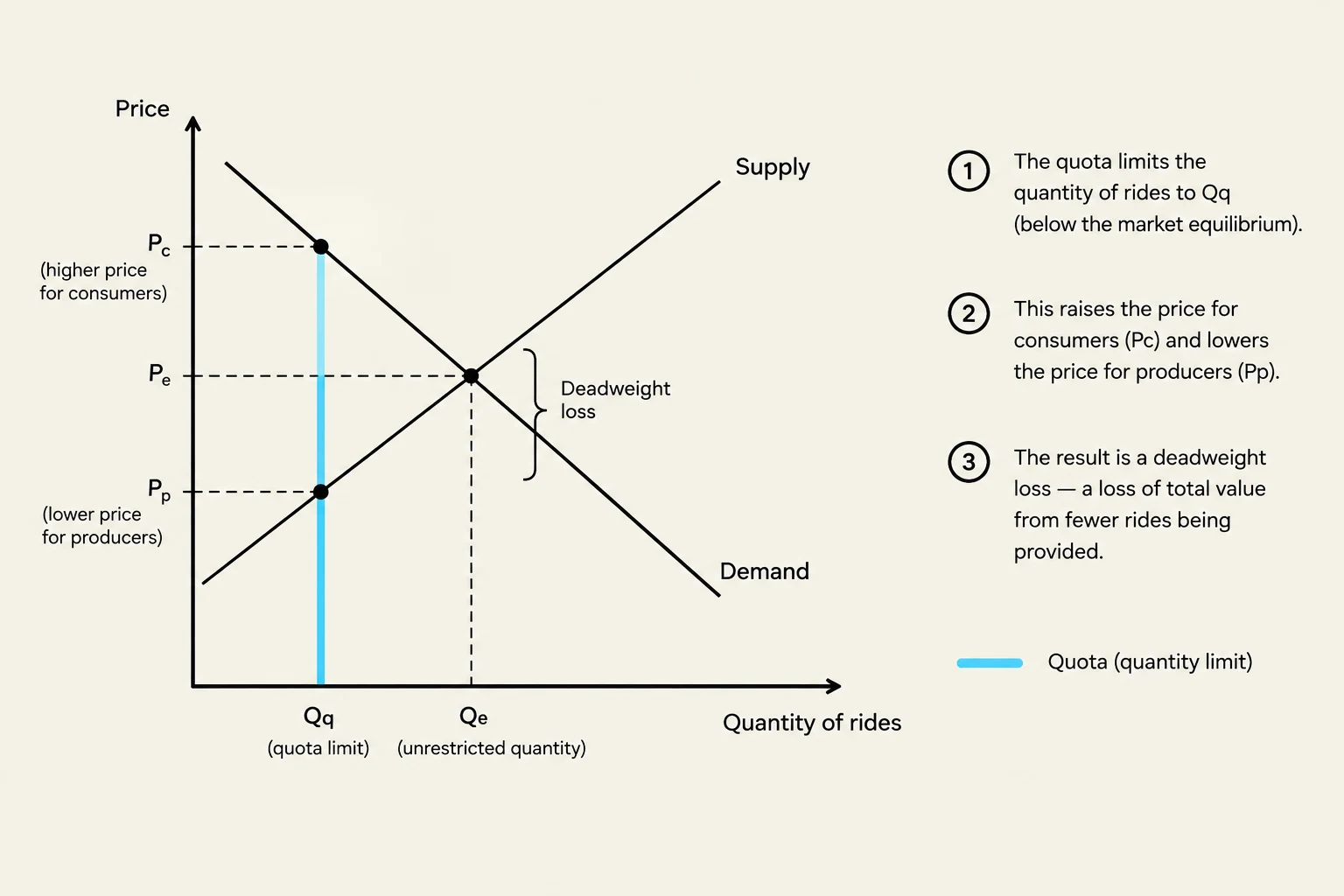
This graph illustrates the economic concept of deadweight loss caused by a quota, which limits the quantity of goods or services traded below the market equilibrium. The quota results in a higher price for consumers and a lower price for producers, leading to a loss of total value.
The Wedge and Quota Rent
A quota creates a "wedge" between the demand price (the price consumers are willing to pay for a specific quantity) and the supply price (the price producers require to supply that same quantity). The difference between these two prices at the quota limit is called the quota rent. This rent represents the extra profit captured by those who hold the legal license to trade.
Like price controls, quotas reduce the total number of transactions, leading to deadweight loss and providing incentives for illegal, unlicensed activity, such as "under-the-table" jobs or unlicensed taxi services.
Summary Comparison
While the mechanisms differ, the fundamental economic result of price ceilings, price floors, and quotas is similar:
Intervention
Primary Effect
Resulting Market Condition
Price Ceiling (Binding)
Price is forced down
Shortage (Demand > Supply)
Price Floor (Binding)
Price is forced up
Surplus (Supply > Demand)
Quota
Quantity is restricted
Reduced transactions and Deadweight Loss
In all three cases, the reduction in the quantity of goods exchanged compared to the equilibrium level results in a loss of total economic welfare.
Keep reading for free.
Create an account to finish this reading and make it part of your study routine.