Learn how to predict precipitation reactions and determine the solubility of ionic compounds using solubility rules and the crisscross method. This guide covers understanding ionic compounds, predicting products, and balancing chemical equations.
Have you ever mixed two clear liquids together only to see the solution suddenly turn cloudy or form a white, powdery substance? This isn't magic—it is a chemical reaction in action. When two aqueous solutions containing different ions are combined, those ions may find a new partner that they prefer to stay with in a solid form rather than remaining dissolved in water. This process is known as a precipitation reaction.
Understanding Precipitation Reactions
In a typical aqueous solution, ionic compounds have dissociated into their constituent parts: cations (positively charged ions) and anions (negatively charged ions). When you mix two such solutions, the cations from one solution can pair up with the anions from the other.
If the resulting combination is an insoluble compound, it will "fall out" of the solution as a solid, known as a precipitate. On a microscopic level, the ions are leaving the aqueous phase to form an organized ionic solid.
Key Terminology:
Aqueous (aq): A substance that is dissolved in water.
Insoluble (s): A substance that does not dissolve in water and forms a solid precipitate.
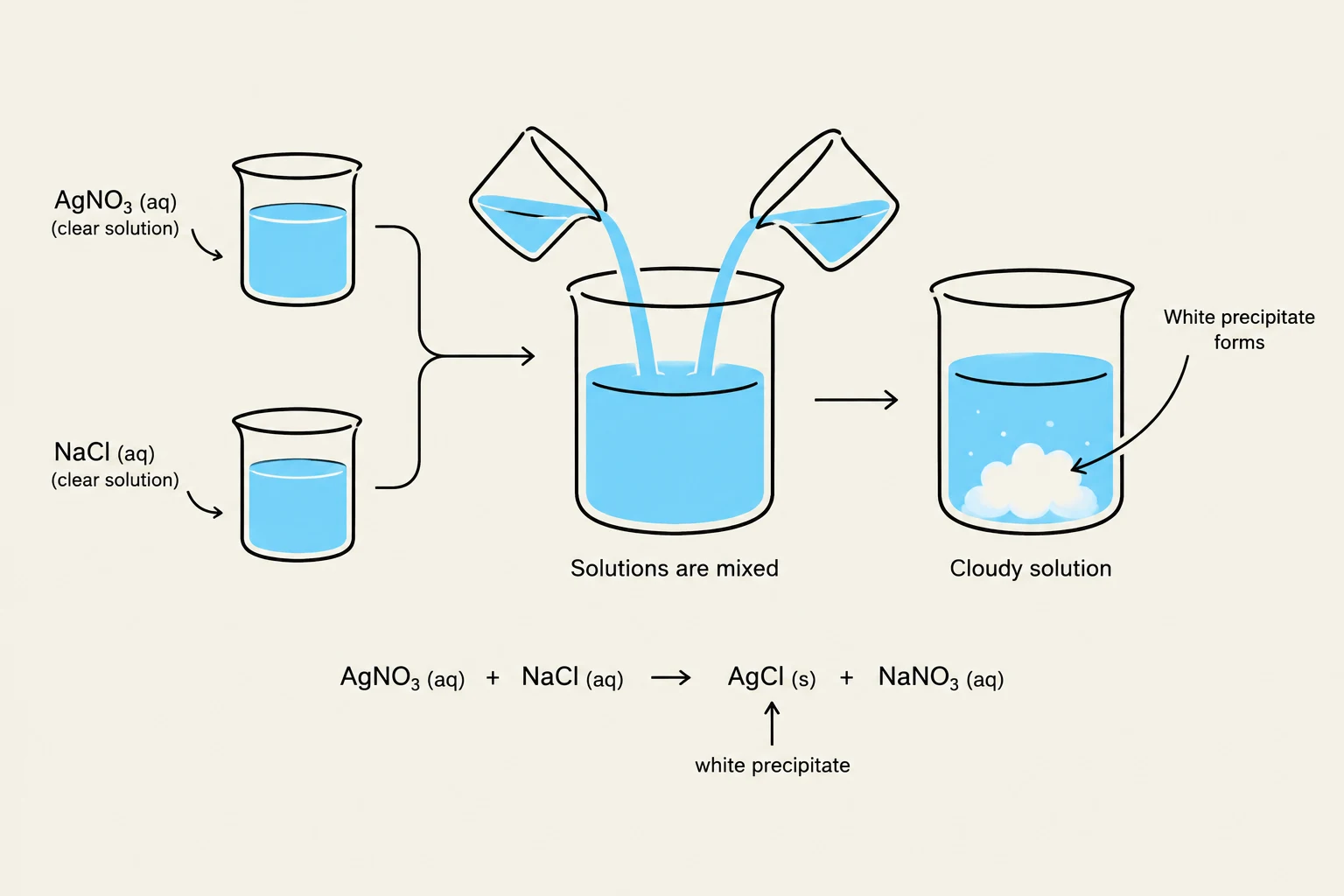
This diagram illustrates the chemical reaction between silver nitrate (AgNO3) and sodium chloride (NaCl) solutions, resulting in the formation of a white precipitate of silver chloride (AgCl) and sodium nitrate (NaNO3) in solution.
Predicting Products: The "Outside-Outside, Inside-Inside" Pattern
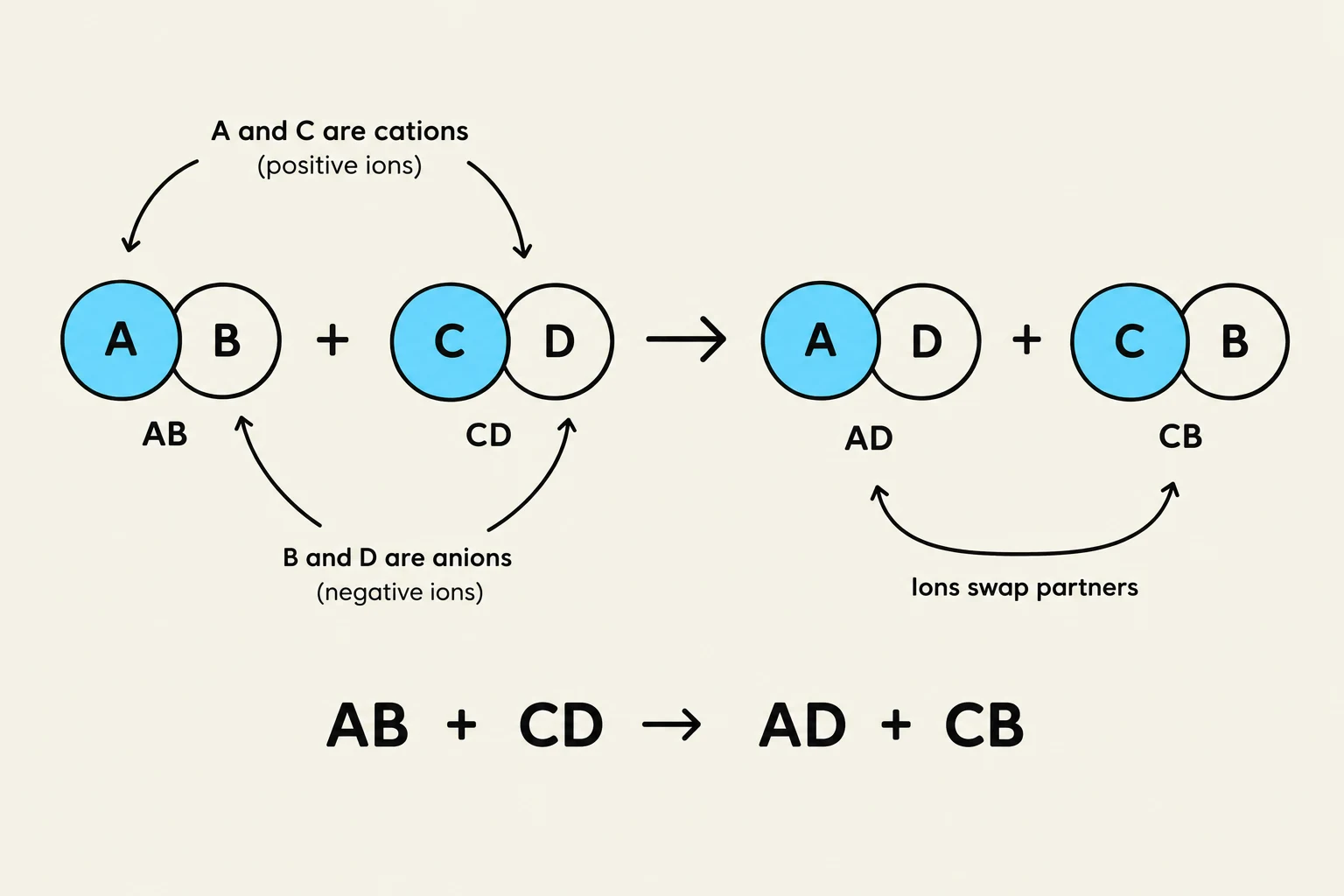
To predict what will happen when two ionic compounds react, we use a pattern-swapping method. Imagine your reactants are represented by the general formula AB and CD, where A and C are cations, and B and D are anions.
To find the new products, we follow the outside-outside, inside-inside pattern:
Outside-Outside: Pair the first ion of the first reactant (A) with the last ion of the second reactant (D).
Inside-Inside: Pair the second ion of the first reactant (B) with the first ion of the second reactant (C).
Crucial Rule: When writing the new formulas, you must always write the cation first, followed by the anion.
This diagram illustrates a double displacement reaction where cations and anions swap partners. Initially, A and C are cations (positive ions) bonded with anions B and D respectively, forming compounds AB and CD. After the reaction, the cations and anions exchange partners, resulting in the formation of new compounds AD and CB.
Determining Formulas: The Crisscross Method
Simply swapping ions isn't enough; you must ensure the resulting chemical formulas are electrically neutral. Because ionic compounds must have a net charge of zero, we use the crisscross method to balance the charges of the cation and anion.
For example, if you are combining Lead(II) ions (Pb2+) and Iodide ions ($I^-$), you take the numerical value of the charge of one ion and make it the subscript of the other:
The 2 from Pb2+ becomes the subscript for I.
The 1 from $I^-$ becomes the subscript for Pb.
The resulting formula is PbI2.
Using Solubility Rules to Identify States
Once you have your predicted formulas, you need to determine if they will be aqueous $(aq)$ or solid $(s)$. This is where the solubility rules and a solubility chart become your most important tools.
General Rules and Exceptions
While there are many rules, you can categorize them into "families" to make scanning a chart easier:
Always Soluble: Compounds containing Group 1 cations (like $Li^+$, Na+, $K^+$), ammonium (NH4+), nitrate (NO3−), and acetate (CH3COO−) are generally soluble.
Usually Insoluble: Carbonates (CO32−), phosphates (PO43−), hydroxides ($OH^-$), and sulfides (S2−) are typically insoluble unless they are paired with a Group 1 cation or ammonium.
The Halide Rule (with exceptions): Chlorides ($Cl^-$), bromides ($Br^-$), and iodides ($I^-$) are usually soluble, but they become insoluble if they pair with Silver (Ag+), Lead (Pb2+), or Mercury (Hg22+).
The Sulfate Rule (with exceptions): Sulfates (SO42−) are mostly soluble, except when paired with Barium (Ba2+), Strontium (Sr2+), or Lead (Pb2+).
Pro-Tip: When using a solubility chart, the most efficient habit is to identify the anion family first, then check the cation to see if an exception applies.
This chart outlines common solubility rules for ions in water, including exceptions for halides and sulfides, and provides a flowchart for predicting solubility or precipitate formation.
Worked Example: A Complete Reaction
Let's combine everything to predict the reaction between Potassium Iodide (KI) and Lead(II) Nitrate (Pb(NO3)2).
Products: K pairs with NO3 (Inside); Pb pairs with I (Outside).
Step 2: Apply Crisscross Method
$K^+$ and NO3−→KNO3
Pb2+ and $I^-$ →PbI2
Step 3: Determine Physical States
KNO3: Potassium is Group 1, so it is soluble →(aq).
PbI2: Iodide is usually soluble, but Lead (Pb2+) is a specific exception that makes it insoluble →(s).
Step 4: Balance the Equation
We must ensure the number of atoms for each element (and polyatomic ion) is equal on both sides.
2KI(aq)+Pb(NO3)2(aq)→2KNO3(aq)+PbI2(s)
By adding the coefficient 2 to KI and KNO3, we balance the Potassium (K), the Iodide (I), and the Nitrate (NO3) groups.
Summary Checklist
To provide a complete and accurate answer for a precipitation reaction, always ensure you have:
The correct balancing coefficients.
The accurate chemical formulas (using the crisscross method).
The correct physical states ($(aq)$ or $(s)$) based on solubility rules.
Keep reading for free.
Create an account to finish this reading and make it part of your study routine.