Precision, Accuracy, and Problem-Solving Strategies in Chemistry
Learn about the crucial concepts of precision and accuracy in scientific measurements, the rules for significant figures, and a systematic strategy for solving chemistry problems, including mass conversions and density calculations.
In the field of chemistry, the ability to measure quantities and solve complex mathematical problems is fundamental. However, simply obtaining a number is not enough; a scientist must understand the quality of that measurement and follow a systematic approach to ensure the results are both mathematically correct and scientifically meaningful. This article explores the nuances of measurement reliability, the essential rules of significant figures, and a structured strategy for tackling chemical calculations.
Precision vs. Accuracy
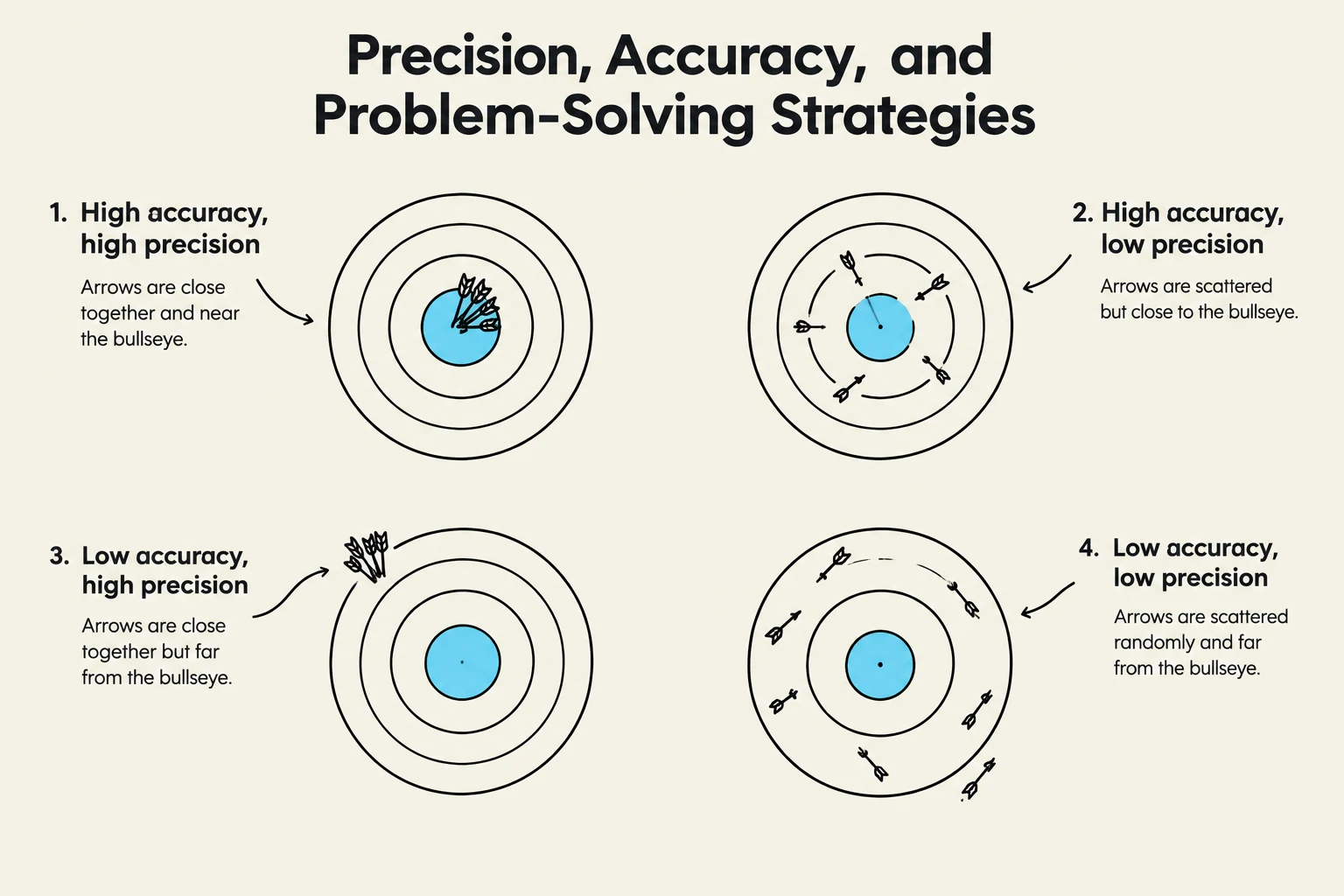
This diagram illustrates the concepts of precision and accuracy using target examples. It shows four scenarios: high accuracy/high precision, high accuracy/low precision, low accuracy/high precision, and low accuracy/low precision, with accompanying explanations and visual representations of arrow placements on targets.
When we perform measurements, we are often dealing with estimations rather than exact determinations. Because of this, we must distinguish between two different concepts of "correctness": precision and accuracy.
Precision refers to the consistency of a series of measurements. If you measure the same object multiple times and get very similar results, your measurements are precise.
Accuracy refers to how close a measured value is to the true or accepted value.
It is a common misconception that these two terms are interchangeable. In reality, it is entirely possible to have a set of measurements that are highly precise (they all yield the same number) but are not accurate (the number is far from the true value).
Exam Tip: When evaluating data, remember that precision is about reproducibility, while accuracy is about correctness.
Significant Figures and Reliability
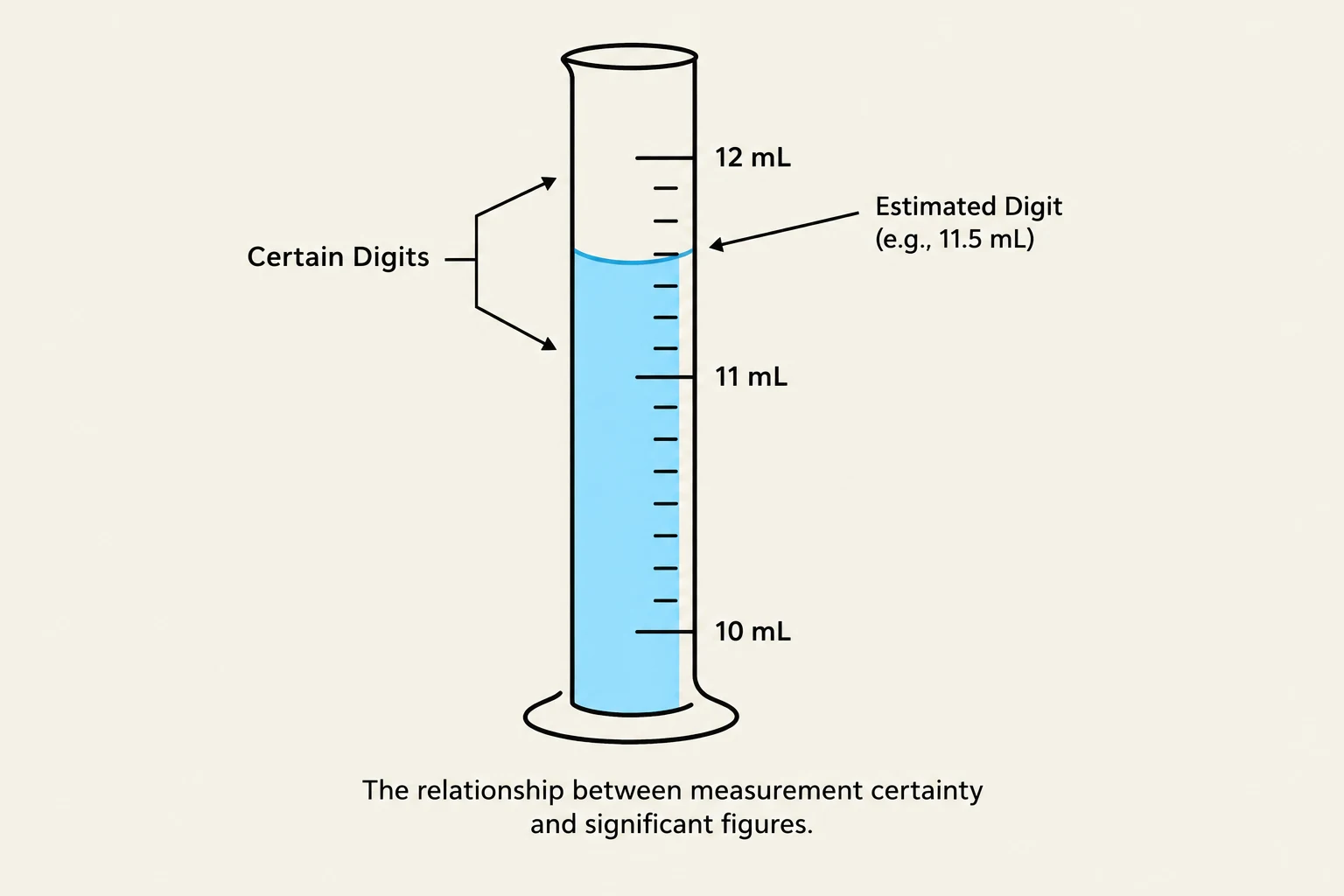
A diagram illustrating measurement certainty and significant figures using a graduated cylinder.
The number of digits reported in a measurement reflects the certainty of that measurement. Scientific measurements are reported such that every digit is certain except for the very last one, which is an estimate. For example, if a scale has markings every 1 g, a reading might be recorded as 1.2 g, where the "2" is the estimated digit.
Rules for Counting Significant Figures (SF)
To maintain the integrity of calculations, you must follow specific rules for determining significant figures:
All non-zero digits are significant (e.g., 28.03 has four SF).
Interior zeros (between non-zeros) are significant (e.g., 408 has three SF).
Leading zeros are NOT significant (e.g., 0.0032 has two SF).
Trailing zeros are significant if they are after a decimal point (e.g., 45.000 has five SF) or before a decimal point (e.g., 140.00 has five SF). However, trailing zeros before an implied decimal point can be ambiguous (e.g., 1200), so scientific notation is preferred in these cases.
Rules for Calculations
When performing math, your final answer cannot be more "certain" than your least certain measurement:
Multiplication and Division: The result should have the same number of significant figures as the factor with the fewest significant figures.
Addition and Subtraction: The result should have the same number of decimal places as the quantity with the fewest decimal places.
Note: If you are performing a multi-step calculation, do not round your intermediate steps. Only round at the very final step to avoid accumulating errors.
A General Problem-Solving Strategy
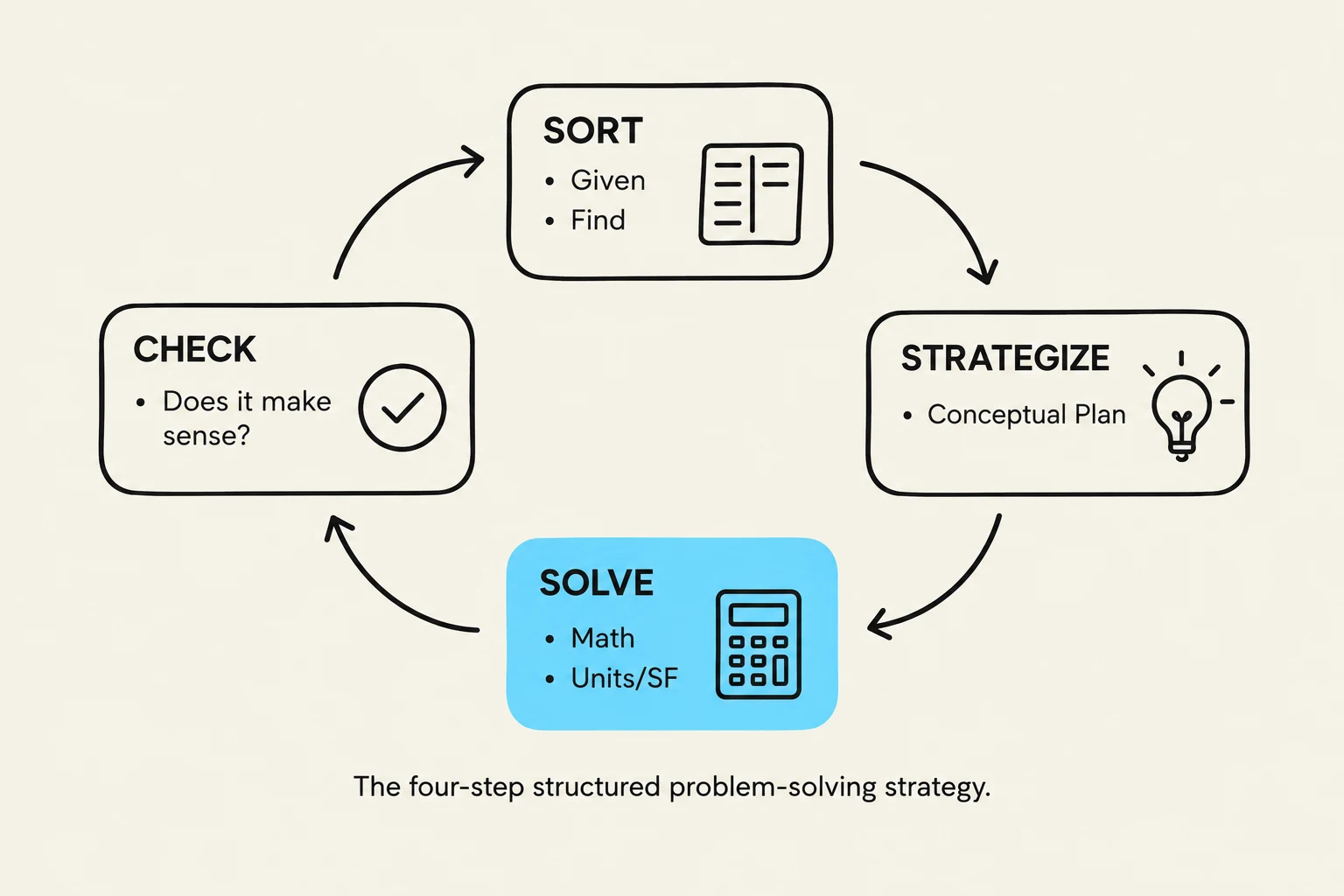
The four-step structured problem-solving strategy involves sorting information, strategizing with a conceptual plan, solving using math and units, and checking for sense.
To avoid errors in complex chemical problems, students should move away from "guesswork" and adopt a structured four-step strategy:
Sort: Identify the given information (what you already know) and the find information (the target variable you are trying to calculate).
Strategize: Develop a conceptual plan. This is a logical roadmap of the steps required to get from your known values to your unknown value.
Solve: Execute the mathematical operations. During this stage, it is vital to manage your units and significant figures correctly.
Check: This is the most overlooked step. Always ask, "Does this answer make sense?". If you are calculating the mass of an atom and get a value in kilograms, you know an error occurred.
Mass Conversions and Density
Many chemistry problems require converting between different units of mass. The metric system uses powers of 1000 for these transitions:
1 kg=1000 g
1 g=1000 mg
1 mg=1000\mug
Worked Example: Mass Conversion
Problem: A chemist requires 150 mg of a chemical for an experiment. She has 11.0 g available. How many times can she repeat the experiment?
1. Sort:
Given: 11.0 g total; 150 mg per experiment.
Find: Number of experiments.
2. Strategize:
Convert grams to milligrams so the units match.
Divide the total milligrams by the milligrams required per experiment.
3. Solve:11.0 g×1 g1000 mg=11,000 mg150 mg/experiment11,000 mg=73.33 experiments
Since she cannot perform a partial experiment, the answer is 73 times.
Density Calculations
Density (d) is an intensive property, meaning it does not depend on the amount of substance present. It is defined by the relationship between mass (m) and volume (V):
density(d)=volume(V)mass(m)
Worked Example: DensityProblem: A sample of an unknown liquid has a mass of 32.6 g and occupies a volume of 41.5 mL. Calculate the density.