- Group 1 cations: Lithium ($Li^+$), Sodium (Na+), Potassium ($K^+$), etc..
- The Ammonium cation: NH4+.
- The Nitrate anion: NO3−.
- The Acetate anion: CH3COO−.
Navigating Exceptions
Solubility rules are not absolute; they often come with specific exceptions that can turn a "soluble" ion into an "insoluble" one.
Halate Exceptions: Halates (such as chloride $Cl^-$, bromide $Br^-$, and iodide $I^-$) are usually soluble. However, they become insoluble if they pair with silver (Ag+), lead (Pb2+), or mercury (Hg22+).
Sulfate Exceptions: Sulfate (SO42−) compounds are mostly soluble, but they become insoluble when paired with barium (Ba2+), strontium (Sr2+), or lead (Pb2+).
Insoluble Anions: Conversely, certain anions are almost always insoluble, such as carbonate (CO32−), phosphate (PO43−), chromate (CrO42−), hydroxide ($OH^-$), and sulfide (S2−). The major exception to this rule is that these anions will become soluble if they combine with Group 1 cations or the ammonium cation.
Exam Tip: The Efficient Reading Method
To save time when using a solubility chart, do not scan the entire table for every compound. Instead, identify the anion family first, then check the cation to see if it falls into an exception category.
Predicting Reaction Products
To predict the products of a reaction between two ionic compounds, you can use a "swap" pattern. If you have two reactants, AB and CD, where A and C are cations and B and D are anions, the products will be formed by pairing the "outside" ions together and the "inside" ions together.
- Outside-Outside: Pair A with D.
- Inside-Inside: Pair C with B (remembering to write the cation first).
Worked Example 1: Potassium Iodide and Lead(II) Nitrate
Let's react KI(aq) with Pb(NO3)2(aq).
Step 1: Predict the products using the swap method.
- The "outside" ions are $K^+$ and NO3−, forming KNO3.
- The "inside" ions are Pb2+ and $I^-$, forming PbI2 (using the crisscross method to balance charges).
Step 2: Determine the physical states using solubility rules.
- KNO3: Potassium is a Group 1 cation, so it is soluble →(aq).
- PbI2: Iodide is usually soluble, but Lead (Pb2+) is a specific exception →(s).
Step 3: Write and balance the equation.
The skeleton equation is:
KI(aq)+Pb(NO3)2(aq)→KNO3(aq)+PbI2(s)
To balance the equation, we notice there are two iodides and two nitrates on the product side. We must adjust the coefficients:
2KI(aq)+Pb(NO3)2(aq)→2KNO3(aq)+PbI2(s)
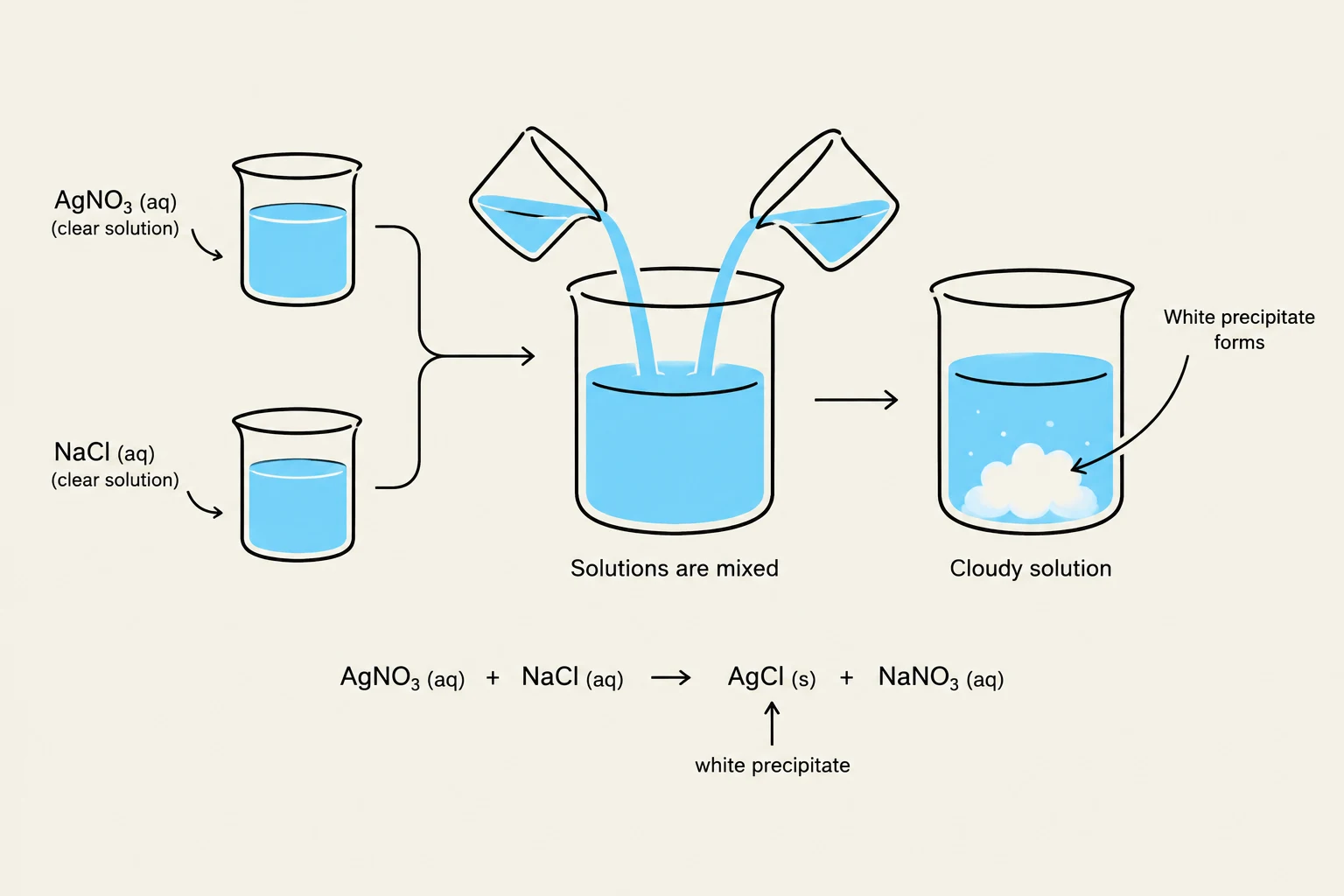
Worked Example 2: Silver Nitrate and Sodium Chloride
Let's react AgNO3(aq) with NaCl(aq).
Step 1: Predict products.
- Outside: Ag and Cl→AgCl.
- Inside: Na and NO3→NaNO3.
Step 2: Determine states.
- NaNO3: Sodium is Group 1 and Nitrate is a soluble anion →(aq).
- AgCl: Chloride is usually soluble, but Silver (Ag+) is a listed exception →(s).
Step 3: Final Equation.
Since the charges are already balanced (1:1 ratio), the equation is:
AgNO3(aq)+NaCl(aq)→AgCl(s)+NaNO3(aq)
By mastering these patterns and keeping your solubility exceptions at the forefront, you can accurately predict the outcomes of complex chemical mixtures.