Learn about precipitation reactions, including electrolytes, solubility guidelines, and how to represent these reactions using molecular, total ionic, and net ionic equations.
When you mix two clear, colorless liquids in a chemistry lab, you might expect them to remain clear. However, sometimes a sudden cloudiness appears, or a colorful solid begins to settle at the bottom of the beaker. This phenomenon is a precipitation reaction. In these reactions, two aqueous solutions containing soluble ionic compounds are mixed, resulting in the combination of a non-soluble cation (a positively charged ion) and a non-soluble anion (a negatively charged ion) to form an insoluble solid known as a precipitate.
Understanding Electrolytes and Solubility
To understand why precipitates form, we must first understand how substances behave when they dissolve in water. Not all substances dissolve in the same way. We categorize solutes based on their ability to produce ions in a solution:
Strong Electrolytes: These are substances that nearly 100% dissociate into ions in aqueous solution. Because they produce a high concentration of ions, they conduct electricity very efficiently. Common examples include strong acids like HCl and HNO3, as well as most soluble ionic compounds like NaCl.
Weak Electrolytes: These substances only partially dissociate into ions. A classic example is acetic acid (vinegar), which exists in an equilibrium between its molecular form and its ions.
Non-electrolytes: These are substances that do not ionize at all when dissolved. For example, sugar dissolves in water, but it stays as whole molecules rather than breaking into ions, meaning it cannot conduct electricity.
Important Distinction: Do not confuse the solubility of a substance (how much dissolves) with its electrolyte strength (how it behaves once dissolved). For example, BaSO4 is very poorly soluble in water, but the tiny amount that does dissolve dissociates completely into Ba2+ and SO42− ions, making it a strong electrolyte.
Predicting Precipitates: Solubility Guidelines
How do we know if mixing two solutions will create a solid? We use solubility guidelines to predict whether the resulting combinations of cations and anions will stay dissolved (aqueous, aq) or fall out of solution as a solid (precipitate, s).
The "Always Soluble" Rules
If a compound contains any of the following, it is generally soluble and will not form a precipitate:
Group I Alkali Metals: Li+, Na+, K+, Rb+, Cs+.
Ammonium: NH4+.
Nitrates: NO3−.
Acetates: CH3COO−.
The "Usually Soluble" Rules (With Exceptions)
Some ions are generally soluble, but they have specific "enemies" that turn them into solids:
Halides (Group 17: Cl−, Br−, I−): Generally soluble, except when paired with Ag+, Cu+, Pb2+, or Hg22+.
Sulfates (SO42−): Generally soluble, except when paired with Pb2+, Hg22+, Ca2+, Ba2+, or Sr2+.
Insoluble Compounds
If a combination of ions does not fall into the "always soluble" or "usually soluble" categories, it is likely to be an insoluble compound. Common insoluble groups include:
Carbonates (CO32−) and Phosphates (PO43−).
Sulfides (S2−) of transition metals.
Most Silver salts (except silver nitrate and silver acetate).
Exam Tip: Rule Precedence
Sometimes rules seem to contradict each other. For example, halides are "generally soluble," but silver is "generally insoluble." If you are asked about AgBr, the "insoluble" rule for silver takes precedence. Therefore, AgBr will form a precipitate.
Representing the Reaction
When a precipitation reaction occurs, chemists represent the process in three distinct stages: the molecular equation, the total ionic equation, and the net ionic equation.
1. The Molecular Equation
This shows the complete chemical formulas of all reactants and products as if they were intact molecules.
Example:
Pb(NO3)2(aq)+2NaI(aq)→PbI2(s)+2NaNO3(aq)
2. The Total (Complete) Ionic Equation
Since the reactants are strong electrolytes, they exist in the water as dissociated ions. The total ionic equation breaks every soluble compound into its constituent ions, while keeping the solid precipitate intact.
Pb2+(aq)+2NO3−(aq)+2Na+(aq)+2I−(aq)→PbI2(s)+2Na+(aq)+2NO3−(aq)
3. The Net Ionic Equation
In the example above, notice that Na+ and NO3− appear exactly the same on both sides of the equation. These are called spectator ions. They are present in the solution, but they do not actually participate in the chemical change that forms the solid.
To find the net ionic equation, we "cancel out" the spectator ions. This leaves us with only the species directly involved in the formation of the precipitate:
Pb2+(aq)+2I−(aq)→PbI2(s)
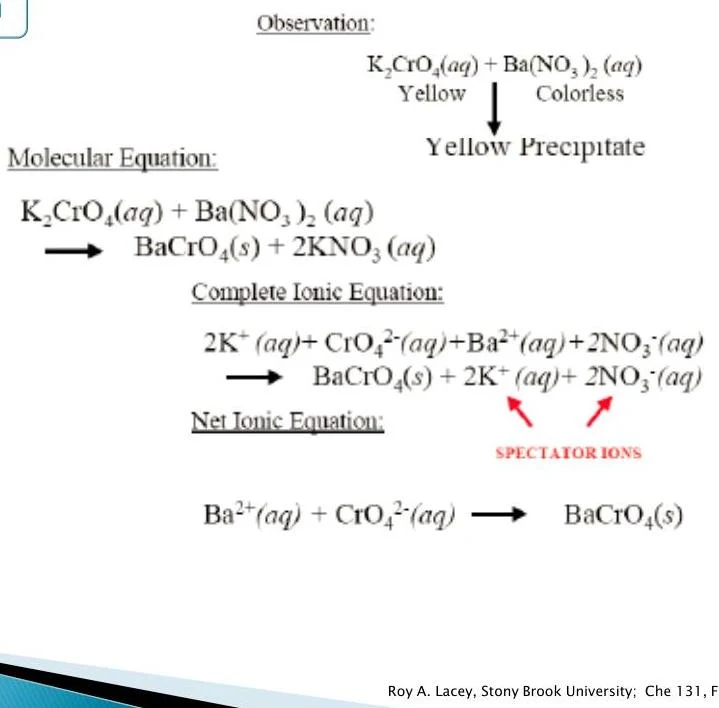
This illustration shows the molecular, complete ionic, and net ionic equations for the reaction between potassium chromate and barium nitrate, resulting in the formation of a yellow precipitate of barium chromate.
Summary Checklist for Precipitation
To master this topic, follow these steps for any given reaction:
Identify the products: Determine which cation and anion pair up to form each new compound.
Apply solubility rules: Check if any of those products are insoluble based on the guidelines.
Write the molecular equation: Ensure it is balanced.
Write the total ionic equation: Dissociate all $(aq)$ strong electrolytes into ions.
Identify spectator ions: Find ions that are identical on both sides.
Write the net ionic equation: Remove the spectators to show the real chemistry.
Keep reading for free.
Create an account to finish this reading and make it part of your study routine.