This content explores building resilience through active hope, resourcing oneself with upward arrows, and utilizing the me, you, and us model. It provides practical strategies for navigating challenges and fostering well-being.
Resilience is often misunderstood as a fixed personality trait—something you either have or you don't. In reality, resilience is a dynamic capacity that fluctuates based on our internal states and external circumstances. Rather than a static shield, think of resilience as a way of navigating a story: every story of resilience begins with a difficulty, but the essence of the concept lies in what makes a better-than-expected outcome more likely.
Understanding Resilience: The Water Level Metaphor
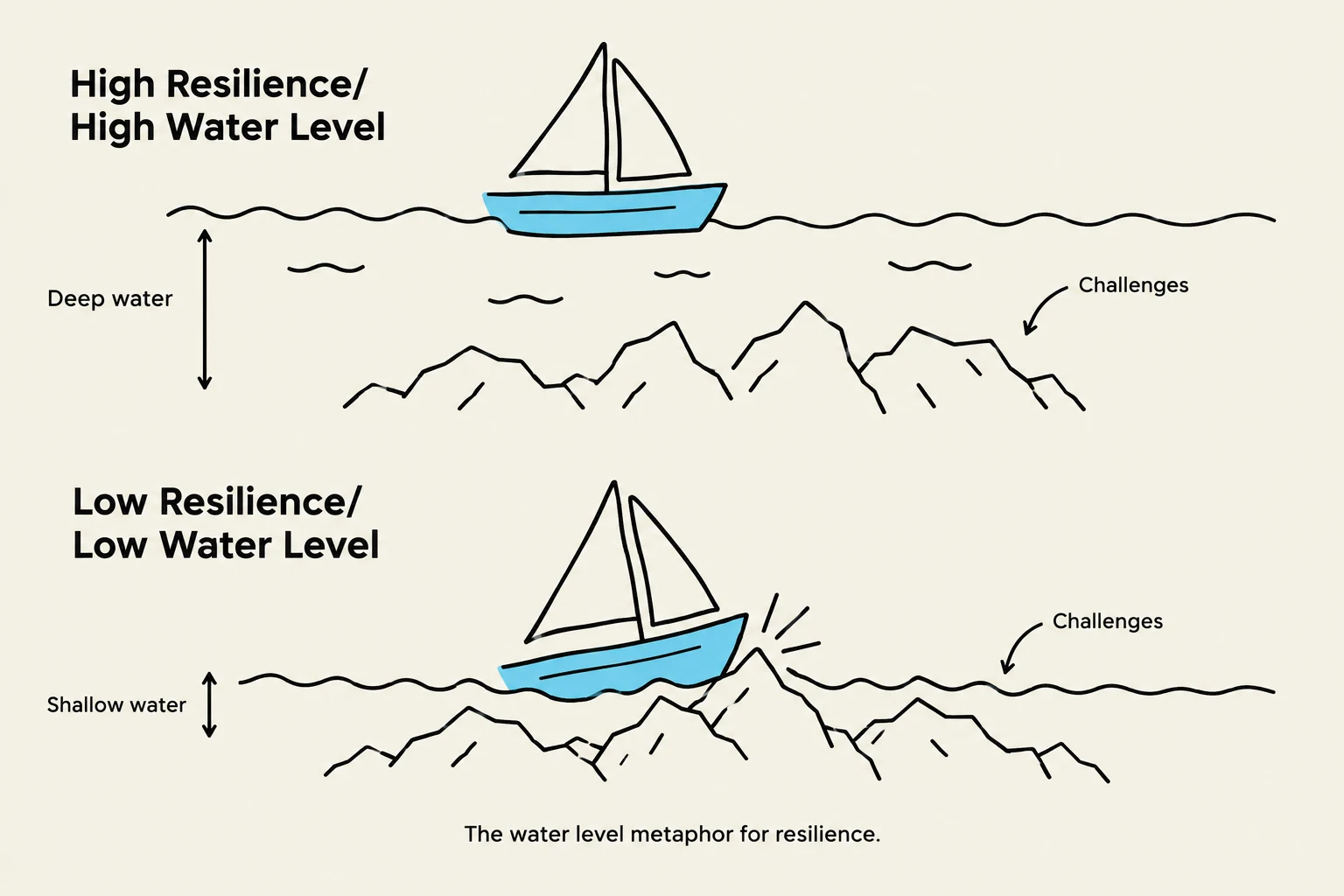
The water level metaphor for resilience.
To visualize how resilience works, imagine a person rowing a boat through a body of water. In this metaphor, the "rocks" represent life's inevitable challenges, crises, and setbacks.
The risk of "crashing" into these rocks is determined by your water level. A high water level represents high resilience; even when you encounter a rock, you have enough buoyancy to float over it. A low water level represents low resilience, where even minor setbacks can cause you to crash and suffer significant damage.
Crucially, your water level is not fixed. It rises and falls based on your health, your support systems, and the tools you use to manage stress.
Active Hope and the Perspective Check
When we find ourselves in a "red zone"—a state of being pushed beyond our normal coping capacity—it is easy to fall into despair. To counter this, we can practice active hope. Unlike passive optimism, which simply waits for things to get better, active hope involves identifying a desired positive outcome and taking actionable steps to make that outcome more likely.
A powerful way to initiate active hope is through a perspective check. This technique helps move the mind from a state of panic to a state of strategic thinking by evaluating three specific scenarios:
What is the best that can happen? (The ideal outcome)
What is the worst that can happen? (The catastrophic outcome)
What is most likely to happen? (The realistic outcome)
Once you have mapped these out, the focus shifts to the distinction between control and influence. While we cannot always control the "worst-case" scenario, we can exert influence to increase the probability of the "best" or "most likely" outcomes.
Exam Tip: The Storyboarding Technique
When facing a crisis, ask yourself: "What would a story of resilience look like here?" This helps you reframe a "problem" as a "chapter" in a larger journey, moving your focus from the difficulty (the "what is happening") to the response (the "what happens next").
Resourcing Yourself with the SSRI Toolkit
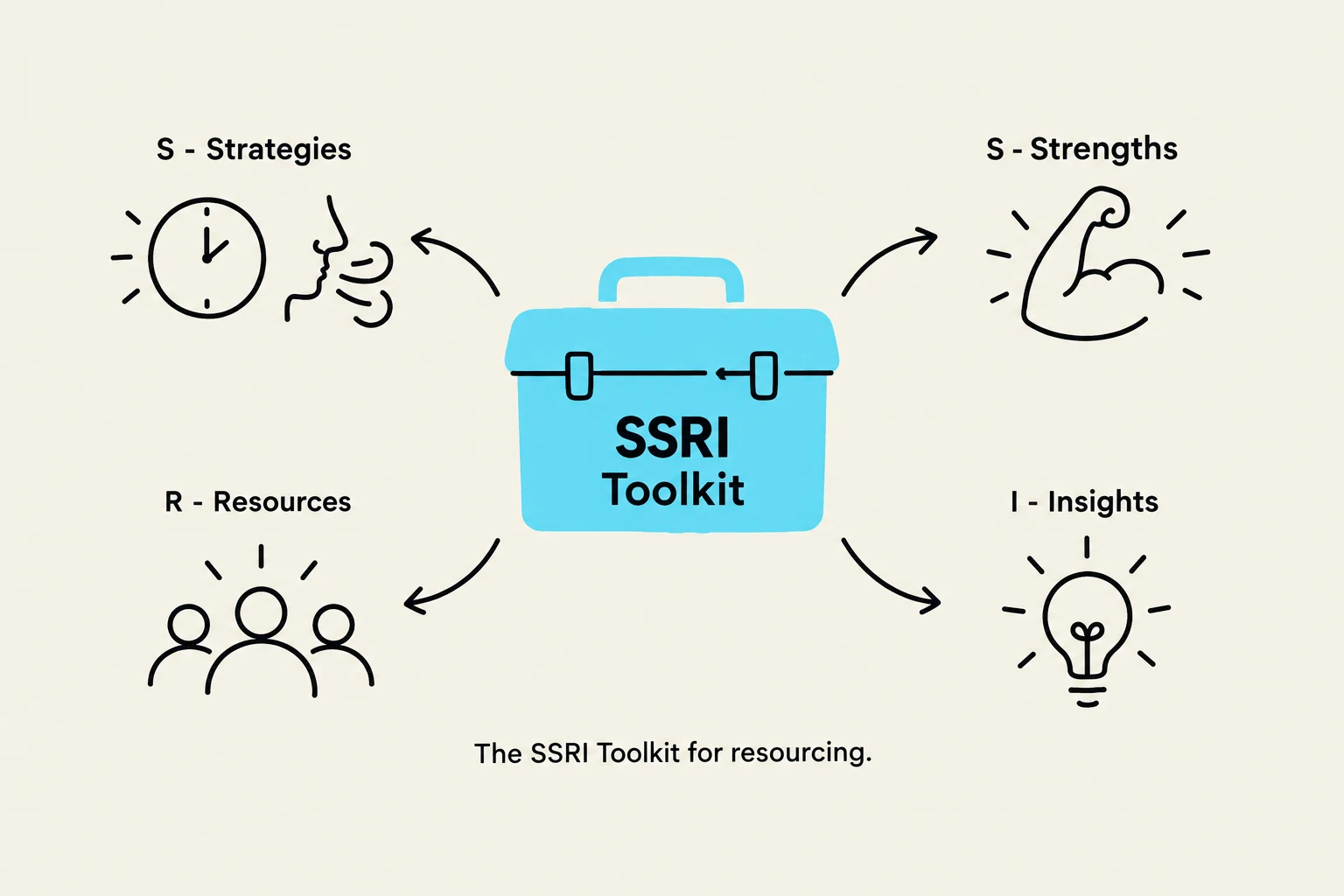
A diagram illustrating the SSRI Toolkit, which includes Strategies, Strengths, Resources, and Insights, presented as a toolbox.
To raise your water level, you must engage in resourcing—the process of drawing on internal and external assets to improve your ability to cope. One effective way to organize these assets is through the SSRI Toolkit (a psychological mnemonic, not a reference to medication):
S – Strategies: Specific, actionable steps you can take (e.g., breathing exercises, scheduling breaks).
S – Strengths: Personal qualities you can lean on (e.g., courage, humor, persistence).
R – Resources: External supports available to you (e.g., friends, family, community, nature).
I – Insights: Guiding ideas or cognitive reframing techniques.
Utilizing Insights: Gratitude and Positive Reminiscence
Two powerful "insights" for your toolkit are gratitude and positive reminiscence.
Gratitude exercises involve actively "hunting the good stuff"—noticing and appreciating what is working well, even in difficult times.
Positive reminiscence involves calling upon memories of past successes or supportive people to provide strength in the present.
Identifying "Upward Arrows"
Resilience is bolstered by identifying upward arrows—specific actions, thoughts, or resources that move your state from a "downward" trajectory toward a "better" one.
A helpful way to practice this is by completing these two sentence starters:
"I tend to cope less well when..." (Identifying downward arrows/risks)
"I tend to cope better when..." (Identifying upward arrows/resources).
The Me, You, and Us Model
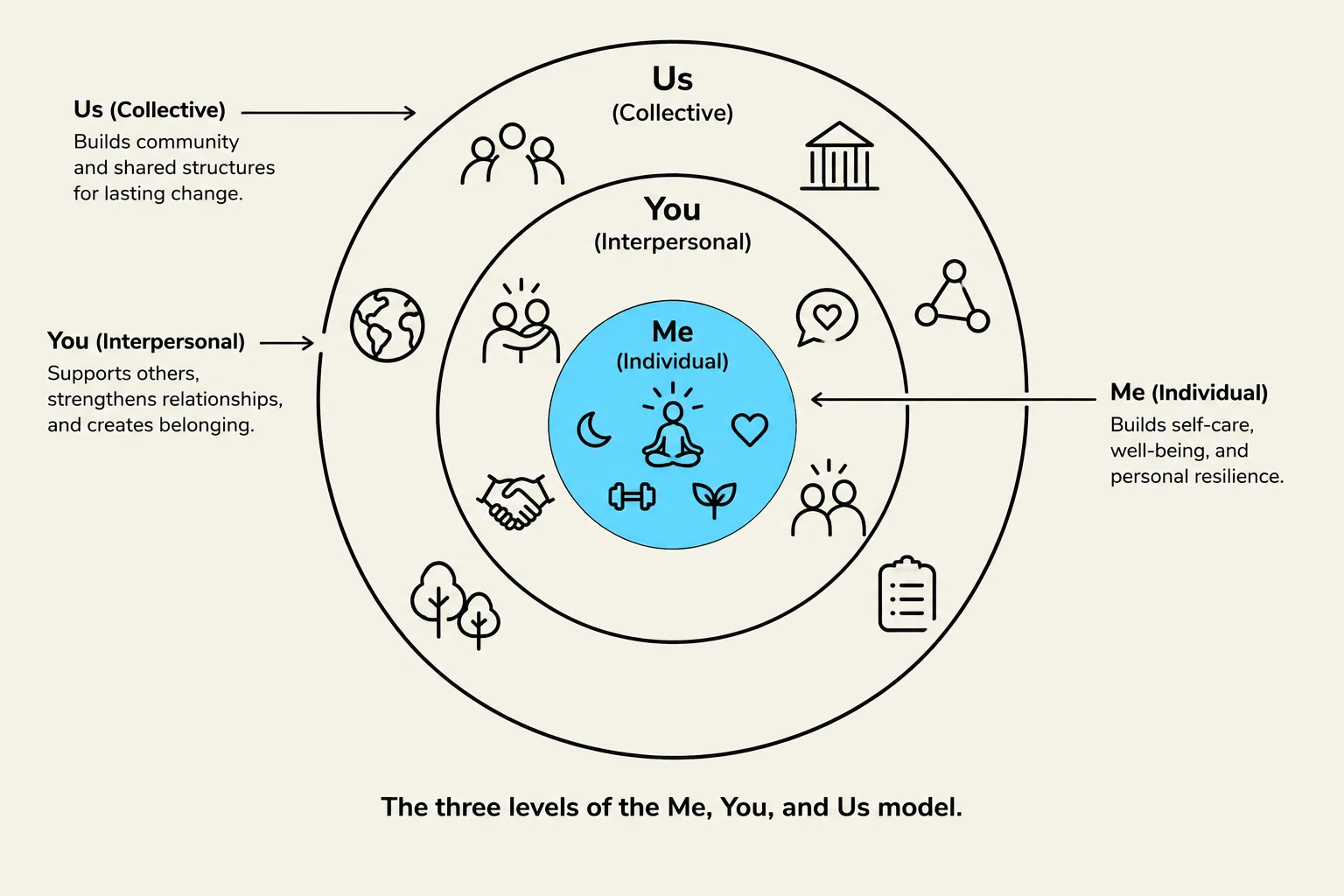
The three levels of the Me, You, and Us model, illustrating individual, interpersonal, and collective aspects of human connection and well-being.
Resilience does not exist in a vacuum; it operates across three interconnected levels. To build sustainable resilience, we must address all three:
Me (Individual): Focusing on personal self-care, managing one's own emotions, and utilizing personal SSRI tools.
You (Interpersonal): Extending support to others, such as family, colleagues, or clients. Helping others can actually boost your own resilience by providing a sense of agency.
Us (Collective): Building collective resilience. This involves community solidarity, trust, and creating structural responses to shared adversity.
By contributing to the "us" level, individuals often find a sense of purpose and meaningfulness that reinforces their own "me" level resilience.
Summary Checklist for Practical Resilience
Acknowledge the present: "Here is me facing this."
Check the water level: Am I at risk of crashing?
Find upward arrows: What helps me cope better?
Apply the perspective check: Best, worst, and most likely?
Actively hope: What can I do to make a better outcome more likely?
Keep reading for free.
Create an account to finish this reading and make it part of your study routine.