This document discusses population growth, carrying capacity, survivorship curves, and factors affecting human population dynamics, including density-independent and density-dependent factors, and Malthusian theory.
Understanding how populations change, grow, and decline is a fundamental pillar of ecology and environmental science. Population dynamics involve the study of how populations change over time based on various biological, environmental, and social drivers. By examining the relationship between species and their environments, we can predict whether a population will flourish, stabilize, or face a catastrophic decline.
Carrying Capacity and the Limits of Growth
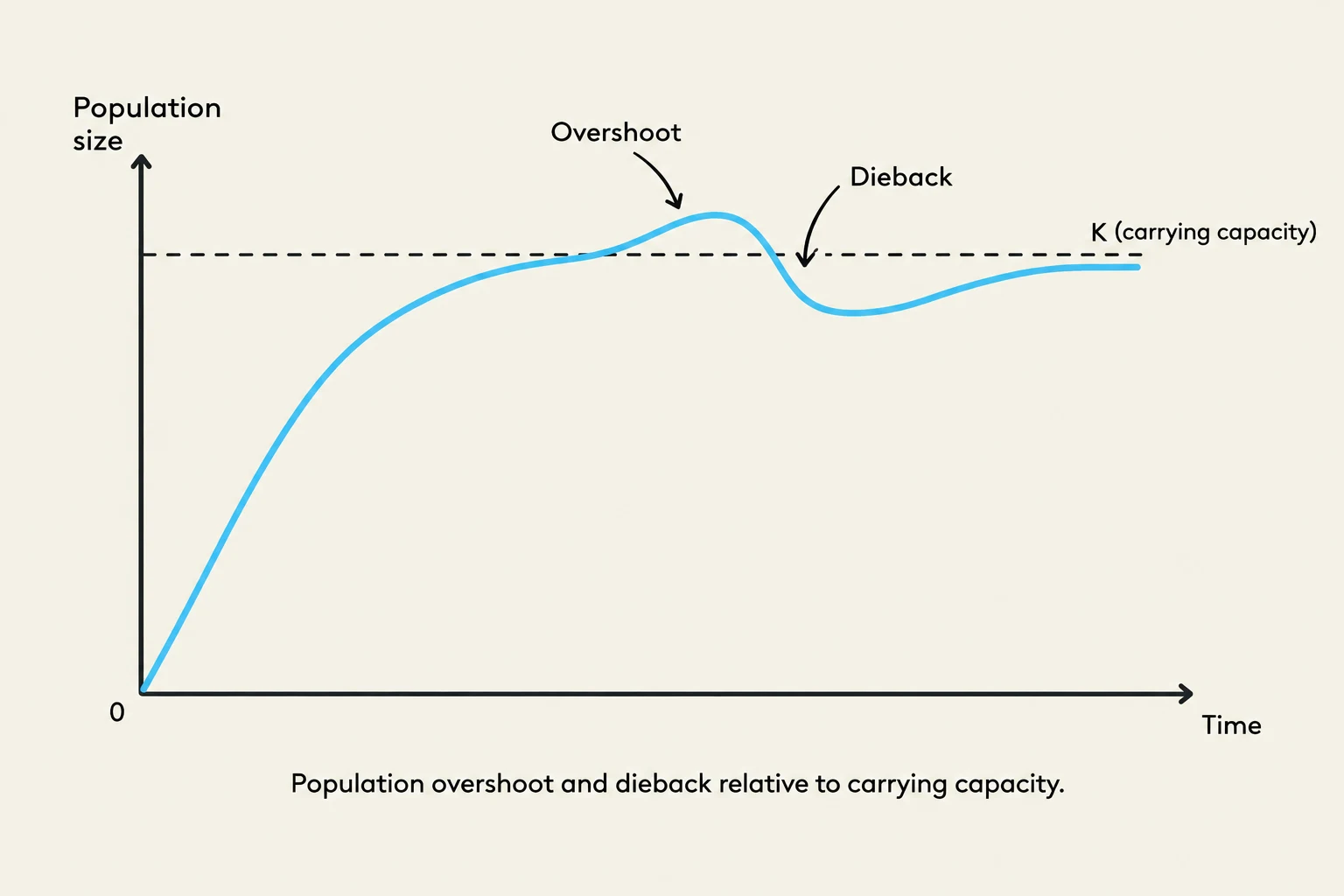
A graph illustrating population size over time, showing overshoot and dieback relative to carrying capacity (K).
At the heart of ecological stability is the concept of carrying capacity, often denoted as K. Carrying capacity represents the maximum population size that a specific environment can sustain indefinitely given the available resources, such as food, water, and habitat.
In an ideal scenario, a population grows until it reaches K and then stabilizes. However, biological systems are rarely perfectly stable. When a population grows too rapidly and exceeds its carrying capacity, a phenomenon known as population overshoot occurs. This overshoot often leads to resource depletion, where the population consumes resources faster than they can be replenished.
The consequence of such depletion is often a dieback—a catastrophic decline in population size. This sudden drop is typically driven by:
Famine due to lack of food.
Increased spread of disease.
Increased conflict over remaining resources.
Exam Tip: Remember that resource availability is finite over all scales of time. If the resource base shrinks, the population must respond through increased mortality or decreased fecundity (the reproductive rate) to return toward or below K.
Factors Influencing Population Growth
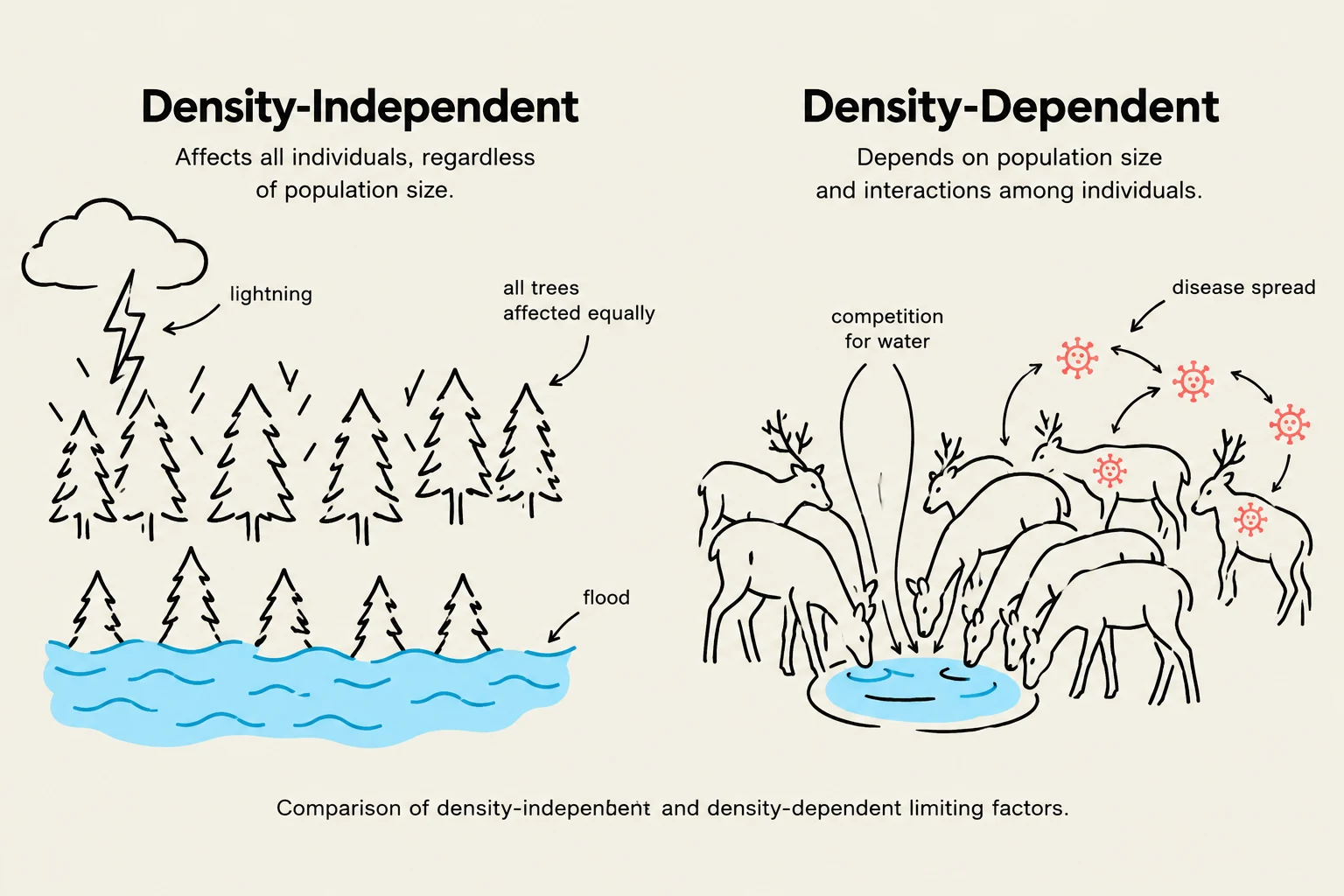
Comparison of density-independent and density-dependent limiting factors in ecology.
Population growth is not a random process; it is governed by specific environmental and biological factors. These are generally categorized into two types:
Density-Independent Factors
These are environmental events that affect a population regardless of how many individuals are present. Because they do not rely on population density, they can strike a small population just as easily as a large one. Examples include:
Natural disasters like storms and fires.
Extreme weather events such as heat waves or droughts.
Density-Dependent Factors
These factors intensify as the population density increases. As more individuals occupy the same space, the competition for essentials becomes more acute. Examples include:
Availability of food and clean water.
Transmission of diseases.
Competition for territory and space.
Reproductive Strategies and Survivorship
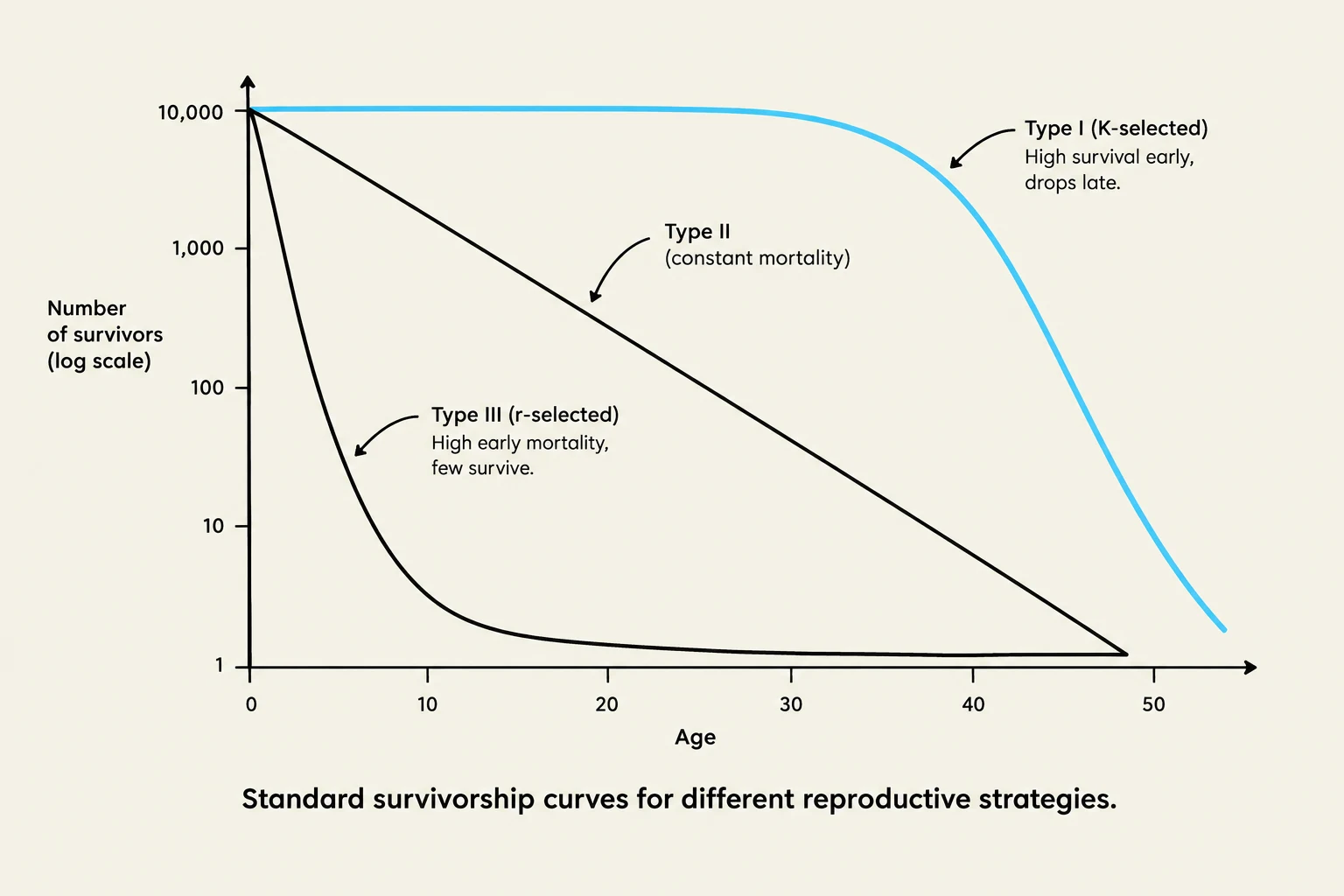
Standard survivorship curves for different reproductive strategies.
Different species have evolved different ways to ensure their offspring reach reproductive age. These strategies are often categorized by their "selection" type and can be visualized through survivorship curves.
r-selected species: These species focus on high growth rates. They typically produce many offspring but provide little to no parental care. This results in a Type III survivorship curve, where most individuals die very early in life, but the few that survive to adulthood have a high chance of reproduction.
K-selected species: These species focus on stability and competition. They produce fewer offspring but invest heavily in parental care. They typically follow Type I or Type II survivorship curves, characterized by high survival rates during early and middle life.
To predict the future of a population, ecologists use age structure diagrams. The shape of these diagrams—whether they are broad at the bottom (many young individuals) or narrow—provides immediate insight into whether a population is poised for rapid growth or decline.
Human Population Dynamics
Human populations are influenced by a complex web of social, economic, and biological factors. Unlike many other species, human growth is heavily impacted by policy, education, and healthcare.
Fertility and Mortality
A key metric in human demography is the Total Fertility Rate (TFR), which is the average number of children a woman will have. TFR is influenced by:
Educational opportunities for females.
Access to family planning.
The age at which women have their first child.
Government policies and marriage customs.
When the fertility rate reaches replacement levels, the population is considered relatively stable. Additionally, infant mortality rates—the rate at which infants die—are critical indicators of a population's health, closely tied to maternal nutrition and access to healthcare.
Malthusian Theory and Growth Calculation
Historically, thinkers like Thomas Malthus suggested that human population growth would eventually be limited by the Earth's carrying capacity and the availability of basic resources, a concept known as Malthusian theory.
To understand the speed of population change, we use the Rule of 70. This mathematical shortcut allows us to estimate the doubling time—how long it takes for a population to twice its current size—based on its percentage growth rate.
The formula is:
Doubling Time≈percentage growth rate70
Worked Example:
If a country has a steady annual population growth rate of $2%$, how long will it take for the population to double?
Using the Rule of 70:
Doubling Time≈270Doubling Time≈35 years
Summary Table: Human Population Drivers
Factor
Impact on Growth
High Female Education
Decreases TFR / Slows Growth
Access to Family Planning
Decreases TFR / Slows Growth
Improved Healthcare
Decreases Infant Mortality / Increases Growth
Improved Nutrition
Decreases Mortality / Increases Growth
Keep reading for free.
Create an account to finish this reading and make it part of your study routine.