For centuries, the structure of human society was defined by a vertical hierarchy. At the apex sat the monarch, whose authority was often justified by "Divine Right"—the belief that power flowed from God to the King, and only then to the people. However, the Enlightenment ushered in a radical paradigm shift. This shift moved the source of political legitimacy from the heavens to the earth, establishing that power resides not in a single ruler, but in the collective will of the citizenry. This article explores the two pillars of this transformation: Popular Sovereignty and Natural Rights.
The Concept of Popular Sovereignty
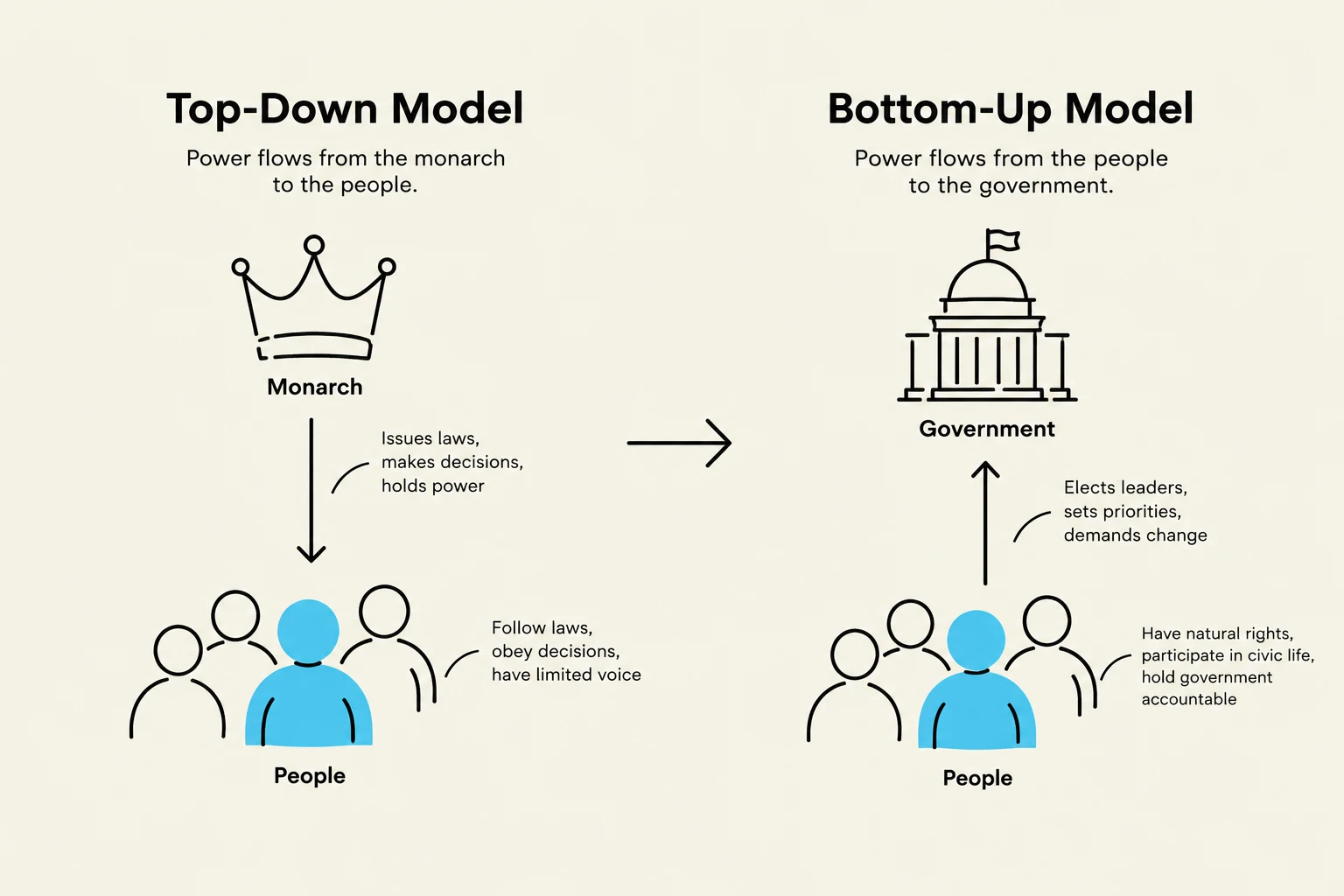
Popular sovereignty is the principle that the authority of a state and its government are created and sustained by the consent of its people, through their elected representatives. This concept fundamentally redefines the relationship between the ruler and the ruled. Under a monarchy, the people are "subjects" who owe obedience; under popular sovereignty, the people are "citizens" who possess agency.
This transition implies that government is not an end in itself, but a tool used by the people to achieve common goals. If a government fails to represent the will of the people, it loses its legitimacy. This idea was a driving force behind historical upheavals, such as the French Revolution, which sought to dismantle absolute rule in favor of a system where the nation itself held the power.
This diagram illustrates two models of governance: the Top-Down Model, where power flows from a monarch to the people, and the Bottom-Up Model, where power flows from the people to the government.
Exam Tip: When discussing popular sovereignty, always distinguish between "Direct Democracy" (where citizens vote on all laws) and "Representative Democracy" (where citizens elect officials to act on their behalf). Most modern states operate on the latter.
Natural Rights: The Inherent Claims of the Individual
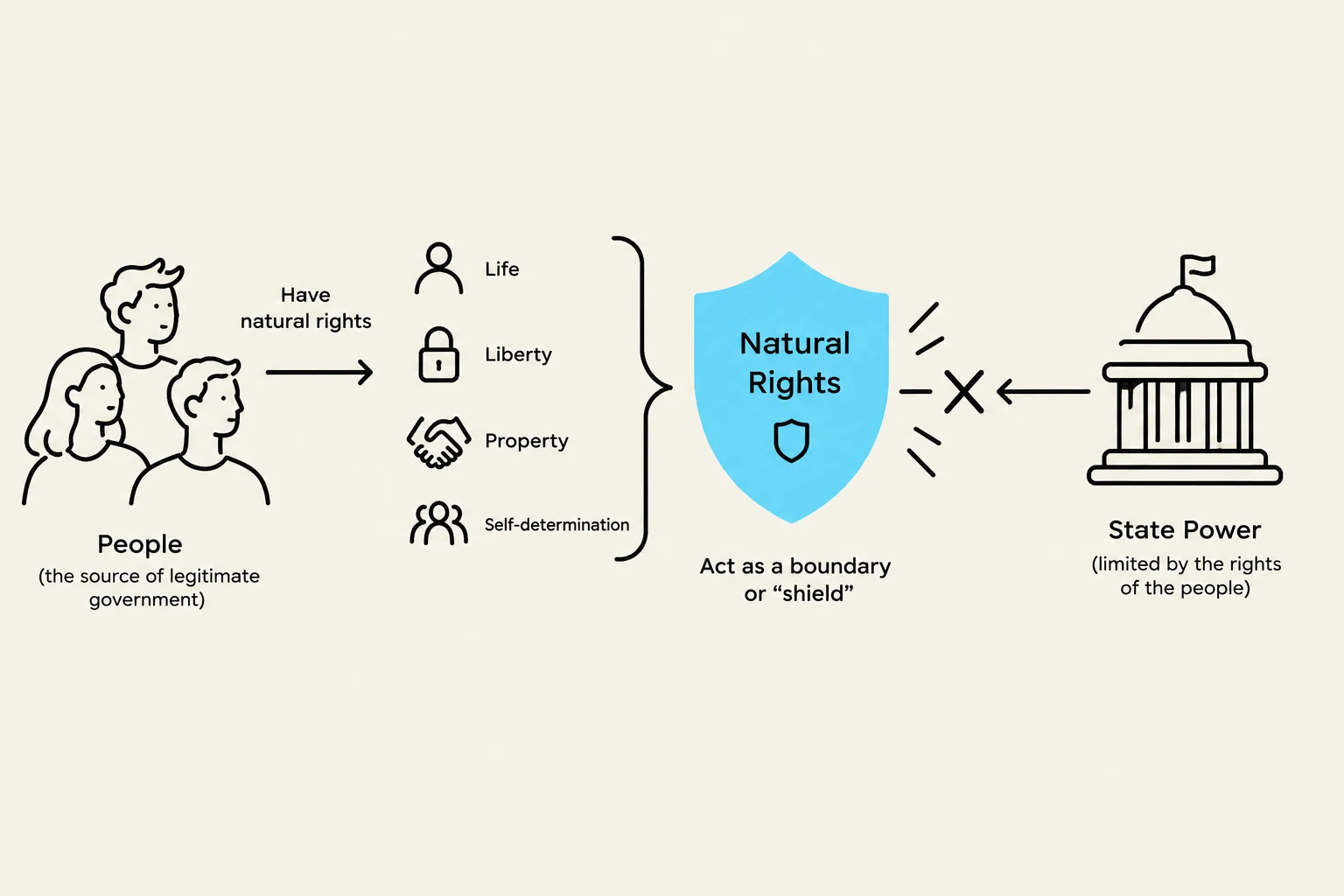
While popular sovereignty defines where power comes from, the theory of Natural Rights defines what that power is prohibited from doing. Natural rights are the idea that certain rights are inherent to all human beings by virtue of their humanity, independent of any laws, customs, or government decrees.
Philosophers of the Enlightenment argued that these rights are "inalienable," meaning they cannot be surrendered or taken away by a state. The most critical of these rights often include:
Life: The right to exist and be safe from arbitrary harm.
Liberty: The right to act, speak, and think without undue restraint.
Property: The right to own and control the fruits of one's labor.
The inclusion of property rights is particularly significant. In the transition from feudalism to modern capitalism, the ability to own land and assets without the arbitrary seizure of a monarch became a cornerstone of individual autonomy and economic stability.
This diagram illustrates the concept of natural rights as a boundary or shield limiting state power, originating from the people.
The Right to Resistance and the Social Contract
The intersection of popular sovereignty and natural rights creates a powerful mechanism for political change: the right to resistance. This is often explained through the framework of the Social Contract.
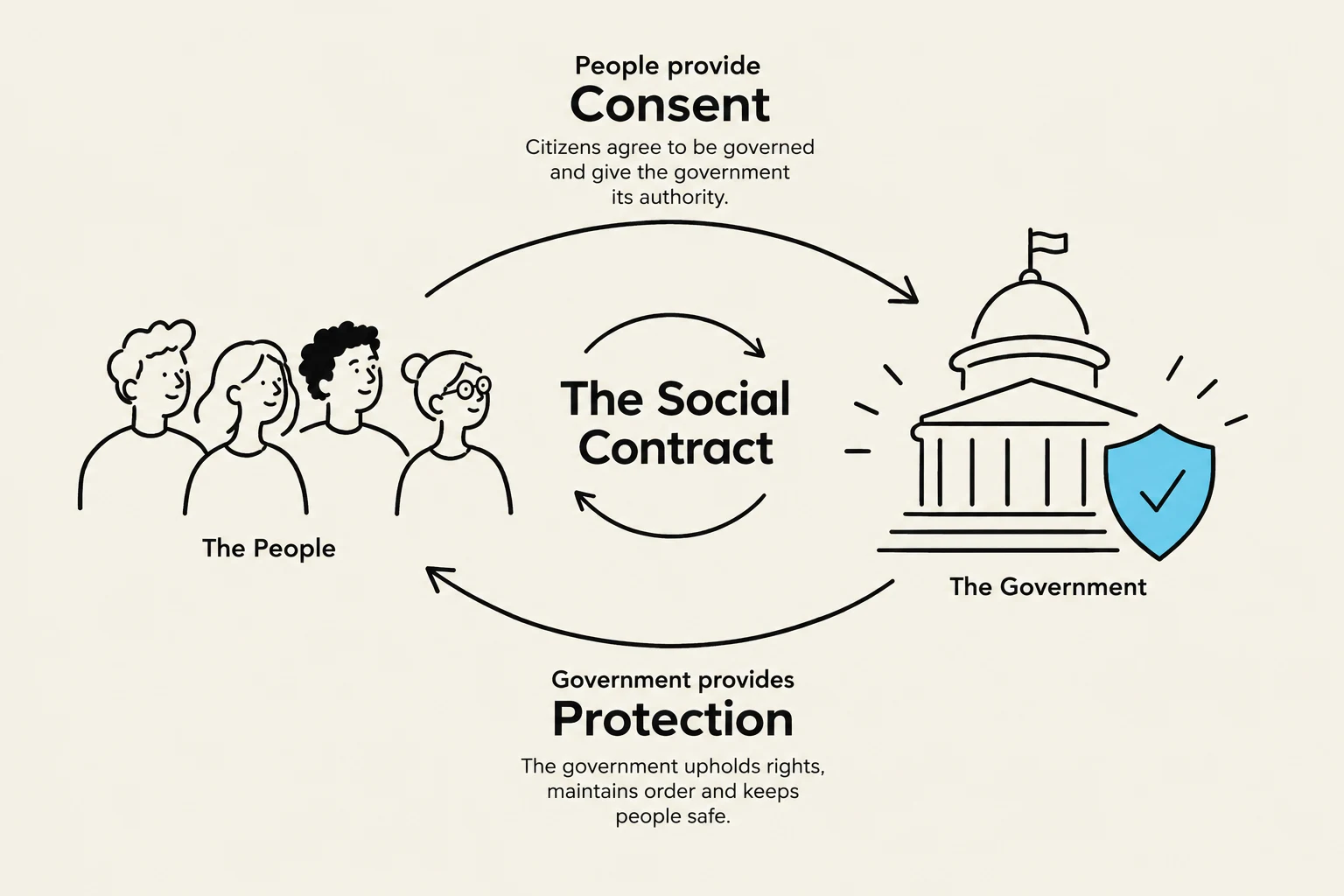
The Social Contract theory suggests that individuals agree to give up a portion of their absolute freedom to a government in exchange for the protection of their natural rights. This is a conditional agreement. If the government becomes tyrannical—meaning it ceases to protect the rights of the people and instead begins to violate them—the contract is considered broken.
When the contract is broken, the people have not only a right but often a perceived moral duty to resist oppression and establish a new government that respects their inherent liberties.
Legitimacy=Consent of the Governed+Protection of Natural Rights
This diagram illustrates the concept of the social contract, where people provide consent to the government in exchange for protection.
Worked Example: The Paradox of Liberty
Consider a hypothetical scenario where a government passes a law stating that all private property must be surrendered to the state to fund a massive military expansion.
Under Monarchy: The King could claim the right to seize property by divine decree, and the citizens would have no legal recourse.
Under Popular Sovereignty & Natural Rights:
The citizens would argue that the right to Property is a natural right.
They would claim the government has violated the Social Contract by failing to protect that right.
Therefore, the government's action is illegitimate, and the citizens may have the right to resist the law or replace the government.
Summary Table: Old vs. New Paradigm
Feature
Monarchical System (Old)
Popular Sovereignty (New)
Source of Power
Divine Right / Heredity
The People (Consent)
Status of Individuals
Subjects (Obedience)
Citizens (Agency)
Role of Law
Tool of the Ruler
Expression of the General Will
Rights
Granted by the State
Inherent to the Individual
Critical Thinking Question: If a majority of the people in a democracy vote to take away the rights of a minority, is that an exercise of popular sovereignty or a violation of natural rights? (Hint: Consider whether "the will of the people" can override "inalienable rights.")
Keep reading for free.
Create an account to finish this reading and make it part of your study routine.