This document explains methods for purifying polyclonal antibodies, including ammonium sulphate precipitation and immunoaffinity chromatography using antigen or Protein A, detailing their mechanisms, target regions, and specificity.
In the field of immunoanalysis, antibodies serve as critical tools for detecting and quantifying biological molecules. When an organism is exposed to an immunogen, it undergoes an adaptive immune response characterized by the production of antibodies by B-cell lineages.
The nature of this response depends on the timing of exposure. The primary immune response occurs upon the first exposure to an antigen; it typically features a lag period of approximately 7 days before IgG levels appear. In contrast, the secondary immune response occurs upon subsequent exposures, resulting in a shorter lag period and a more sustained, high-titer IgG response.
A Polyclonal Antibody (PAb) is produced when several different plasma cell "clones" secrete antibody molecules. Because each clone recognizes a different epitope on the target antigen, the resulting antiserum is heterogeneous, containing a mixture of different antibody molecules directed against various parts of the antigen. To utilize these antibodies in laboratory settings, they must often be extracted from the host's antiserum (the antibodies found in the serum after immunization) and purified to achieve the necessary specificity and concentration.
Depending on the intended application, the purification strategy varies. If the goal is simply to use high-titer antibodies in a diluted form, simple dilution of the serum may suffice. However, if the goal is to prepare pure antibodies or antibody-conjugates, more rigorous purification is required.
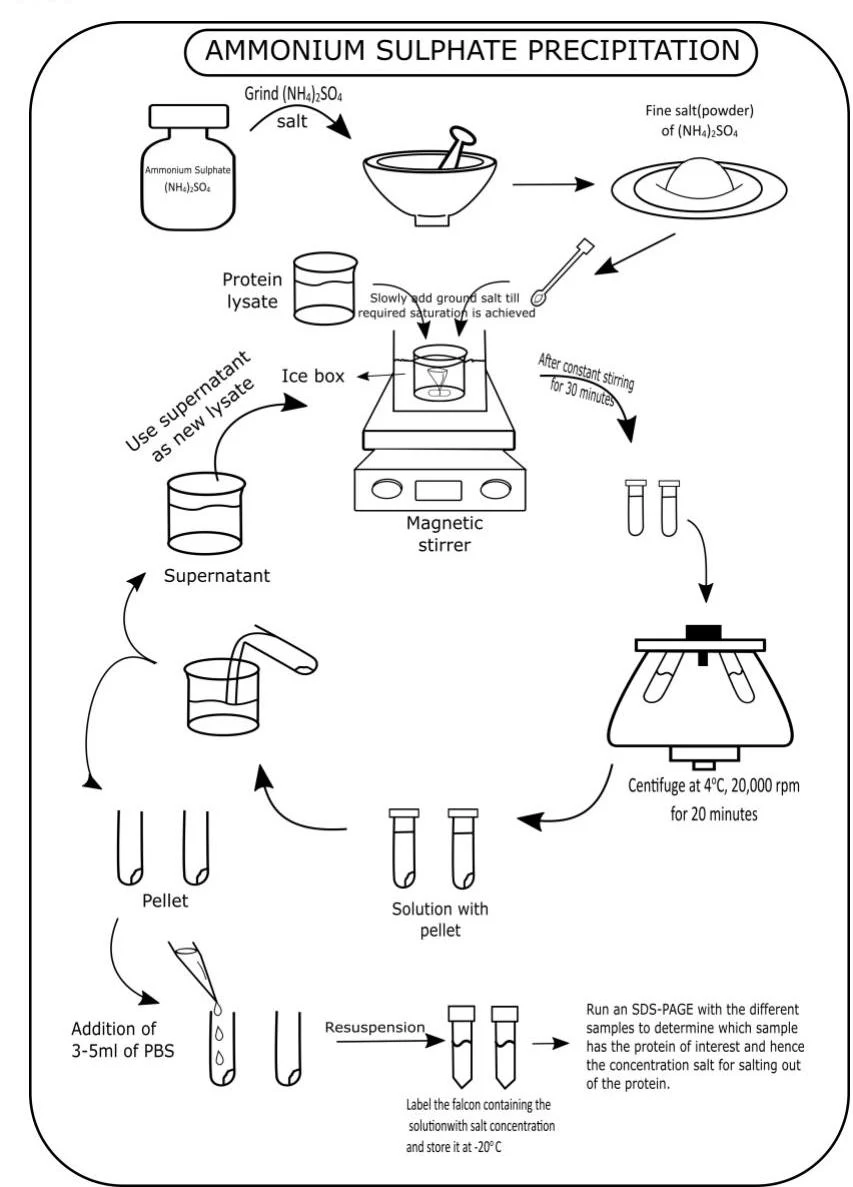
The first stage of intensive purification often involves ammonium sulphate precipitation. This technique exploits the solubility properties of proteins. By adding ammonium sulphate to the serum to reach a specific saturation level—commonly 40%—the target proteins (including antibodies) are induced to precipitate out of the solution.
The process generally follows these steps:
Saturation: Adding ammonium sulphate to the serum to reach the desired concentration.
Recovery: The resulting precipitate is collected using centrifugation.
Desalting: The precipitate undergoes dialysis to remove the excess ammonium sulphate and other residual salts, preparing the sample for more refined chromatography steps.
This diagram illustrates the process of ammonium sulfate precipitation, a common method for protein purification. It details steps such as grinding ammonium sulfate, preparing protein lysate, adding salt to achieve saturation, centrifugation, and resuspension, followed by SDS-PAGE analysis to determine protein concentration.
Study Tip: Remember that ammonium sulphate precipitation is a "bulk" purification method. It concentrates proteins but does not provide the high level of specificity offered by affinity-based methods.
To achieve high purity, researchers utilize Immunoaffinity Column Chromatography. This method relies on the highly specific biological affinity between an antibody and its target. There are two primary ways to approach this, depending on which part of the antibody is being targeted: the antigen-binding site or the structural constant region.
1. Antigen-Based Purification
In antigen-based purification, the specificity is driven by the antibody's ability to recognize its specific epitope.
The process involves using a chromatography matrix, such as cyanogen bromide activated Sepharose 4B, which has been chemically prepared to allow the attachment of a specific antigen. When the antiserum is passed through the column, the specific antibodies bind to the immobilized antigen via their Fab or F(ab)2 regions (the "arms" of the Y-shaped antibody).
This diagram illustrates the process of antigen-affinity purification, where antigen-coated beads are used to capture specific antibodies from a serum sample. The captured antibodies are then eluted using an acidic solution.
Once the target antibodies are bound, unbound serum proteins are washed through the column using a buffer. To recover the purified antibodies, an elution buffer is applied. A common method is using a glycine buffer at a low pH (e.g., pH 3). This change in pH triggers antigen-antibody dissociation, breaking the non-covalent bonds between the antibody and the antigen and allowing the pure antibody to flow out of the column.
2. Protein A-Based Purification
While antigen-based methods target the binding site, Protein A-based purification targets the structural "tail" of the antibody.
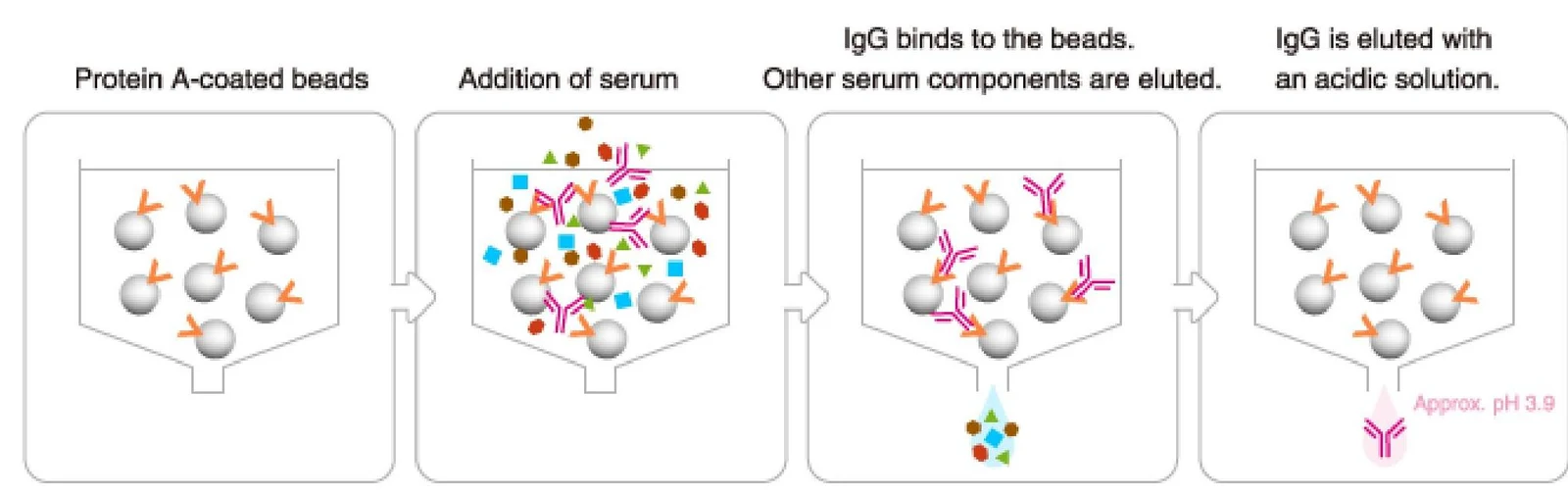
In this method, a Sepharose matrix is coated with Protein A, a bacterial protein that has a natural, high affinity for the IgG Fc region (the constant "stem" of the antibody).
This diagram illustrates the process of affinity chromatography using Protein A-coated beads to isolate IgG antibodies from serum. The process involves binding IgG to the beads, eluting other serum components, and finally eluting the purified IgG with an acidic solution at approximately pH 3.9.
The advantages and steps are as follows:
Binding: As the mixed protein solution passes through the column, all IgG antibodies bind to the Protein A via their Fc regions, while other proteins pass through.
Elution: Similar to the antigen method, the bound antibodies are released by altering the pH of the elution buffer, which causes the antibody to dissociate from the Protein A.
Summary of Purification Strategies
Feature
Ammonium Sulphate
Antigen-Affinity
Protein A-Affinity
Mechanism
Solubility/Salting out
Antigen-Antibody binding
Protein A-Fc binding
Target Region
Bulk proteins
Fab or F(ab)2
IgG Fc region
Specificity
Low
Very High
High (for IgG)
Primary Use
Initial concentration
Isolating specific clones
General IgG purification
By combining these techniques—starting with bulk precipitation and moving toward highly specific affinity chromatography—scientists can isolate high-titre, pure polyclonal antibodies suitable for sensitive downstream applications in diagnostics and research.
Keep reading for free.
Create an account to finish this reading and make it part of your study routine.