An introduction to political science as a discipline, exploring its scientific methodology, epistemological foundations, and the research process involved in studying political phenomena.
What does it mean to "study politics"? While many people view politics as a matter of opinion, debate, or news cycles, scholars approach it through a structured framework known as political science. This discipline does not merely observe events; it seeks to understand the underlying mechanisms of power, resource allocation, and systemic behavior using a rigorous methodology. By applying a scientific approach, political scientists aim to move beyond mere description toward a reliable body of knowledge that can explain and even predict political phenomena.
Defining the Field: Politics and Political Science
To understand the science, we must first define the subject. Politics is often described as the "authoritative allocation of values and resources in society". Political science, meanwhile, is the systematic study of "who gets what, when, and how".
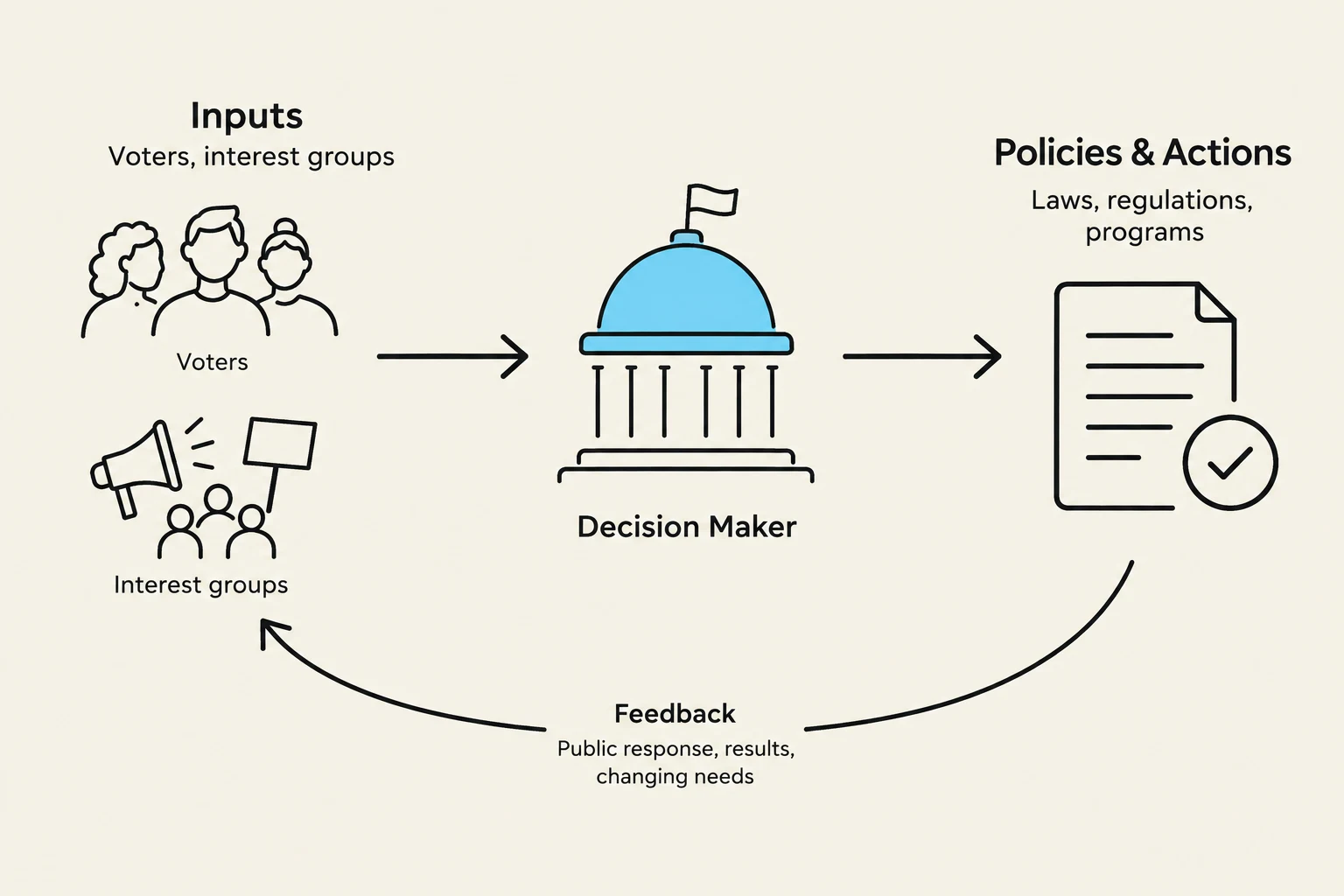
Researchers often view this through the lens of a political system, a continuous feedback loop where "inputs" from voters and groups are processed by decision-makers into "outputs" (policies), which then affect the environment and trigger new inputs. Political analysis is the specific tool used by scholars to determine exactly how and why these phenomena occur.
This diagram illustrates a simplified model of the policy-making process, showing how inputs from voters and interest groups influence a decision-maker, leading to policies and actions, with feedback from the public influencing future inputs.
Epistemology and the Scientific Approach
At the heart of any scientific discipline lies epistemology, which is the study of the foundations of knowledge. Epistemology asks: How do we know what we know? How do we distinguish truth from falsehood?
The scientific approach is defined not by what it studies, but by its methodology—the system of explicit rules and procedures used to evaluate claims. This is distinct from other ways of acquiring knowledge:
Authoritarian: Knowledge is accepted because it comes from a socially or politically powerful source (e.g., a monarch or celebrity).
Mystical: Knowledge is obtained through supernatural authorities or signs.
Rationalistic: Knowledge is acquired through strict adherence to the formal rules of logic, independent of observable phenomena.
In contrast, the scientific approach relies on empirical knowledge—knowledge derived from perceptions, experiences, and observations. It is built upon several fundamental assumptions: nature is orderly, nature is knowable, and natural phenomena have natural causes.
Exam Tip: Remember that science is united by methodology, not subject matter. A researcher is rejected not because their topic is "unimportant," but because their methodology is unsound.
Explaining the World: Induction and Deduction
The ultimate goal of social science is to produce a reliable body of knowledge that allows us to describe, explain, and predict phenomena. Explanation is one of the most critical components, and it generally follows two logical paths:
Deductive Explanation
Deductive reasoning moves from the general to the specific. In this model, a phenomenon is explained by demonstrating that it can be logically inferred from an established general law. For example, if we accept the general law that "political parties act rationally to win office," we can deduce that a candidate will moderate their position during a general election to appeal to more voters.
Inductive or Probabilistic Explanation
Inductive reasoning moves from the specific to the general. Because social science rarely deals with universal laws (unlike physics or chemistry), most explanations are inductive or probabilistic. This involves making specific observations and then establishing tendencies or probabilities. For instance, we might observe that "severe economic conditions usually lead to more government spending." While this is a high-probability tendency, it is not a guaranteed law.
This diagram illustrates the difference between deductive and inductive reasoning. Deductive reasoning starts with a general law or theory and applies it to a specific case, leading to a prediction. Inductive reasoning begins with specific observations, identifies patterns, and forms a general law or conclusion.
Scientific Progress: Normal vs. Revolutionary Science
Science is not a static collection of facts; it is a dynamic process. The philosopher Thomas Kuhn described this through the distinction between "normal" and "revolutionary" science:
Normal Science: This involves the routine verification of the dominant theory (the "paradigm") of a given period. It is often described as "puzzle-solving" within the existing rules.
Revolutionary Science: This occurs when an abrupt development of a rival paradigm takes place. A new theory is only accepted once it can explain or predict phenomena better than the previous theory (e.g., the shift from a geocentric to a heliocentric model of the solar system).
The Research Process
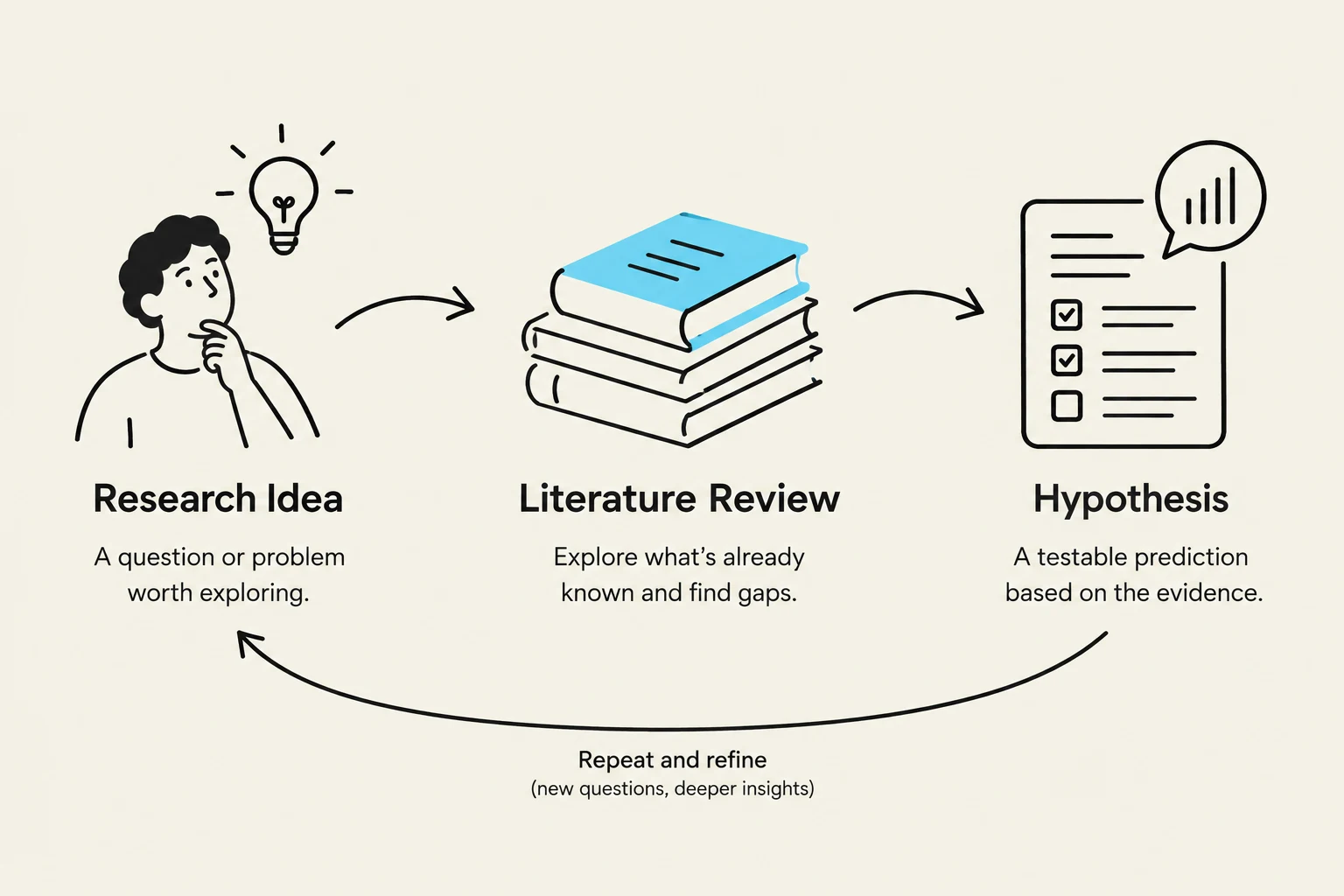
Scientific inquiry follows a cyclical research process. While the process can vary, it generally follows these key stages:
Formulating the Research Idea: Identifying a question that can be answered using the scientific method.
Literature Review: Investigating what research has already been done to ensure the question is original and to understand existing expert debates. Researchers often use the "snowball technique," where one recent article leads to its references, which lead to more sources.
Hypothesis Formulation: Drawing specific, testable relationships from existing theories or observations.
Defining and Operationalizing Concepts: Defining what a term means (the concept) and determining how it will be measured numerically (operationalization).
Data Collection and Analysis: Gathering data (via surveys or existing datasets) and applying statistical techniques to test the hypothesis.
Drawing Conclusions and Reporting: Determining if the evidence supports the hypothesis and sharing the results through a research report to allow for peer critique and replication.
This diagram illustrates the iterative process of research, starting with a research idea, followed by a literature review, and leading to the formation of a hypothesis, which can then be repeated and refined.
The Debate: Is Political Science "Real" Science?
The scientific nature of political science is a subject of intense debate, particularly regarding federal funding.
Critics, such as those in the U.S. Congress, have argued that political science does not meet the rigorous standards of "hard" sciences like physics or chemistry. They contend that social behavior is too subjective, lacks the reproducibility of laboratory experiments, and is often influenced by value judgments.
Proponents argue that while the subject matter (humans) is different, the mechanisms of evaluation are the same. They point to the significant public benefits of the field, such as understanding the causes of terrorism, the drivers of economic growth, and the mechanics of democracy. They maintain that political science provides the rigorous, evidence-based analysis that journalists and policy analysts rely on to make sense of the world.
Keep reading for free.
Create an account to finish this reading and make it part of your study routine.