Explains active transport across the plasma membrane, including direct (ATPase pumps) and indirect (co-transport) mechanisms, the role of ATP, and the creation of electrochemical gradients.
In the study of cell biology, understanding how molecules cross the plasma membrane is fundamental to understanding life itself. While some molecules move passively down their concentration gradients, cells must often move substances "uphill"—from areas of low concentration to areas of high concentration. This process, known as active transport, is essential for maintaining the non-equilibrium concentrations of ions and nutrients required for cellular survival, waste removal, and the maintenance of a distinct internal environment.
The Energetics of Transport: ATP and Chemical Reactions
To move substances against their natural gradient, the cell must perform work, which requires an input of energy. This energy is primarily provided by Adenosine Triphosphate (ATP), often referred to as the "energy currency of the cell".
The relationship between energy and transport can be understood through the lens of thermodynamics, specifically by looking at metabolic processes:
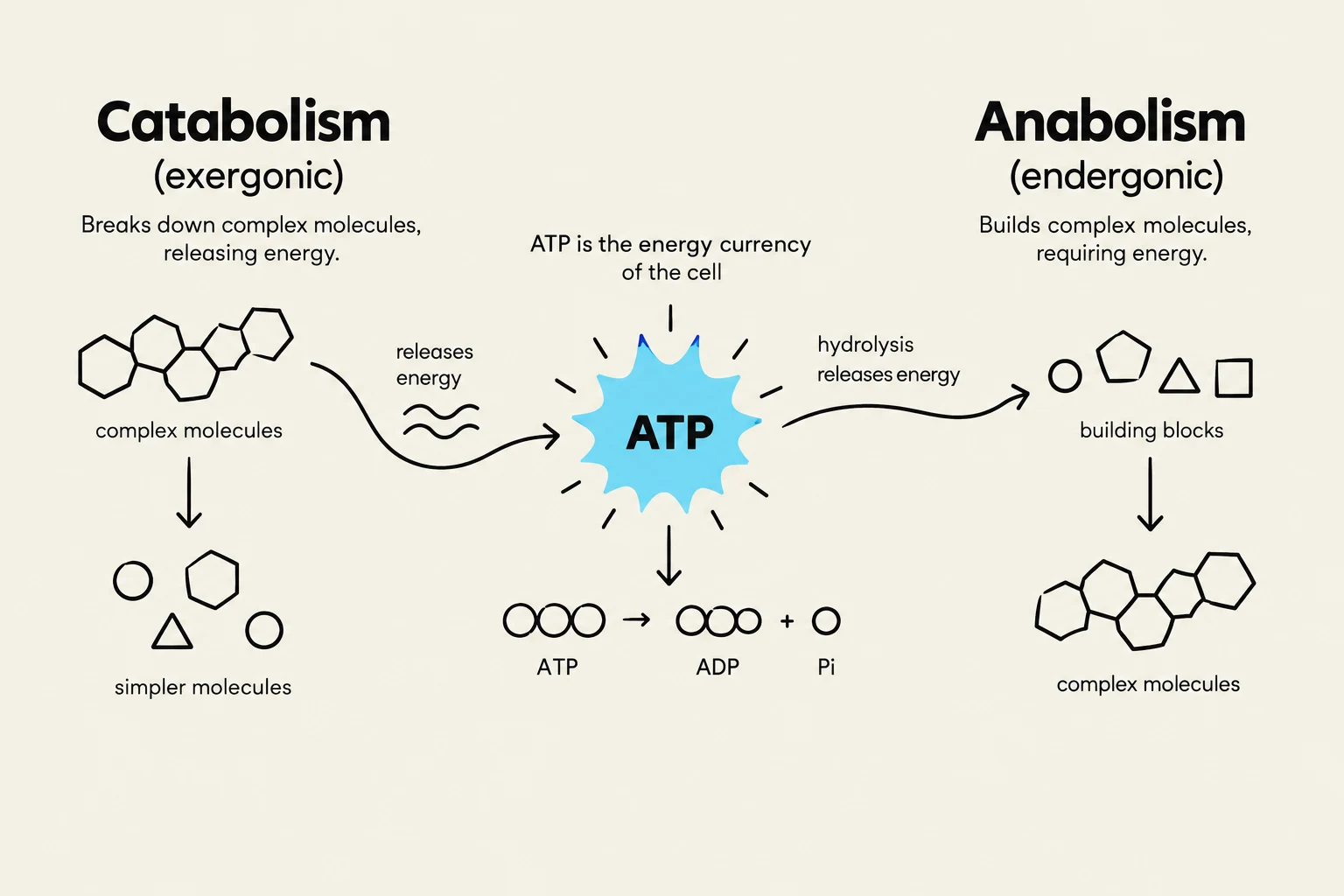
Catabolism: The process of breaking down complex chemicals to release energy. These are exergonic reactions, meaning they release energy.
Anabolism: The process of building larger, more complex molecules, which requires an input of energy. These are endergonic reactions, meaning they require energy to proceed.
Active transport is an endergonic process because it moves solutes against their gradient. To make this possible, the cell couples the endergonic transport with an exergonic process—most commonly the hydrolysis of ATP. When ATP is hydrolyzed, the released energy "powers" the transport protein to change its shape and move the solute.
Exam Tip: Remember the distinction between the two types of reactions. Exergonic = Energy out (releases); Endergonic = Energy in (requires). Active transport is endergonic and must be coupled with an exergonic reaction like ATP hydrolysis to function.
This diagram illustrates the processes of catabolism and anabolism, which are fundamental to cellular energy metabolism. Catabolism breaks down complex molecules into simpler ones, releasing energy, often in the form of ATP. Anabolism uses energy, typically from ATP, to build complex molecules from simpler building blocks.
Direct Active Transport: The Role of ATPase Pumps
Active transport is classified into two main categories based on the energy source and the number of solutes involved: Direct (Primary) and Indirect (Secondary).
Direct active transport occurs when the movement of a solute is directly linked to an exergonic chemical reaction, typically the hydrolysis of ATP. The proteins responsible for this are known as ATPase pumps (or transport ATPases). These pumps are specialized membrane proteins that act as enzymes to catalyze the breakdown of ATP to drive transport.
There are four major types of ATPase pumps:
P-type ATPase pumps
V-type ATPase pumps
F-type ATPase pumps
ABC-type ATPase pumps
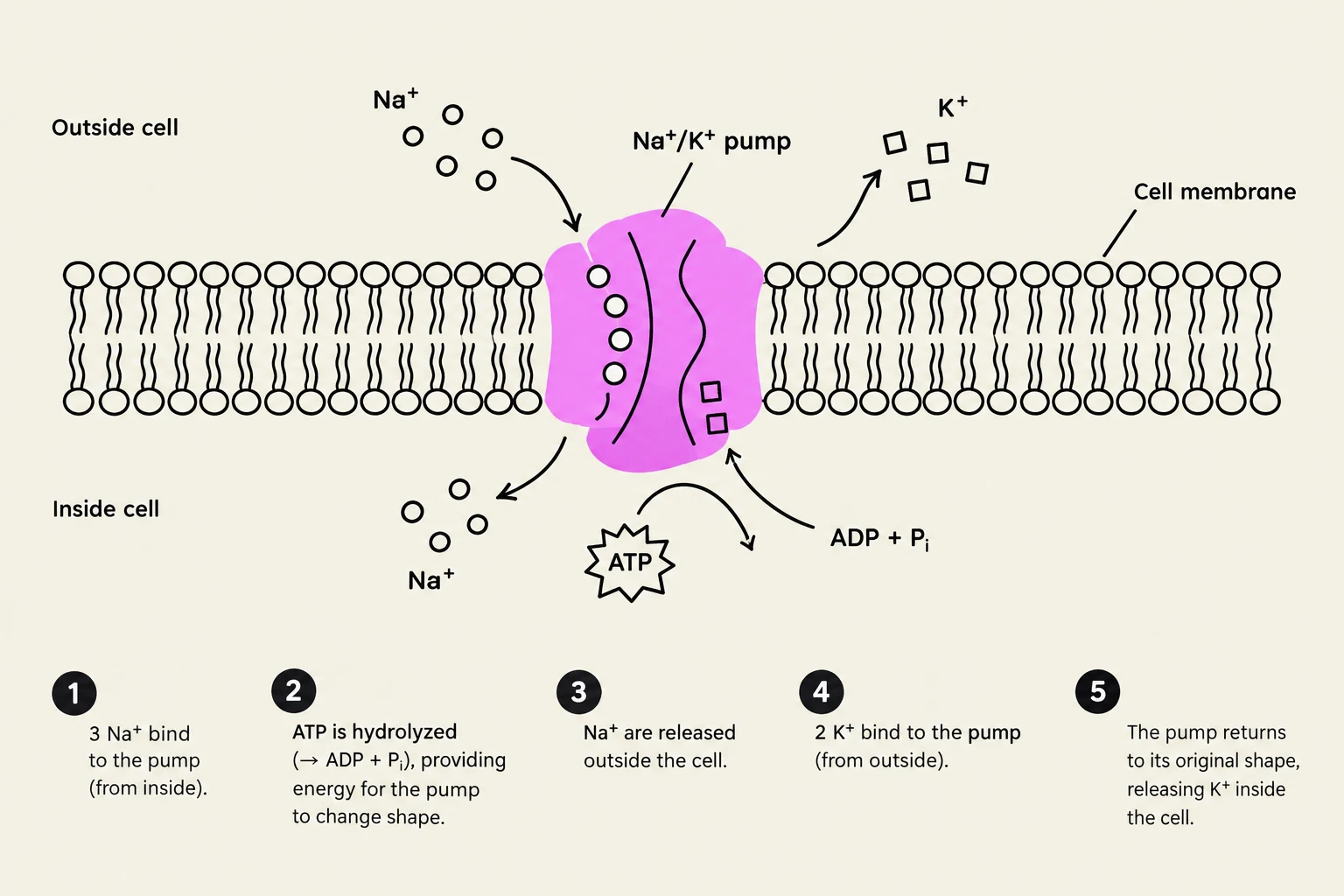
A classic and vital example of direct active transport is the Na+/K+ Pump (a P-type ATPase). This pump is essential for maintaining the electrochemical gradient in cells. In a single cycle, the pump moves three sodium ions (Na+) out of the cell and two potassium ions (K+) into the cell.
The sodium-potassium pump (Na+/K+-ATPase) is an enzyme and transporter protein found in the plasma membrane of all animal cells. It uses ATP to move sodium ions (Na+) out of the cell and potassium ions (K+) into the cell, maintaining electrochemical gradients across the cell membrane.
Indirect Active Transport: Co-transport Mechanisms
Unlike direct transport, indirect active transport (also known as secondary active transport) does not use ATP directly to move a specific solute. Instead, it relies on the energy stored in an electrochemical gradient created by primary active transport.
In this mechanism, two solutes are transported simultaneously. One solute moves "downhill" (from high to low concentration), providing the energy to pull the second solute "uphill" (from low to high concentration). Depending on the direction of movement, this is classified as:
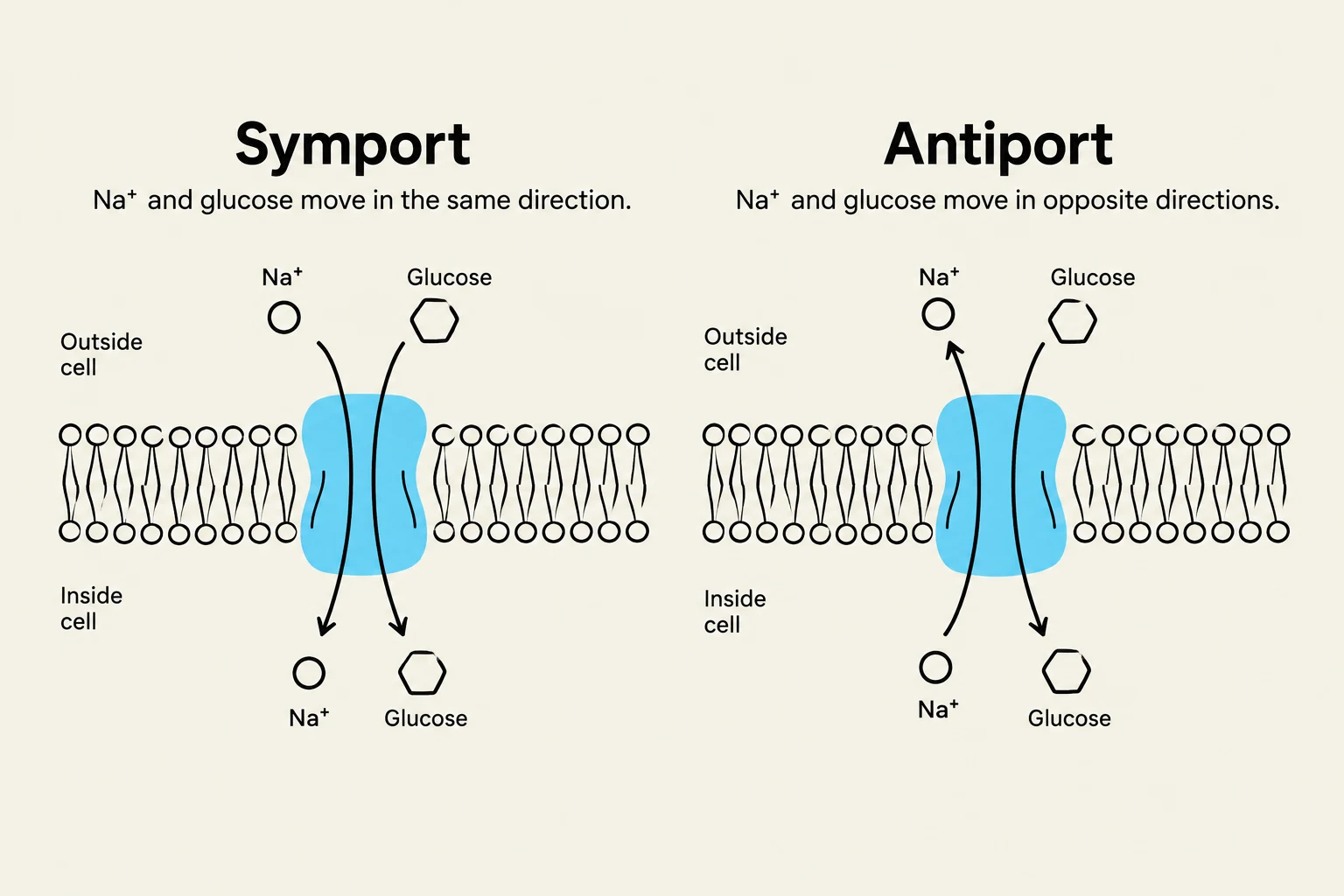
Symport: Both solutes move in the same direction.
Antiport: The solutes move in opposite directions.
Real-World Examples of Indirect Transport
Na+ Dependent Glucose Transporter (SGLT): In the cells lining the intestine, glucose must be absorbed even when its external concentration is low. The Na+/K+ pump creates a high concentration of Na+ outside the cell. The SGLT protein uses the "downhill" flow of Na+ into the cell to pull glucose "uphill" into the cell via symport.
Sodium-Calcium Exchanger (NCX): Found in cardiac cells, this mechanism uses the Na+ gradient to move calcium ions. It functions via antiport, where Na+ moves into the cell to drive the removal of Ca2+ out of the cell.
Diagrams illustrating symport and antiport mechanisms of ion and glucose transport across a cell membrane.
The Electrochemical Gradient and Membrane Potential
The continuous work of active transport pumps and the presence of "leaky" ion channels create an electrochemical gradient. This gradient is determined by two factors:
Solute concentration: The difference in the amount of a substance across the membrane.
Electrical gradient: The difference in charge across the membrane.
Because ion channels (specifically "leak channels") are always open, ions like K+ can diffuse out of the cell. As positive potassium ions leave, they leave behind unbalanced negative ions (anions), resulting in a negative resting membrane potential inside the cell.
This electrical state is crucial for excitable cells, such as neurons, skeletal muscle cells, and cardiac muscle cells, which rely on rapid changes in membrane potential to transmit signals. To prevent the cell from reaching equilibrium (which would result in cell death), the Na+/K+ pump works nonstop to restore these gradients.
Summary Table: Transport Comparison
Feature
Facilitated Diffusion
Active Transport
Direction
High → Low (Downhill)
Low → High (Uphill)
Energy Required?
No
Yes (ATP)
Gradient
Along gradient
Against gradient
Goal
Reach equilibrium
Maintain non-equilibrium
Keep reading for free.
Create an account to finish this reading and make it part of your study routine.