Explores the vital role of plants in human nutrition, detailing macronutrients like carbohydrates, proteins, and fats, and micronutrients such as vitamins and minerals. Discusses energy measurement, nutrient categories, and the structure of various carbohydrates, fibers, amino acids, and lipids.
Human survival and health are deeply intertwined with the plant kingdom. Plants serve as the primary source for the majority of human nutritional requirements. To maintain bodily functions and prevent deficiency diseases—which can cause widespread negative effects across various biological systems—humans must consume a balanced diet of macronutrients and micronutrients.
Understanding Energy and Nutrients
Before diving into specific nutrients, it is essential to understand how we measure energy intake. Energy is measured in Calories (C) or kilocalories (kcal). In nutritional contexts, 1 Calorie (C) is equivalent to 1 kilocalorie (kcal).
The scientific definition of a simple calorie (c) is the amount of energy required to raise the temperature of 1g of water by 1∘C. Therefore, the relationship is:
1000 c=1 Calorie (C)=1 kcal
Nutrients are categorized into two main groups:
Macronutrients: Required in large amounts to provide energy and structural components. These include carbohydrates, proteins, and fats (lipids).
Micronutrients: Required in smaller amounts for regulatory functions. These include vitamins and minerals.
Carbohydrates: The Primary Energy Source
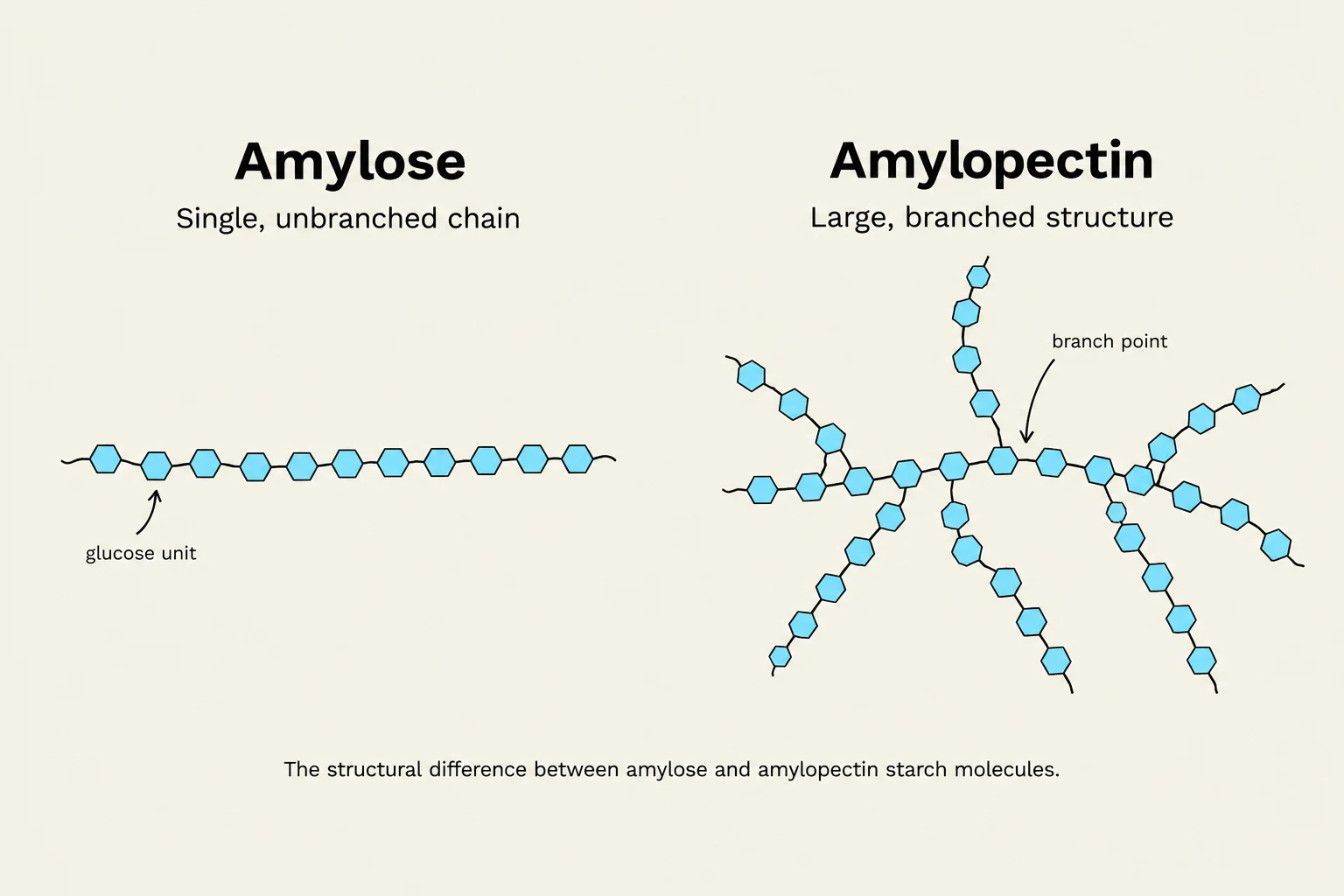
This illustration shows the structural difference between amylose, a single unbranched chain of glucose units, and amylopectin, a large branched structure of glucose units with branch points.
Carbohydrates are a major macronutrient, providing approximately 4 kcal/g of energy. They are classified based on their molecular complexity:
Monosaccharides
These are single sugar units with the general chemical formula C6H12O6.
Glucose: The primary fuel for cellular respiration.
Fructose: Commonly known as fruit sugar.
Disaccharides
Disaccharides consist of two monosaccharides joined together:
Sucrose (table sugar): Glucose + Fructose.
Maltose (beer sugar): Glucose + Glucose.
Lactose (milk sugar): Glucose + Galactose.
Polysaccharides
Polysaccharides are large chains of repeating monosaccharide units.
Starch: The primary energy storage molecule in plants. Chemically, starch consists of two components: amylose (an unbranched chain) and amylopectin (a highly branched chain). Because amylopectin is broken down more rapidly, foods with higher amylopectin levels have a higher glycemic index.
Glycogen: The storage polysaccharide found in animals.
Cellulose: A structural component in plant cell walls.
Exam Tip: If you see a microscopic matrix of glucose molecules attached in both horizontal and vertical formations, you are likely looking at cellulose.
Dietary Fibre
Fibre is a critical component of plant-based nutrition and is categorized by its solubility:
Insoluble Fibre: Includes cellulose (the most abundant carbohydrate), hemicelluloses, and lignin found in plant cell walls. It is indigestible by humans and functions to speed the passage of waste through the colon, which may reduce the risk of colon cancer.
Soluble Fibre: Includes pectins, gums, and mucilage. These are fermented by bacteria in the colon to produce butyric acid, which helps lower blood cholesterol levels.
Proteins and Amino Acids
Proteins are large, complex molecules used for structural support, regulation, and defense. They are composed of subunits called amino acids joined by peptide bonds.
There are 20 naturally occurring amino acids. Humans can synthesize 11 of these (the nonessential amino acids), but 9 must be obtained through the diet (the essential amino acids). Because essential amino acids cannot be stored, a lack of them in the diet leads to deficiency diseases.
Complete Proteins: Contain all essential amino acids in the correct proportions (mostly animal sources).
Incomplete Proteins: Deficient in one or more essential amino acids (all plant sources).
Nutritional Strategy: To meet protein needs on a plant-based diet, combine complementary proteins. For example, beans are low in methionine but adequate in lysine, while corn is low in lysine but adequate in methionine.
Fats (Lipids)
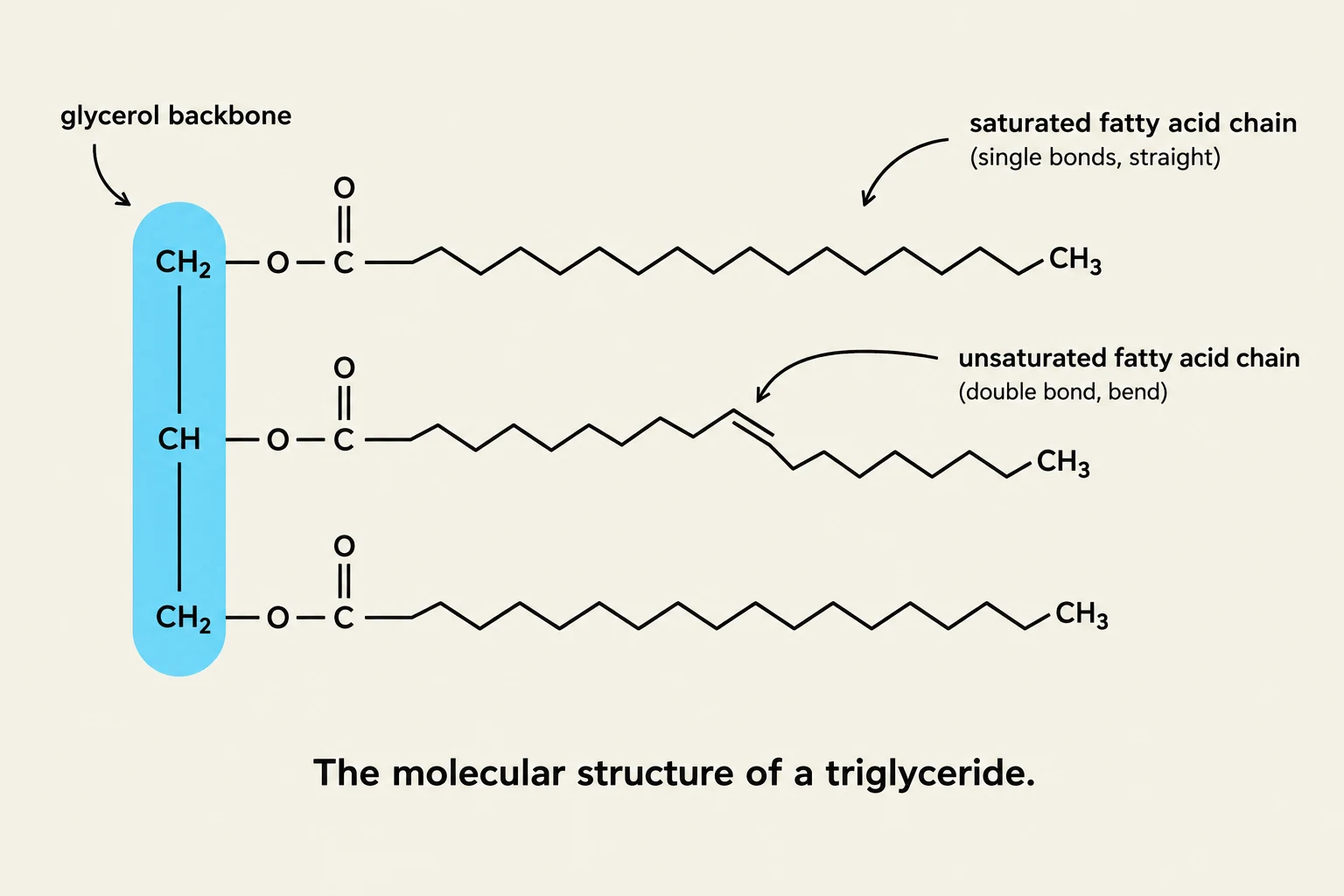
The molecular structure of a triglyceride, showing a glycerol backbone attached to saturated and unsaturated fatty acid chains.
Lipids are a diverse group of molecules, including waxes, triglycerides, phospholipids, and steroids; their only commonality is that they are insoluble in water.
Triglycerides are composed of one glycerol molecule and three fatty acids. They are categorized as:
Saturated Fatty Acids: Contain only single bonds and the maximum number of hydrogen atoms; they are typically solid at room temperature (e.g., animal fats, butter).
Unsaturated Fatty Acids: Contain one or more double bonds.
Monounsaturated: One double bond.
Polyunsaturated: Two or more double bonds.
Micronutrients: Vitamins and Minerals
Vitamins
Vitamins are organic compounds essential for health. They are divided into two types:
Fat-Soluble (A, D, E, K): Stored in fatty tissues; can reach toxic levels if over-consumed.
Vitamin A: Essential for vision; deficiency causes night blindness.
Vitamin D: Regulates calcium and phosphorus; deficiency causes rickets in children.
Water-Soluble (C and B-complex): Not stored in the body and easily excreted in urine.
Vitamin C: Essential for collagen synthesis; deficiency causes scurvy.
Vitamin B12 (Cobalamin): Found only in animal products; deficiency causes pernicious anemia.
Folic Acid (B9): Deficiency can lead to neural tube defects in fetuses.
Minerals
Minerals are inorganic elements required for various bodily functions:
Calcium: Essential for bones, teeth, and nerve transmission.
Iron: Vital for blood; deficiency causes anemia.
Iodine: Required for thyroid hormone production; deficiency can cause a goiter (enlarged thyroid gland).
Starchy Staples and Plant Storage
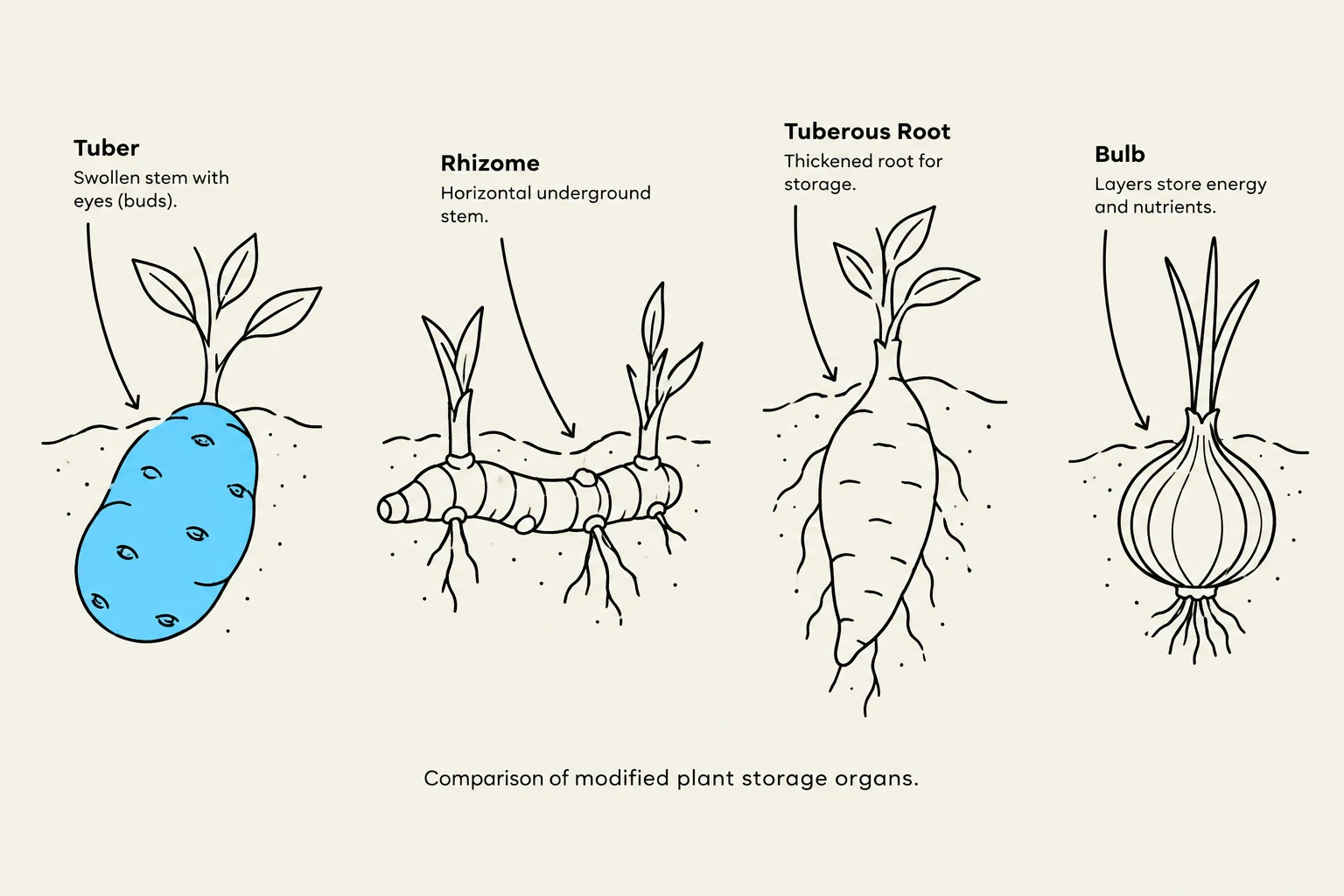
Comparison of modified plant storage organs.
Many plants store energy in modified underground organs, which serve as vital food reserves. These include:
Modified Stems: Rhizomes, tubers (like the white potato), bulbs, and corms (like taro).
Modified Roots: Tuberous roots (like sweet potatoes and cassava) and taproots.
While these staples are high in carbohydrates, they are often low in protein and fat. For instance, cassava is a major source of calories in the tropics but is very low in protein (<1%), which can lead to protein deficiency diseases like kwashiorkor if not supplemented.
Keep reading for free.
Create an account to finish this reading and make it part of your study routine.