Physiology of Excitable Cells: Membrane Potential and Ion Movement
Explore the fundamental concepts of membrane potential in excitable cells, including resting membrane potential, electrochemical gradients, and the roles of ion channels and the sodium-potassium pump in maintaining cellular electrical properties.
In the study of biology, most cells maintain a stable internal environment, but a specialized group of cells possesses the unique ability to respond to stimuli by rapidly changing their electrical properties. These are known as excitable cells. Primarily comprising neurons and muscle cells (such as skeletal muscle), these tissues can be stimulated by electrical, chemical, or mechanical signals to perform specific functions, such as transmitting a thought or contracting a limb. To understand how these cells "fire," we must first understand the electrical baseline they maintain: the membrane potential.
The Foundation: Membrane Potential
Every living cell maintains a membrane potential, which is defined as the charge difference across the cell membrane due to the unequal distribution of ions on either side. If this difference ever reaches zero, the cell is effectively dead.
This potential is driven by two primary forces acting on ions:
Concentration Gradients (Chemical Gradients): The tendency of ions to move from an area of high concentration to an area of low concentration.
Electrical Gradients: The tendency of charged particles to move toward an opposite charge (opposites attract).
When these two forces are combined, they form the electrochemical gradient.
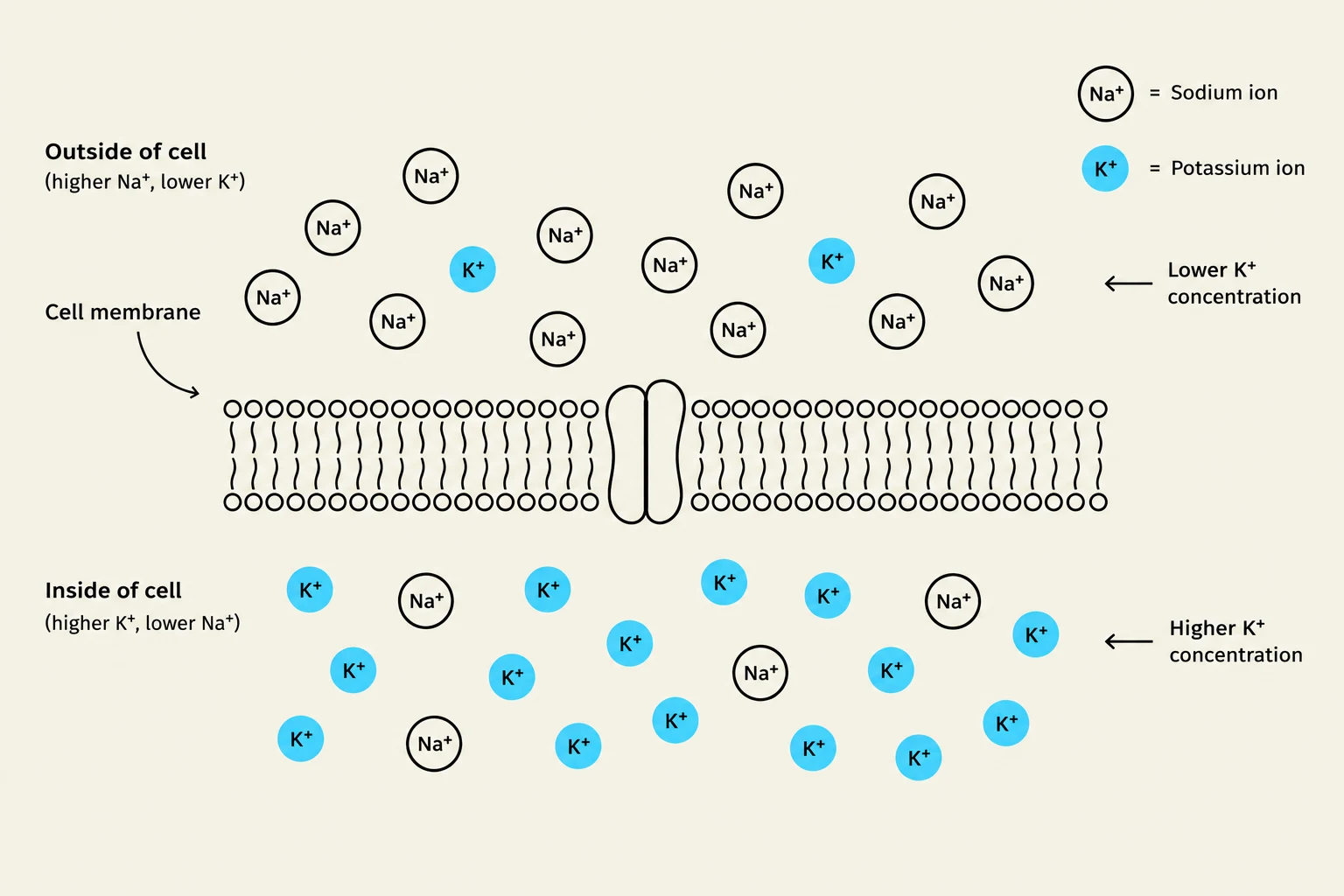
In a typical cell, the extracellular fluid (outside) is rich in sodium (Na+), chloride ($Cl^-$), and calcium (Ca2+), while the intracellular fluid (inside) has a high concentration of potassium ($K^+$) and negatively charged proteins. Because the cell membrane is more permeable to potassium than to sodium—meaning there are more potassium "leak channels" available—potassium tends to move out of the cell.
Diagram illustrating the concentration gradient of sodium (Na+) and potassium (K+) ions across a cell membrane, with higher Na+ outside and higher K+ inside.
The baseline state of this charge difference is called the resting membrane potential (RMP). While different cells have different RMPs (for example, a typical neuron is approximately −70 mV), the negative sign indicates that the inside of the cell is more negatively charged relative to the outside.
Maintaining the Battery: The Sodium-Potassium Pump
If ions were left to move freely through leak channels according to their gradients, the cell would eventually reach equilibrium, and the membrane potential would vanish. To prevent this, the cell uses active transport to move ions against their natural gradients.
The primary engine for this is the sodium-potassium ATPase, commonly known as the sodium-potassium pump. This protein acts as an antiport mechanism, meaning it moves two different ions in opposite directions across the membrane:
It pumps three sodium ions (3Na+) out of the cell.
It pumps two potassium ions ($2K^+$) into the cell.
This process requires energy in the form of ATP. The demand for this energy is immense; in many cells, the sodium-potassium pump consumes approximately 90% of the total ATP produced. By constantly working to push sodium out and pull potassium in, the pump maintains the "battery" that allows excitable cells to function.
Exam Tip: Remember that permeability is determined by the number of available channels, not the concentration gradient. The cell membrane is more permeable to potassium than to sodium because there are more potassium leak channels present.
Excitable Changes: Graded vs. Action Potentials
Excitable cells do not just sit at rest; they deliberately change their membrane potential to communicate or move. These changes generally fall into two categories: graded potentials and action potentials.
Graded Potentials
A graded potential is a local electrical change that affects only a specific part of the membrane. For example, in a neuron, if a chemical binds to a gated channel on a dendrite, the resulting ion movement might only change the voltage in that immediate area. The magnitude of the change depends on how many channels open and for how long; the further away you move from the site of stimulation, the weaker the effect becomes.
Action Potentials
An action potential is a rapid, large-scale electrical change that conducts across the entire membrane of the cell. This is the "all-or-nothing" signal used by neurons to send information down an axon or by muscle cells to trigger contraction.
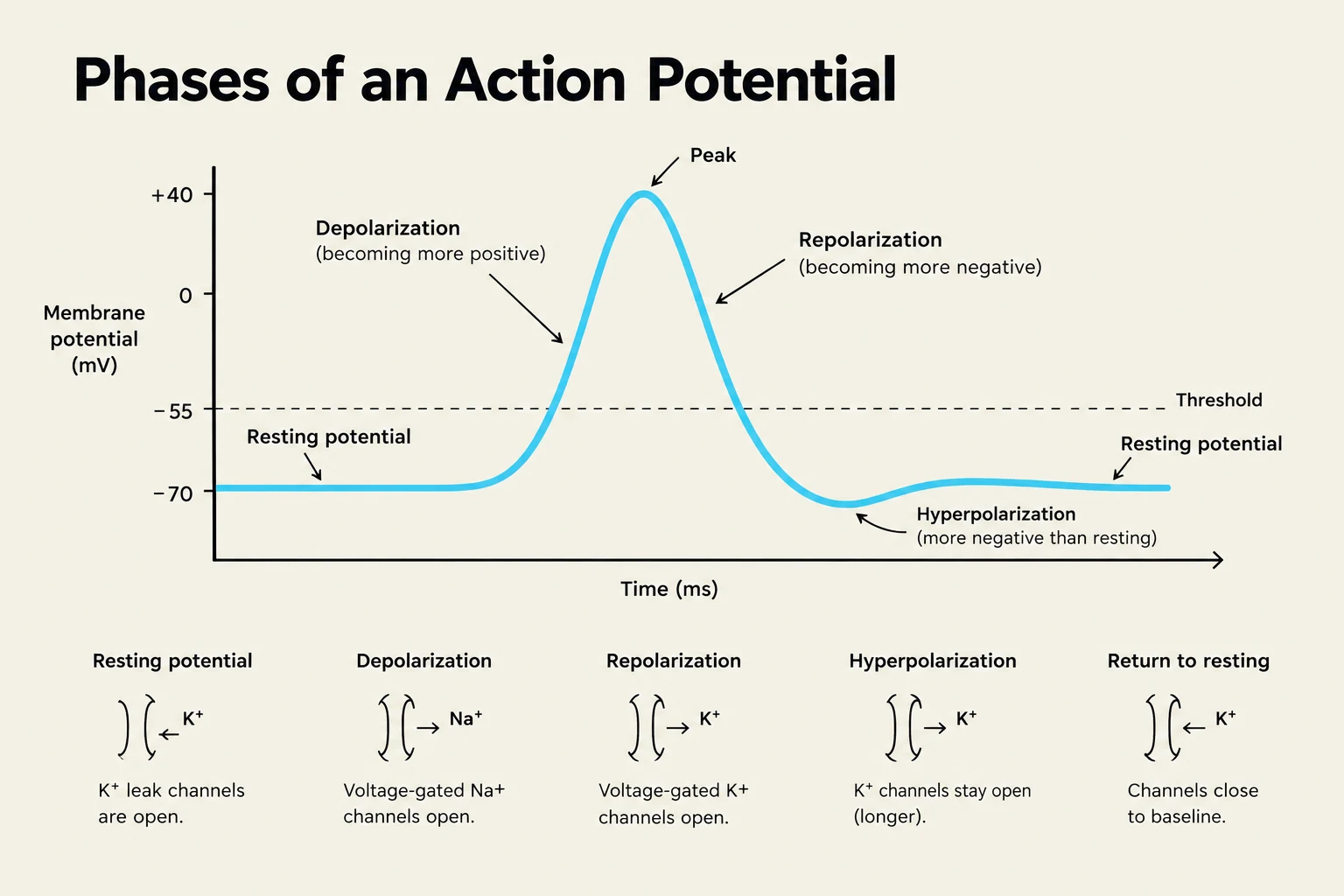
This diagram illustrates the phases of an action potential, a key concept in neurobiology. It shows the change in membrane potential over time, detailing resting potential, depolarization, repolarization, and hyperpolarization, along with the associated ion channel activity.
The Mechanics of Voltage Change
To understand how these potentials occur, we must look at how specific ions affect the voltage when their gates open:
Depolarization: This occurs when the membrane potential becomes more positive (less negative). This typically happens when positive ions, like sodium (Na+) or calcium (Ca2+), enter the cell.
Repolarization: This is the process of returning the membrane potential from a depolarized state back down toward the resting membrane potential.
Hyperpolarization: This occurs when the membrane potential becomes even more negative than the resting potential. This can happen if positive ions (like $K^+$) leave the cell or if negative ions (like $Cl^-$) enter the cell.
Summary Table of Ion Movement
Ion
Direction of Movement (if gate opens)
Effect on Membrane Potential
Sodium (Na+)
Into the cell
Depolarization
Potassium ($K^+$)
Out of the cell
Hyperpolarization / Repolarization
Chloride ($Cl^-$)
Into the cell
Hyperpolarization
Calcium (Ca2+)
Into the cell
Depolarization
By coordinating the opening and closing of these gated channels, excitable cells can transform simple chemical or physical stimuli into the complex electrical language of the nervous and muscular systems.
Keep reading for free.
Create an account to finish this reading and make it part of your study routine.