Physical vs. Human Geography: Understanding Earth's Systems and Societies
Explore the two main branches of geography: Physical Geography, focusing on natural systems like landforms and climate, and Human Geography, examining societies, cultures, and their interaction with the environment. Understand their interconnectedness and the central theme of human-environment interaction.
Geography is often misunderstood as merely the study of maps or the memorization of capital cities. In reality, it is a complex, multi-dimensional discipline that seeks to understand the world by examining the relationship between the Earth's physical systems and the people who inhabit them. To study geography effectively, one must distinguish between its two primary branches: Physical Geography and Human Geography. While they focus on different subjects, they are deeply interconnected, forming a holistic view of our planet.
Physical Geography: The Study of Natural Systems
Physical geography is the branch of the discipline that focuses on the natural processes and patterns of the Earth. It examines the "stage" upon which human history unfolds. This field is heavily rooted in the natural sciences, such as geology, meteorology, biology, and hydrology.
The primary goal of a physical geographer is to understand how natural systems function and how they change over time. This includes the study of:
Geomorphology: The study of landforms (mountains, valleys, coasts) and the processes that shape them, such as erosion and plate tectonics.
Climatology and Meteorology: The study of long-term weather patterns and atmospheric conditions.
Hydrology: The study of the Earth's water systems, including rivers, oceans, and groundwater.
Biogeography: The study of the distribution of plants and animals across the globe.
By analyzing these elements, physical geographers can predict natural hazards like floods or landslides and understand the fundamental mechanics of the Earth's biosphere.
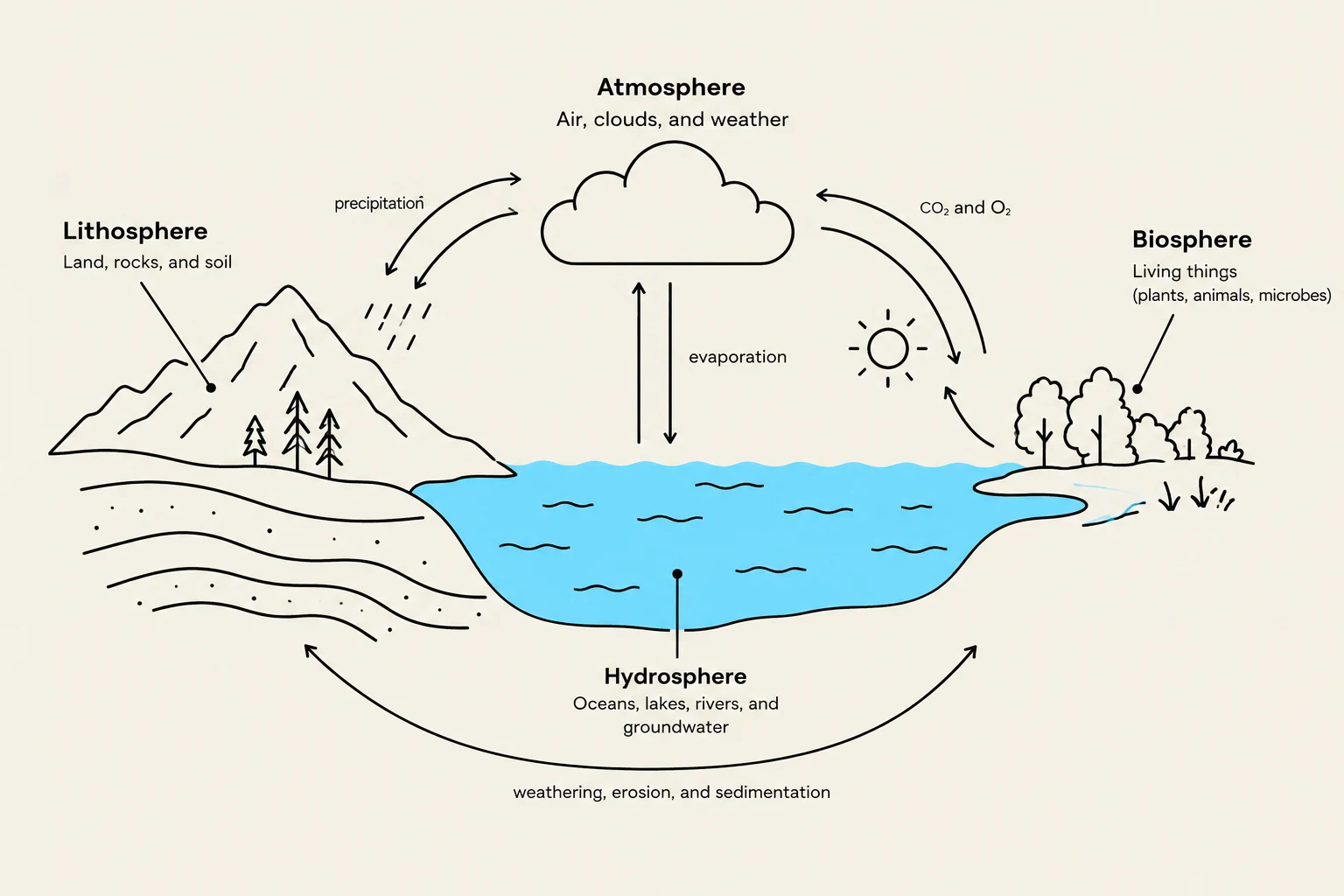
This diagram illustrates the Earth's spheres: Lithosphere (land), Atmosphere (air), Hydrosphere (water), and Biosphere (living things), and their interactions through processes like precipitation, evaporation, and weathering.
Exam Tip: If a question asks about "abiotic" factors (non-living components like sunlight, soil, or temperature), it is almost certainly referring to the domain of Physical Geography.
Human Geography: The Study of Societies and Culture
While physical geography looks at the natural world, human geography focuses on the "actors" within that world: humans. This branch examines how people live, how they organize themselves into societies, and how they interact with their environment.
Human geography is more closely aligned with the social sciences. It seeks to answer questions about why people live where they do, how they use resources, and how culture shapes the landscape. Key subfields include:
Cultural Geography: The study of how beliefs, languages, and customs vary across space.
Economic Geography: The study of how people earn a living, the movement of goods, and the distribution of resources.
Political Geography: The study of boundaries, nations, and how political power is distributed geographically.
Urban Geography: The study of cities, infrastructure, and the development of human settlements.
Human geographers look for patterns in human behavior. For example, they might study why a specific religion is concentrated in a certain region or how globalization has changed the way people consume products in different parts of the world.
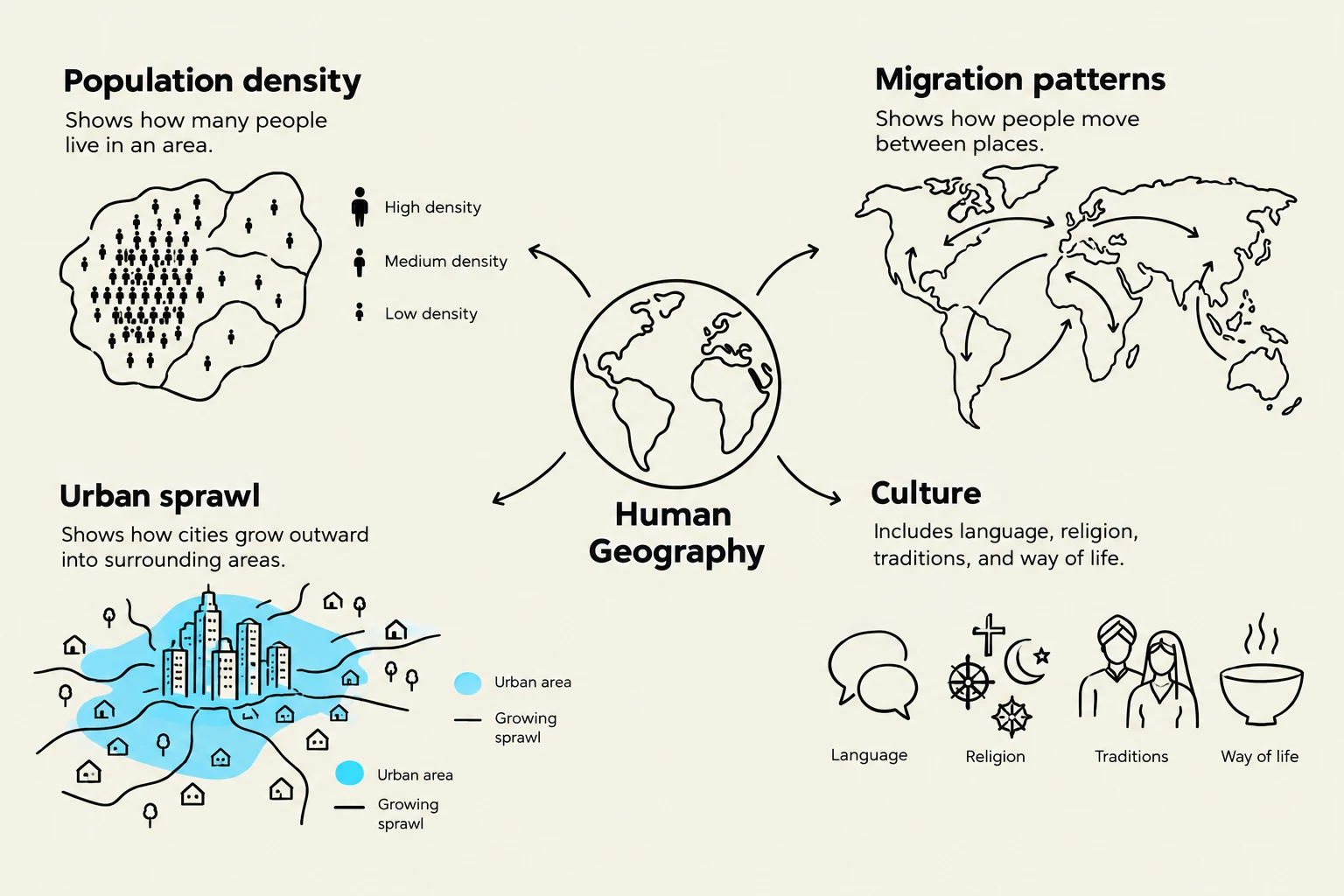
This illustration depicts key concepts in human geography, including population density, migration patterns, urban sprawl, and culture, with visual representations for each.
The Intersection: Environment and Society
It is a mistake to view these two branches as entirely separate silos. In the modern world, the most critical geographic questions exist at the intersection of physical and human systems. This is often referred to as the study of Environment and Society.
The relationship between the two is often a feedback loop. Physical systems provide the resources (water, fertile soil, minerals) that allow human societies to grow. In turn, human activities—such as agriculture, urbanization, and industrialization—can fundamentally alter those physical systems.
Worked Example: The Impact of Deforestation
To see how these two fields merge, consider the phenomenon of deforestation:
The Physical Perspective: A physical geographer would study how the removal of trees affects soil stability, how it changes the local water cycle (transpiration), and how it impacts local biodiversity and carbon sequestration.
The Human Perspective: A human geographer would study the economic drivers behind deforestation (such as the demand for timber or palm oil), the impact on indigenous communities living in those forests, and the political policies that govern land use.
The Synthesis: By combining both views, we can understand the full scope of the issue: how human economic needs are driving physical changes that, in turn, create new social and economic challenges (like climate change or food insecurity).
Key Concept: The "Human-Environment Interaction" is the central theme that bridges the gap between physical and human geography.
Summary Comparison
To help with your studies, use the following table to distinguish between the two branches:
Feature
Physical Geography
Human Geography
Primary Focus
Natural processes and systems
Human activities and societies
Scientific Root
Natural Sciences (Geology, Biology)
Social Sciences (Sociology, Economics)
Key Questions
How do mountains form? Why does it rain?
Why do people migrate? How do cities grow?
Examples of Study
Climate change, erosion, ecosystems
Urbanization, culture, trade routes
Understanding the distinction between these two fields is the first step toward mastering geography. By recognizing both the natural constraints of our planet and the complex ways humans navigate those constraints, you gain a much deeper understanding of the world we inhabit.
Keep reading for free.
Create an account to finish this reading and make it part of your study routine.