Physical Examination and Data Collection in Nursing
A comprehensive guide to the principles and techniques of physical examination and data collection in nursing, covering various assessment approaches, vital signs, and system-specific assessments.
Physical examination and data collection are the foundational pillars of the nursing process. Through these processes, nurses identify abnormal findings, detect potential health problems, and establish a scientific basis for a personalized nursing care plan. The ultimate goal is to distinguish between a client's normal physiological state and any deviations that may signify disease, illness, or a risk for future complications.
Approaches to Physical Examination
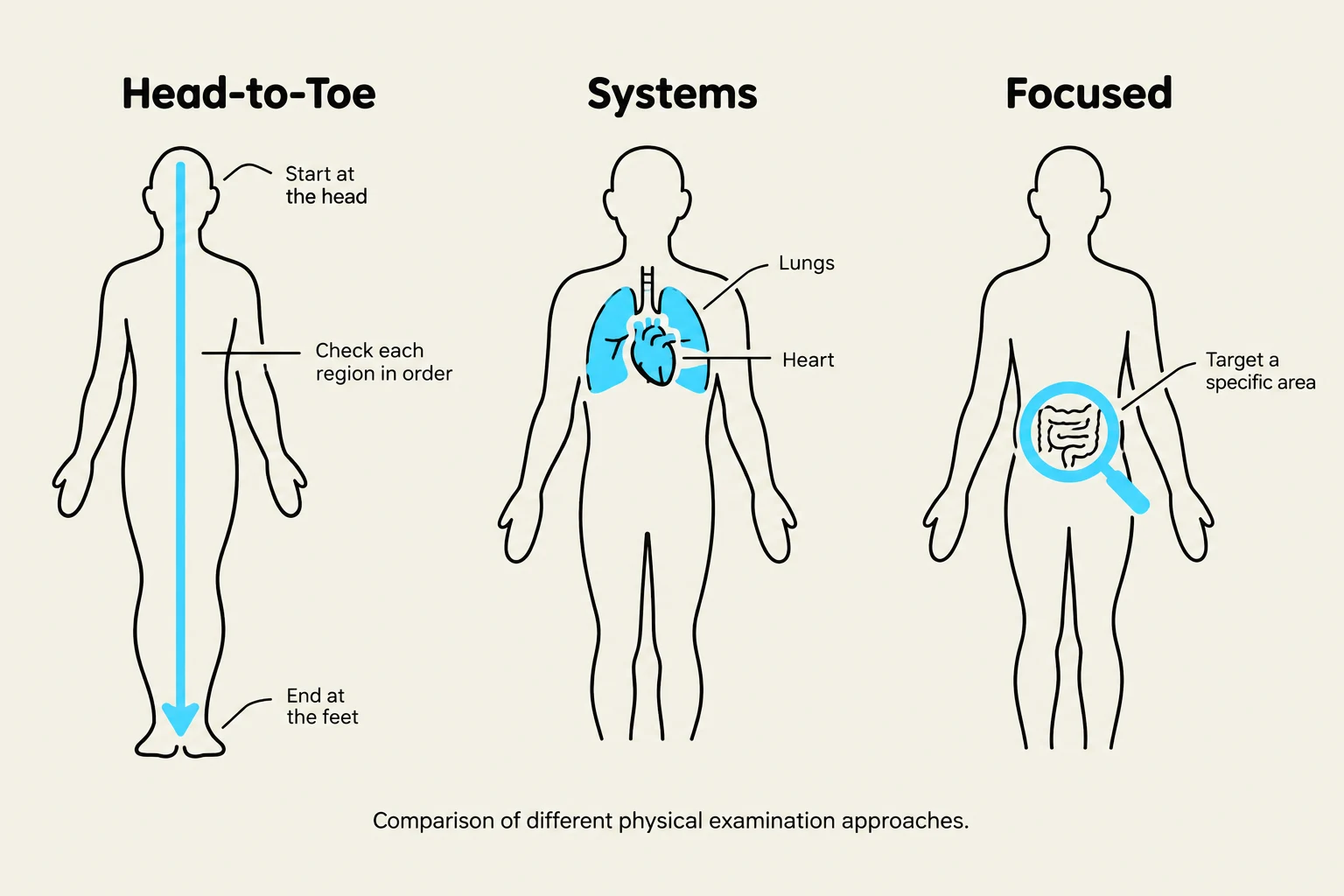
Comparison of different physical examination approaches: Head-to-Toe, Systems, and Focused.
Nurses utilize different examination formats depending on the client's needs and the clinical setting. Choosing the correct approach ensures that the assessment is both efficient and thorough.
Head-to-Toe Method: This is a systematic, sequential approach. The nurse begins with a general survey and then moves logically from the head and neck, down through the chest and abdomen, to the extremities, and finally to the perineum.
Systems Approach: This method focuses on specific body systems rather than a single anatomical direction. For example, a nurse might perform a dedicated cardiovascular or respiratory assessment to evaluate the function of those specific organs.
Focused Physical Examination: Often prompted by a specific client complaint (such as chest pain or abdominal pain), this is a concentrated assessment of a single body system or a specific area of concern.
The General Survey and Vital Signs
Every physical examination should begin with a General Survey. This involves observing the client's overall appearance, including posture, gait, facial expressions, grooming, and hygiene. This initial observation provides immediate clues about the client's neurological and psychological status.
A critical component of the general survey is the collection of Vital Signs. These provide objective, measurable data regarding the client's physiological stability. Key vital signs include:
Temperature
Pulse
Respirations
Blood Pressure
Oxygen Saturation (SaO2)
NCLEX Alert: When prioritizing client needs, always follow the ABCs: Airway, Breathing, and Circulation.
Integumentary System Assessment
Visual examples of primary skin lesions: macule, papule, and vesicle.
The skin, hair, and nails provide vital information about hydration, perfusion, and systemic health. During inspection and palpation, nurses look for specific indicators:
Skin Integrity and Perfusion
Skin Turgor: This measures skin resiliency. When skin is pinched, it should return to its original position immediately; "tenting" may indicate dehydration.
Capillary Refill: By applying pressure to the nail bed, the nurse assesses how quickly color returns. A normal finding is a refill of <3 seconds.
Color Variations: Nurses must document deviations such as erythema (redness), cyanosis (blueness indicating low oxygen), pallor (paleness), or jaundice (yellowing of skin/eyes).
Edema: Nurses also assess for swelling or fluid accumulation in the tissues.
Primary Skin Lesions
Identifying the type of lesion is essential for accurate documentation. Common lesions include:
Macules: Flat, colored spots on the skin.
Papules: Small, raised lesions.
Vesicles: Small, fluid-filled blisters.
Neurological and Cognitive Assessment
Assessing the neurological status involves evaluating the client's Level of Consciousness (LOC) and their cognitive functioning. A nurse must determine if the client is oriented to person, place, time, and surroundings.
A common tool for assessing neurological response is the Glasgow Coma Scale, which provides a standardized way to measure consciousness. Additionally, nurses perform a Pupillary Assessment using the PERRLA + C PE acronym to ensure the eyes are functioning correctly:
Pupils
Equal
Round
Responsive to light
Light constriction
Accommodation
Center (Consensual)
Pupillary Equality.
Musculoskeletal, Cardiovascular, and Respiratory Assessment
Musculoskeletal Function
The nurse assesses the musculoskeletal system by inspecting the Range of Motion (ROM) of joints—including flexion, extension, abduction, and adduction—and testing muscle strength to identify potential impairments.
Cardiovascular and Respiratory Health
Auscultation is the primary method for assessing these systems.
Lung Sounds: Nurses listen for normal breath sounds or adventitious (abnormal) sounds. Abnormalities include crackles (moist bubbling sounds caused by fluid in the airways), wheezes (high-pitched sounds from constricted passages), and rhonchi (low-pitched, moaning sounds).
Peripheral Pulses: To assess circulation, the nurse checks the strength and regularity of pulses in various locations, such as the radial, carotid, femoral, and dorsalis pedis sites.
Abdominal Assessment
When assessing the abdomen, the nurse must be careful with the order of operations. Unlike other systems where auscultation follows inspection, in the abdomen, auscultation should occur early to avoid altering bowel motility through palpation. The nurse auscultates the four quadrants to identify bowel sounds. The normal range is typically between 5 and 34 clicks or gurgles per minute.
Special Considerations and Preparation
Assessment techniques must be adapted for different populations. For example, in pediatric assessments, nurses should build rapport using play and toys to reduce anxiety. In adolescents, nurses should look for specific developmental indicators like scoliosis (curvature of the spine), while in infants, the assessment of fontanelles (soft spots on the skull) is critical.
Regardless of the age group, proper preparation is essential. Always explain the procedure to the client and ensure privacy to alleviate anxiety and ensure the accuracy of the data collected.
Clinical Tip: Always document skin integrity, including any redness or irritation, upon admission. This protects both the client and the facility by establishing a baseline of the client's condition.
Keep reading for free.
Create an account to finish this reading and make it part of your study routine.