Photosynthesis: Converting Light Energy to Chemical Energy
Explore the fundamental biological process of photosynthesis, detailing the light-dependent reactions, the Calvin cycle, and adaptations like C4 and CAM pathways. Understand how organisms convert light energy into chemical energy for life.
Photosynthesis is the fundamental biological process that powers the biosphere by converting light energy into chemical energy. This complex redox reaction involves the reduction of CO2 and the oxidation of H2A (where A is O or S) to produce carbohydrates (CH2O), O2, and H2O. The general chemical equation for this process is:
CO2+2H2A+Light Energy→CH2O+A2+H2O
This process allows photoautotrophs, such as green plants, algae, and cyanobacteria, to create organic molecules from inorganic sources. In contrast, heterotrophs must consume these organic molecules to sustain life.
The Chloroplast: The Site of Energy Transformation
In eukaryotic photoautotrophs, photosynthesis occurs within specialized organelles called chloroplasts. These organelles are characterized by a double membrane system (outer and inner membranes) and a fluid-filled region called the stroma.
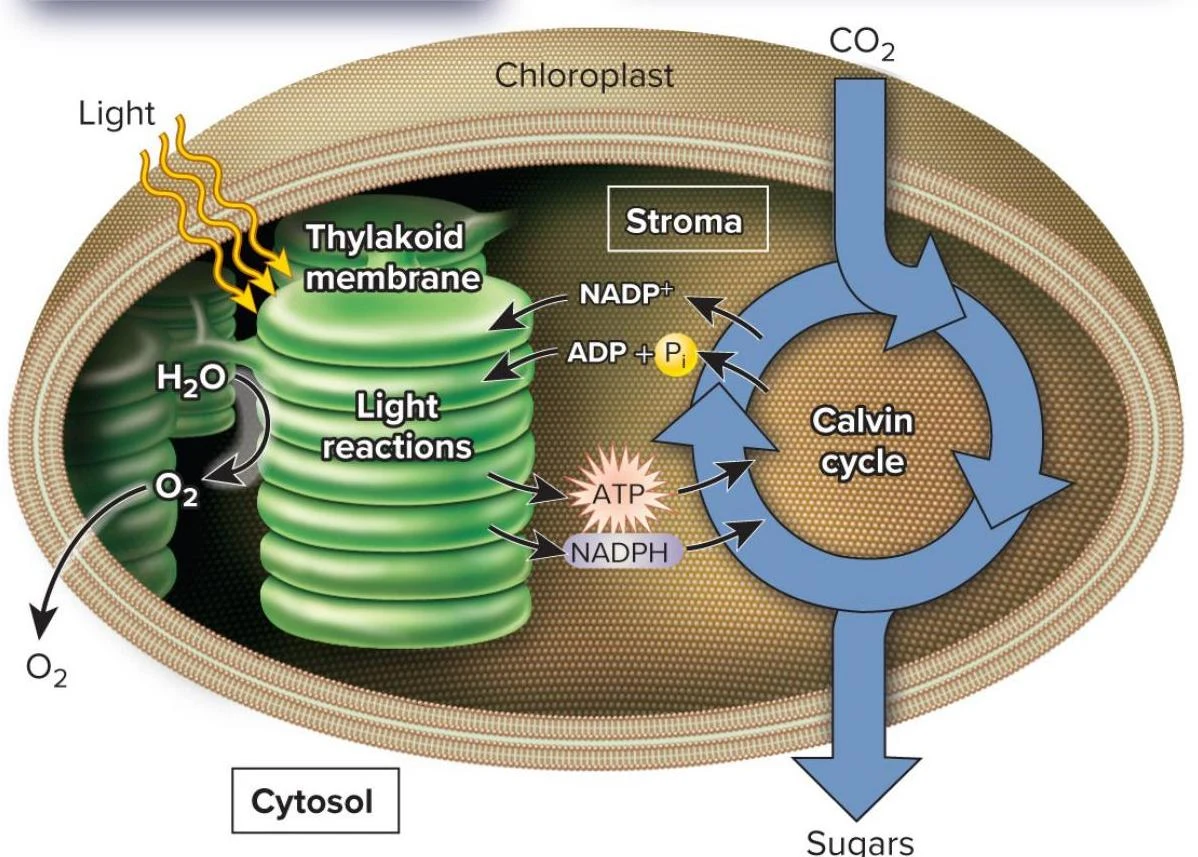
Within the stroma, there is a third membrane system consisting of flattened, fluid-filled tubules known as thylakoids. These thylakoids are often stacked into structures called grana. The thylakoid membrane is the critical site for light absorption and the generation of an electrochemical gradient, while the stroma is where the synthesis of carbohydrates occurs.
Diagram illustrating the process of photosynthesis within a chloroplast, showing the light-dependent reactions and the Calvin cycle.
Pigments and the Physics of Light Absorption
Light travels as electromagnetic radiation in waves. The energy of light is determined by its wavelength (λ)—the distance between wave peaks—and its frequency. The energy (E) of a single photon is calculated using Planck's constant (h):
E=hv=λhc
Exam Tip: Note the inverse relationship between energy and wavelength. Shorter wavelengths (like violet) have higher energy, while longer wavelengths (like red) have lower energy.
Pigments are molecules that absorb specific wavelengths of light while reflecting others. For example, leaves appear green because they absorb red and violet wavelengths but reflect green light. When a pigment absorbs a photon, an electron is boosted to an excited state, an unstable high-energy orbital. To return to a stable ground state, the electron may release energy as heat, light (fluorescence), or transfer its energy to a nearby molecule via resonance energy transfer.
Plants utilize a variety of pigments to maximize energy capture, including chlorophyll a, chlorophyll b, and carotenoids.
The Light-Dependent Reactions
The first stage of photosynthesis takes place in the thylakoid membranes and transforms light energy into chemical energy in the form of ATP and NADPH.
Photosystem II (PSII) and Water Splitting
The process begins at Photosystem II (PSII), which contains the pigment P680. Light energy is captured by an antenna complex and transferred via resonance energy transfer to P680. To prevent the excited electron from simply losing its energy as heat, PSII transfers the electron to a stable primary acceptor called pheophytin (Pp).
To replace the lost electron, water is oxidized, a process that releases oxygen (O2) as a byproduct and contributes H+ ions to the thylakoid lumen.
Photosystem I (PSI) and NADPH Production
Electrons travel from PSII through an Electron Transport Chain (ETC) to Photosystem I (PSI). At PSI, the pigment P700 absorbs light to re-energize the electrons. These high-energy electrons are then passed to NADP+ reductase, which facilitates the formation of NADPH by combining NADP+, electrons, and H+.
Chemiosmosis and ATP Synthesis
As electrons move through the ETC, they help pump H+ ions into the thylakoid lumen, creating an electrochemical gradient. This gradient drives ATP synthase, a molecular motor that produces ATP as H+ ions flow back into the stroma. This specific process of using light to drive ATP synthesis is called photophosphorylation.
The Calvin Cycle (Light-Independent Reactions)
The second stage of photosynthesis occurs in the stroma and uses the ATP and NADPH produced in the light reactions to fix CO2 into carbohydrates. This cycle proceeds in three distinct phases:
Carbon Fixation: The enzyme Rubisco incorporates CO2 into a five-carbon sugar called ribulose bisphosphate (RuBP). This produces an unstable intermediate that immediately splits into two molecules of 3-phosphoglycerate (3-PGA).
Reduction: Using energy from ATP and electrons from NADPH, 3-PGA is converted into glyceraldehyde-3-phosphate (G3P), a high-energy three-carbon sugar.
Regeneration: While some G3P molecules exit the cycle to form glucose and other carbohydrates, the majority are used to regenerate RuBP using additional ATP, allowing the cycle to continue.
Environmental Adaptations and Photorespiration
Photosynthetic efficiency is heavily influenced by light intensity, temperature, and water availability.
The Challenge of Photorespiration
In many plants (known as C3 plants), Rubisco can mistakenly bind to O2 instead of CO2 when O2 levels are high or CO2 levels are low (often due to closed stomata in hot/dry conditions). This process, called photorespiration, consumes energy and reduces the efficiency of carbohydrate production, though it may serve to protect the plant from oxidative damage.
Evolutionary Solutions: C4 and CAM Plants
To minimize photorespiration, some plants have evolved specialized pathways:
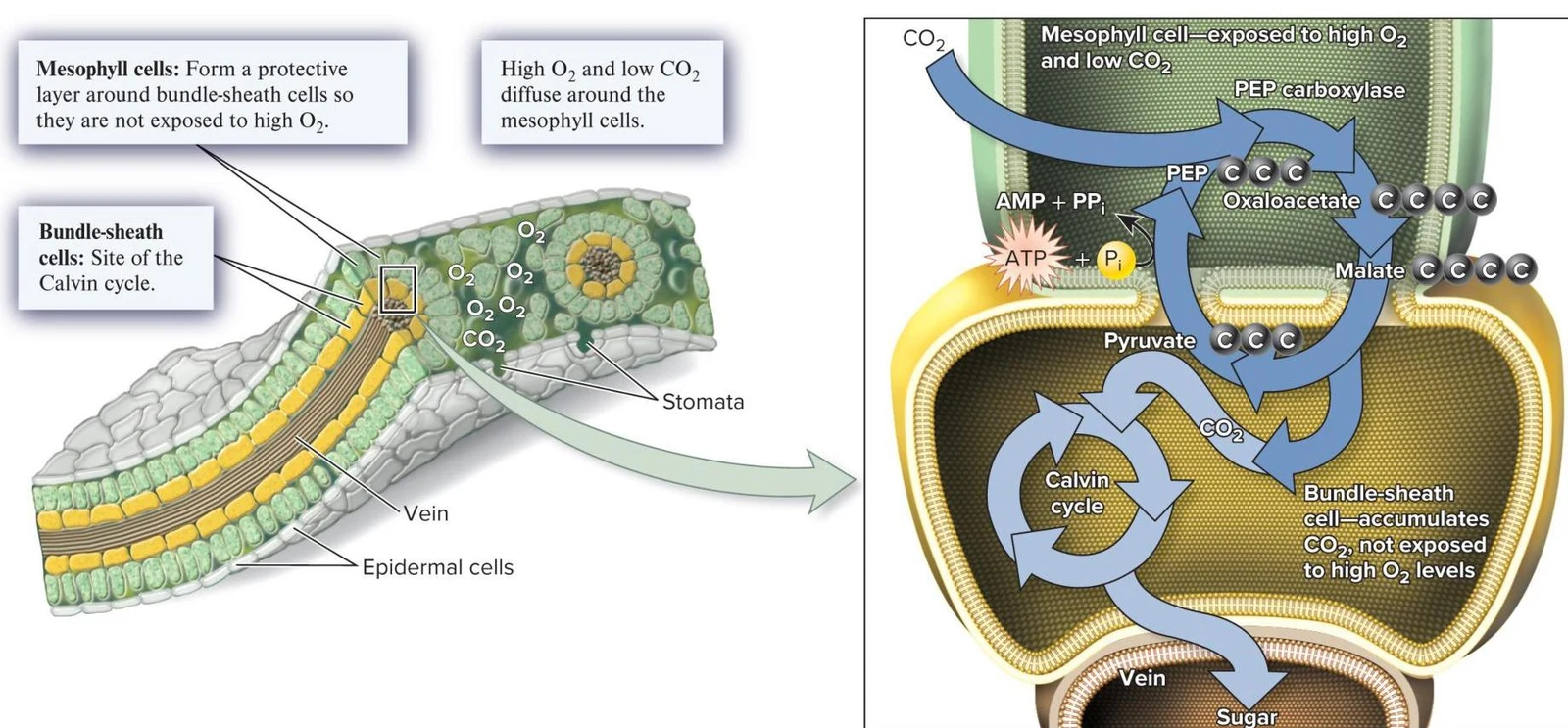
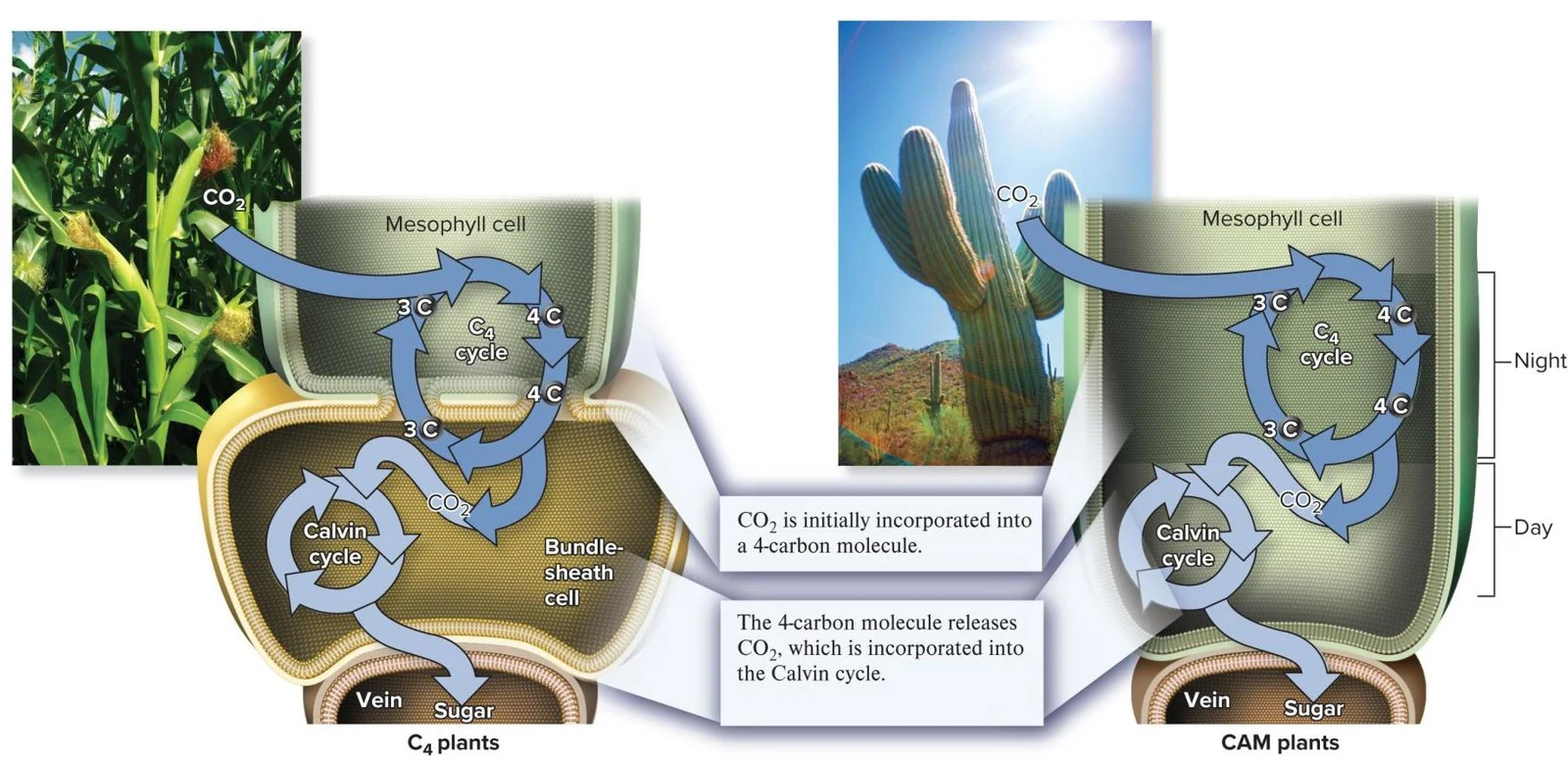
C4 Plants: These plants (e.g., corn) physically separate carbon fixation from the Calvin cycle. They use the enzyme PEP carboxylase to fix CO2 into a four-carbon molecule in the mesophyll cells, which is then transported to bundle-sheath cells where CO2 is released at high concentrations for Rubisco to use.
Diagram illustrating the C4 photosynthesis pathway, showing the roles of mesophyll cells and bundle-sheath cells in carbon dioxide fixation and the Calvin cycle.
CAM Plants: These plants (e.g., cacti) separate the processes temporally. They open their stomata at night to take up CO2 and store it as organic acids, then close their stomata during the day to conserve water, releasing the stored CO2 for use in the Calvin cycle.
Diagram illustrating the C4 and CAM photosynthesis pathways, showing CO2 fixation and cycling within mesophyll and bundle-sheath cells.
Keep reading for free.
Create an account to finish this reading and make it part of your study routine.