Photosynthesis: Converting Light Energy to Chemical Energy
Explore the fundamental process of photosynthesis, detailing the light-dependent reactions within chloroplasts and the Calvin cycle, which convert solar energy into chemical energy for plant life.
Photosynthesis is the fundamental biological process that powers life on Earth by converting solar energy into stable chemical energy. Occurring within specialized organelles called chloroplasts, this process allows plants to transform inorganic molecules into organic sugars. The overall chemical transformation can be summarized by the following equation:
6CO2+6H2O+Light Energy→C6H12O6+6O2
To understand how a plant "eats" light, we must examine the two distinct but interconnected stages: the Light Reactions and the Calvin Cycle.
Light Harvesting and the Electromagnetic Spectrum
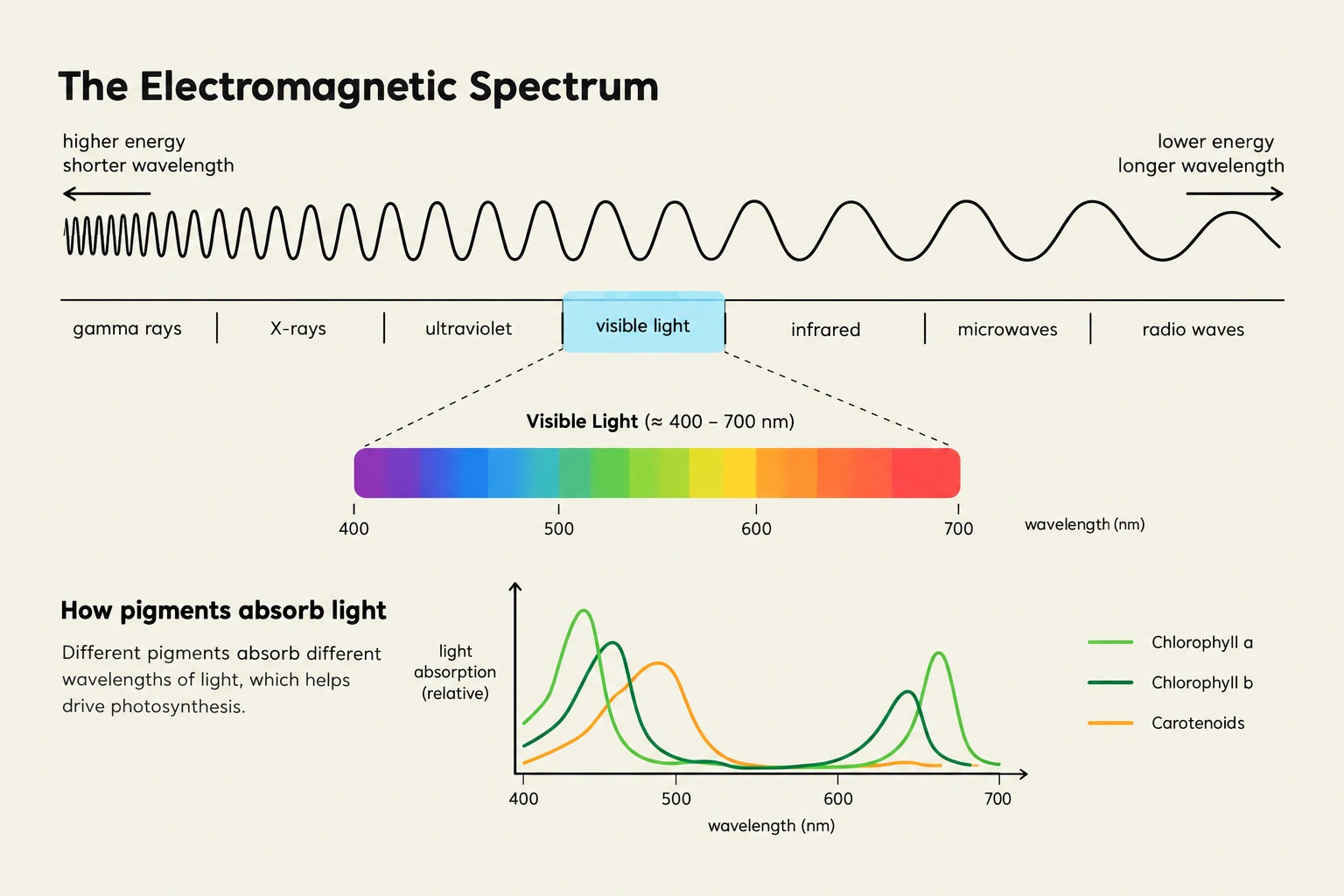
Before energy can be converted, it must be captured. Light travels in electromagnetic waves, where the distance between wave crests defines the wavelength. Shorter wavelengths carry higher energy, while longer wavelengths carry less. Plants interact specifically with visible light, the narrow band of the spectrum ranging from approximately 380 nm (violet/indigo) to 740 nm (red).
The capture of this light is mediated by pigments located within the chloroplasts. Chlorophyll a serves as the primary light-capturing pigment that participates directly in the light reactions. However, plants also utilize accessory pigments, including chlorophyll b and carotenoids, which absorb additional wavelengths of light and transfer that energy to chlorophyll a.
Why are plants green?
While pigments absorb blue and red wavelengths efficiently, they reflect or transmit green light. This reflected light is what reaches our eyes, giving plants their characteristic color.
The electromagnetic spectrum illustrates the range of electromagnetic radiation, from gamma rays to radio waves, with visible light being a small portion. Below, graphs show how different pigments like chlorophyll a, chlorophyll b, and carotenoids absorb light at various wavelengths, which is crucial for photosynthesis.
Phase 1: The Light Reactions
The light reactions take place within the thylakoid membranes of the chloroplast. The primary goal of this phase is to convert light energy into chemical energy in the form of ATP and NADPH, while releasing O2 as a byproduct.
Photosystem II and the Electron Transport Chain
The process begins at Photosystem II (PS II / $P680$). When light hits the pigment complex, it excites electrons to a higher energy state. These electrons are transferred to a primary acceptor, leaving the reaction center ($P680$) in an oxidized state ($P680^+$). To replace these lost electrons, $P680^+$ acts as a powerful oxidizing agent that splits water molecules (H2O), releasing electrons, protons ($H^+$), and oxygen gas (O2).
The high-energy electrons then travel down an Electron Transport Chain (ETC), moving through carriers such as plastoquinone and the Cytochrome Complex.
Chemiosmosis and Photophosphorylation
As electrons move through the Cytochrome Complex, the energy released is used to actively pump protons ($H^+$) from the stroma into the thylakoid space. This creates a concentration gradient (a proton motive force). These protons then flow back down their gradient into the stroma through ATP Synthase, a molecular motor that uses this flow to power the synthesis of ATP from ADP and inorganic phosphate (Pi). This specific process of using light to drive ATP production is called photophosphorylation.
Photosystem I and NADPH Production
The electrons arrive at Photosystem I (PS I / $P700$), where they are re-energized by another input of light. These re-excited electrons are passed to the enzyme Reductase, which uses them (along with a proton) to reduce NADP+ into NADPH.
Depending on the plant's energy needs, electrons may follow two different paths:
Linear Electron Flow: The standard pathway involving both PS II and PS I, producing ATP, NADPH, and O2.
Cyclic Electron Flow: A pathway involving only PS I, where electrons cycle back to the Cytochrome Complex to produce extra ATP without producing NADPH or O2.
Diagram illustrating the light-dependent reactions of photosynthesis, showing the electron transport chain within the thylakoid membrane, including Photosystem II, Photosystem I, and ATP synthase, leading to the production of ATP and NADPH.
Phase 2: The Calvin Cycle
While the light reactions capture energy, the Calvin Cycle uses that energy to build sugars. This phase occurs in the stroma, the fluid-filled space surrounding the thylakoids. The cycle requires CO2 from the atmosphere, along with the ATP and NADPH produced in the first phase.
The cycle proceeds through three essential stages:
Carbon Fixation: The enzyme Rubisco catalyzes the attachment of inorganic CO2 to a five-carbon sugar called RuBP (ribulose bisphosphate).
Reduction: Using the chemical energy from ATP and the reducing power of NADPH, the fixed carbon molecules are converted into a three-carbon sugar called G3P (glyceraldehyde 3-phosphate).
Regeneration: In a final energy-intensive step, some of the G3P molecules are rearranged using ATP to regenerate the original RuBP molecules, allowing the cycle to continue.
Gas Exchange and Environmental Adaptations
For photosynthesis to function, plants must manage the intake of CO2 and the release of O2. This is handled by stomata, microscopic pores located primarily on the underside of leaves.
However, gas exchange presents a challenge. On hot, dry days, plants may close their stomata to prevent water loss. This causes CO2 levels inside the leaf to drop while O2 levels rise. Under these conditions, Rubisco may mistakenly bind to O2 instead of CO2, a wasteful process known as photorespiration that consumes energy without producing sugar.
To combat this, various plants have evolved specialized metabolic pathways:
C4 Plants (e.g., corn, sugarcane): These plants physically separate carbon fixation and the Calvin cycle into different cells (mesophyll and bundle-sheath cells) to maintain high CO2 concentrations around Rubisco.
CAM Plants (e.g., cacti, pineapples): These plants use temporal separation. They open their stomata at night to fix CO2 into organic acids and keep them closed during the day to conserve water, running the Calvin cycle using the stored CO2.
Summary Table: Photosynthesis Overview
Feature
Light Reactions
Calvin Cycle
Location
Thylakoid Membrane
Stroma
Primary Input
Light, H2O
CO2, ATP, NADPH
Primary Output
ATP, NADPH, O2
G3P (Sugar)
Key Enzyme/Complex
Photosystems II & I
Rubisco
Keep reading for free.
Create an account to finish this reading and make it part of your study routine.