Photosynthesis: Converting Light Energy into Chemical Energy
Explore the fundamental biological process of photosynthesis, detailing how light energy is converted into chemical energy through light-dependent reactions and the Calvin cycle. Learn about chloroplast structure, photosynthetic pigments, and adaptations like C4 and CAM pathways.
Photosynthesis is the fundamental biological process that serves as the first step in the flow of energy through most of the living world. It is a complex sequence of events by which light energy is converted into the stored chemical energy of organic molecules. By taking carbon dioxide from the air and incorporating it into organic molecules, plants produce the energy sources that sustain life, while simultaneously releasing the oxygen we breathe into the atmosphere.
The Nature of Light and Energy Conversion
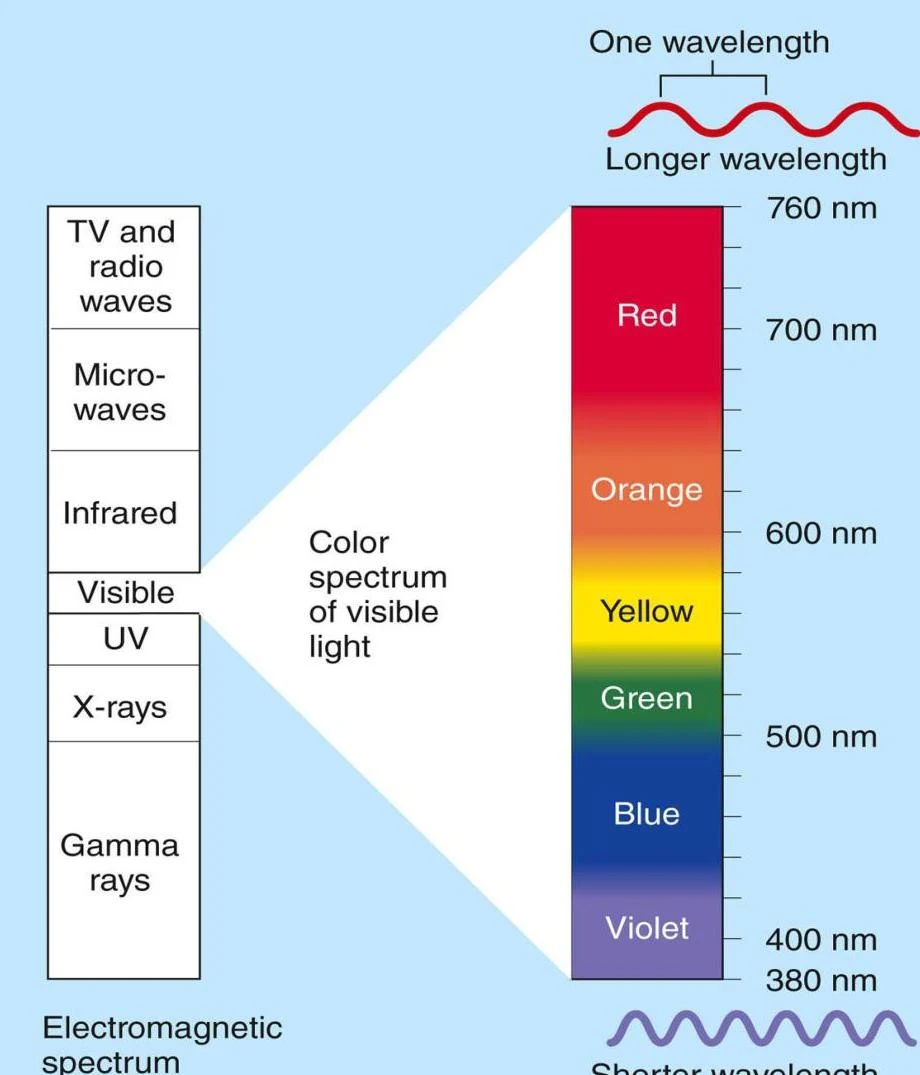
To understand photosynthesis, one must first understand the nature of light. Visible light is a small portion of the electromagnetic spectrum, which consists of radiation traveling in waves. The energy of light is carried in small particles called photons. A critical rule of photon energy is that it is inversely proportional to its wavelength: shorter-wavelength light (such as violet) contains more energy per photon than longer-wavelength light (such as red).
The electromagnetic spectrum shows different types of electromagnetic radiation, including radio waves, microwaves, infrared, visible light, ultraviolet, X-rays, and gamma rays, ordered by wavelength. The visible light spectrum is further broken down into colors from red to violet, with corresponding wavelengths in nanometers.
When a molecule absorbs a photon, one of its electrons becomes energized. This energized electron may return to its lower-energy ground state, dissipating energy as heat or light (fluorescence), or it may be accepted by an electron acceptor molecule. This transfer of electrons is the basis of redox reactions, which consist of oxidation (the loss of electrons) and reduction (the gain of electrons).
Chloroplast Structure and Leaf Anatomy
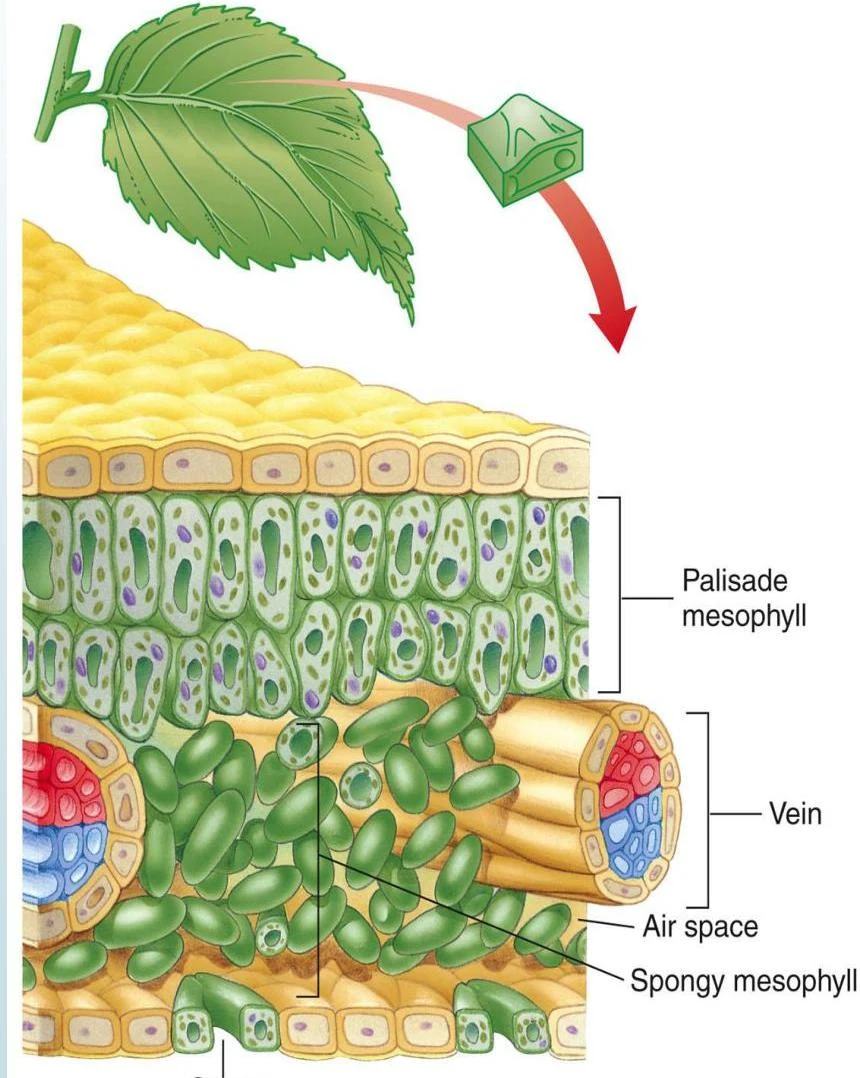
Photosynthesis takes place within specialized organelles called chloroplasts, which are primarily located in the cells of the leaf's mesophyll. The leaf is designed for efficient gas exchange; it contains microscopic pores called stomata that allow carbon dioxide to enter and oxygen to exit.
Diagram illustrating the cross-section of a plant leaf, showing palisade mesophyll, spongy mesophyll, air spaces, and a vein.
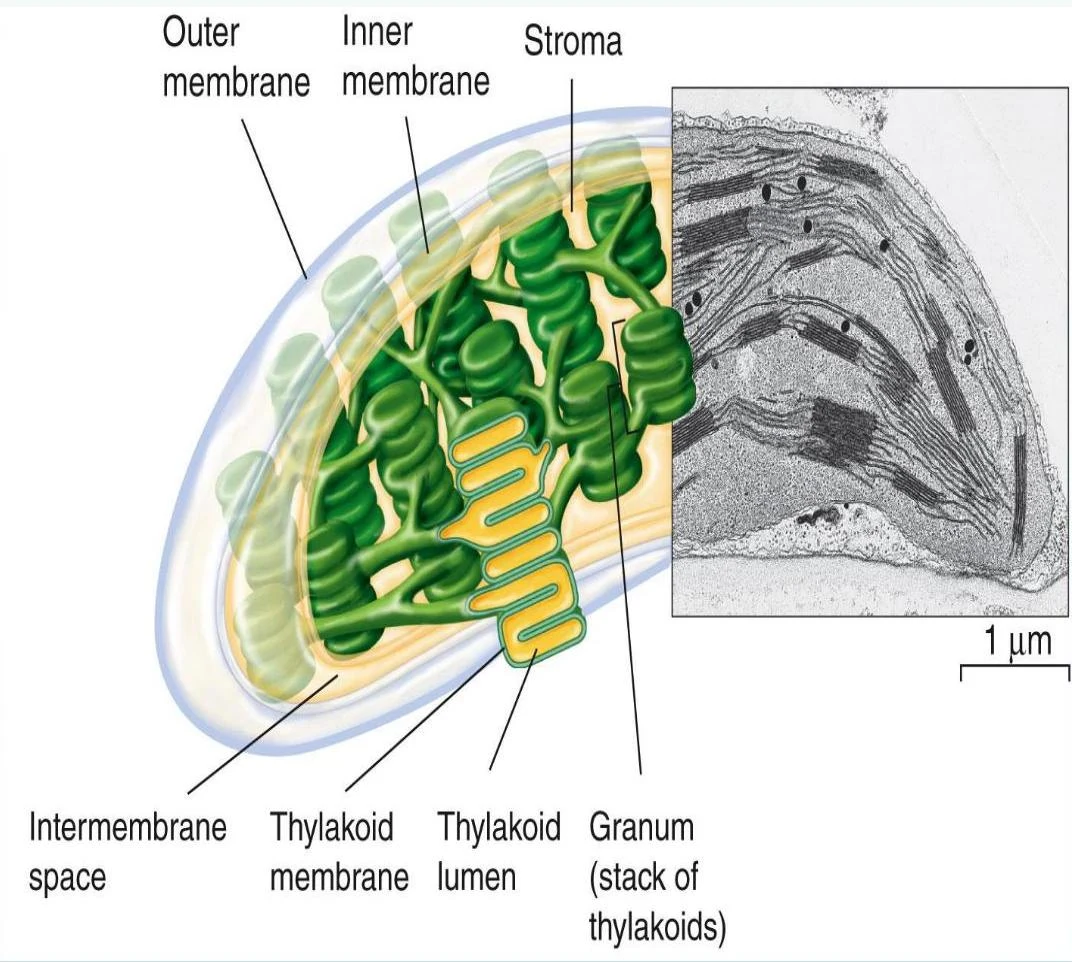
The chloroplast is enclosed by an outer and inner membrane. The inner membrane encloses a fluid-filled space called the stroma, which contains the enzymes necessary to produce carbohydrates. Suspended within the stroma is a third system of membranes that forms an interconnected set of flat, disc-like sacs known as thylakoids. These thylakoids are often arranged in stacks called grana. Each thylakoid encloses a fluid-filled interior space called the thylakoid lumen.
Diagram and electron micrograph of a chloroplast, illustrating its outer and inner membranes, stroma, thylakoid membranes, thylakoid lumen, and grana (stacks of thylakoids).
Photosynthetic Pigments and Light Absorption
To capture light, chloroplasts utilize pigments located in the thylakoid membranes. The primary pigment is chlorophyll, which absorbs light most effectively in the blue and red regions of the visible spectrum but does not absorb green light, which is why leaves appear green.
Beyond chlorophyll, plants use accessory pigments to expand the range of light they can capture:
Chlorophyll a and b: Chlorophyll a initiates the light-dependent reactions, while chlorophyll b participates in the process.
Carotenoids: Yellow and orange pigments that absorb different wavelengths than chlorophyll.
Phycobilins: Another class of accessory pigments.
Scientists distinguish between the absorption spectrum (a plot of how much light of different wavelengths a pigment absorbs) and the action spectrum (a graph showing the relative effectiveness of different wavelengths in powering photosynthesis).
This graph illustrates the relationship between wavelength and the rate of photosynthesis, showing the action spectrum and the absorption spectra of chlorophyll a and chlorophyll b.
The Two Phases of Photosynthesis
Photosynthesis is divided into two distinct but interconnected phases:
1. Light-Dependent Reactions
Occurring in the thylakoid membranes, these reactions convert light energy into chemical energy in the form of ATP and NADPH.
The process involves "antenna complexes"—groups of chlorophyll and accessory pigments that absorb light and transfer the energy to a reaction center. There are two types of photosystems:
Photosystem II (P680): Absorbs light at 680 nm. It uses light energy to split water (photolysis), which releases oxygen and provides electrons.
Photosystem I (P700): Absorbs light at 700 nm. It receives electrons from Photosystem II and uses them to reduce NADP+ to NADPH.
Through a process called chemiosmosis, a proton (H+) gradient is established across the thylakoid membrane. As protons flow from the stroma into the thylakoid lumen and back through ATP synthase, ADP is phosphorylated to form ATP.
Exam Tip: Remember the difference between noncyclic and cyclic electron transport. Noncyclic transport involves both PS II and PS I, produces both ATP and NADPH, and releases oxygen. Cyclic transport involves only PS I, produces only ATP, and does not release oxygen.
2. Carbon Fixation (The Calvin Cycle)
The second phase, also known as the light-independent reactions or the Calvin-Benson cycle, takes place in the stroma. This phase uses the ATP and NADPH produced in the light-dependent reactions to "fix" carbon from CO2 into organic molecules like glucose.
The Calvin cycle consists of three main phases:
CO2 uptake: The enzyme rubisco catalyzes the attachment of CO2 to a five-carbon sugar called RuBP.
Carbon reduction: ATP and NADPH are used to convert the fixed carbon into a three-carbon sugar called G3P.
RuBP regeneration: The remaining molecules are rearranged to regenerate RuBP so the cycle can continue.
The overall summary of photosynthesis can be written as:
6CO2+12H2O+light energy→C6H12O6+6O2+6H2O
Adaptations to Environmental Stress
In hot, dry conditions, plants face a dilemma. To conserve water, they close their stomata, which causes CO2 levels to drop and O2 levels to rise within the leaf. This leads to photorespiration, where the enzyme rubisco binds to O2 instead of CO2, wasting energy and reducing photosynthetic efficiency.
To combat this, some plants have evolved alternative pathways:
C4 Plants: These plants (like corn) physically separate carbon fixation from the Calvin cycle. They initially fix CO2 in mesophyll cells and then transport it to bundle sheath cells, where the Calvin cycle occurs.
CAM Plants: These plants (like cacti) separate the processes by time. They open their stomata at night to admit CO2 and store it as organic acids, then use that CO2 during the day for the Calvin cycle while keeping stomata closed to prevent water loss.
Keep reading for free.
Create an account to finish this reading and make it part of your study routine.