Philosophical Theories of Human Nature and Morality
This text explores various philosophical perspectives on human nature and its relationship to morality, from classical views of essence and function to modern challenges posed by existentialism, Nietzsche, and feminism. It also delves into the debate between moral relativism and objectivity, and the concepts of social
What does it mean to be human? This question is not merely a biological inquiry; it is the bedrock of all ethical thought. Throughout history, philosophers have argued that our understanding of "human nature"—the essential characteristics or functions that define us—directly dictates how we ought to behave, what we should value, and how we should treat one another. If humans have a fixed essence, morality might be a matter of fulfilling that essence. If we have no essence, morality becomes a matter of radical choice.
The Classical View: Essence and Function
In the tradition of Plato and Aristotle, human nature was understood through the lens of "essence" or "function". To understand if something is "good," one must first understand what that thing is meant to do.
Aristotle’s Teleology and the Mean
Aristotle departed from Plato’s idea of a separate world of perfect "Forms." Instead, he argued that forms exist within the objects themselves. He proposed that everything in the universe has a purpose or "final cause". For humans, the "highest good" is happiness, which is not a fleeting emotion but the ultimate end we seek in all our actions.
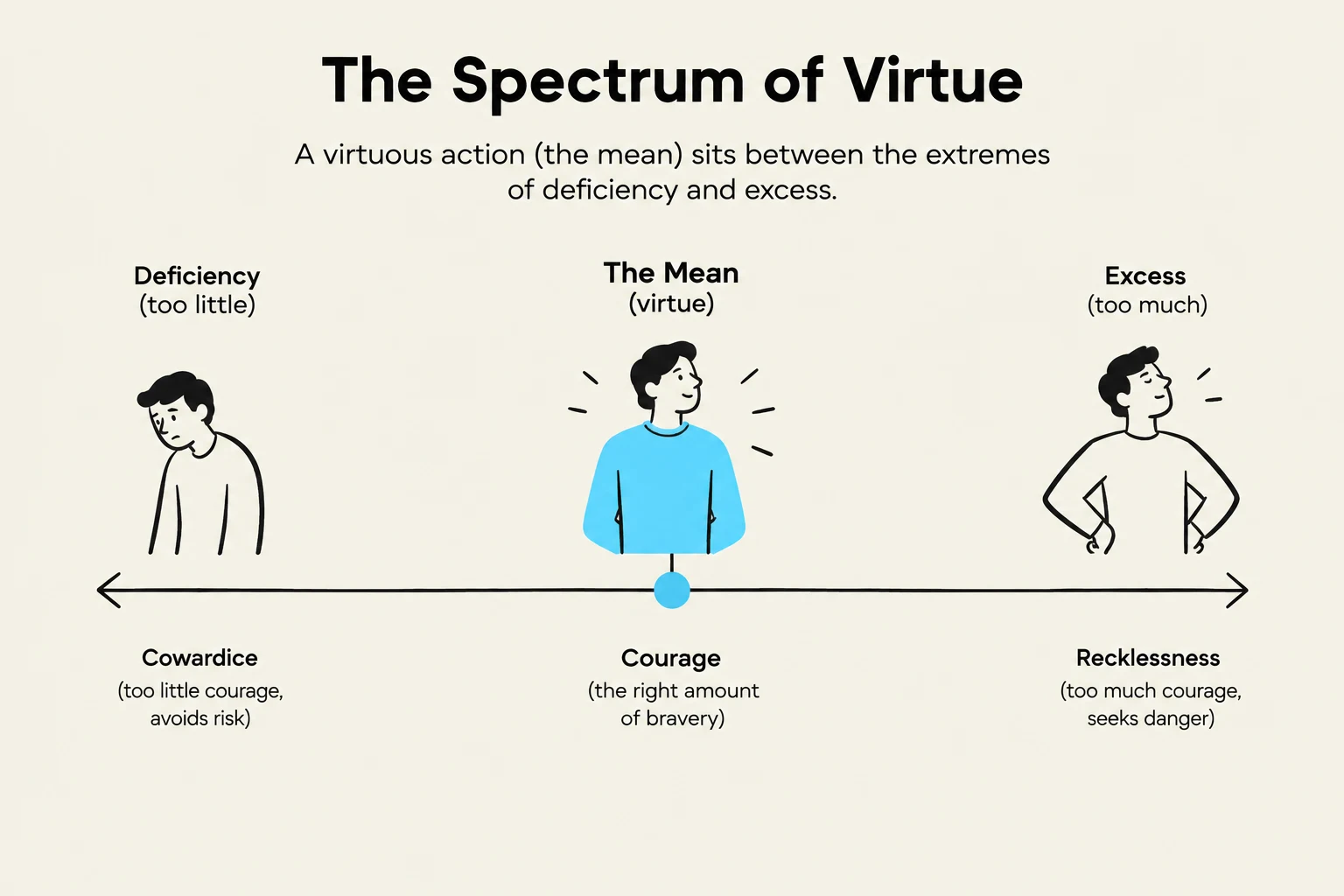
To achieve this happiness, humans must fulfill their specific function: the exercise of reason through virtue. Aristotle taught that virtue is found in "the mean"—the balanced middle ground between two extremes of behavior.
Worked Example: The Doctrine of the Mean
Consider the emotion of Fear.
Deficiency: Cowardliness (too much fear, not enough action).
Excess: Rashness (too little fear, acting without thought).
The Mean:Courage (the virtuous balance of feeling the right amount of fear and acting appropriately).
The Spectrum of Virtue illustrates that a virtuous action, or the mean, lies between the extremes of deficiency and excess, using courage as an example with cowardice and recklessness as the opposing vices.
Confucian Ethical Humanism
While the Greeks focused on individual reason, Confucius developed an "ethical humanism" in China. He believed that social harmony could only be achieved when individuals adhered to the principles of their human nature, specifically through benevolence and reciprocity. For Confucius, the heart of virtue is treating others as you wish to be treated.
The Modern Challenges: Existentialism and Power
In the 19th and 20th centuries, the idea of a universal, shared human nature came under intense scrutiny.
Nietzsche: The Will to Power
Friedrich Nietzsche launched a devastating critique of traditional morality, famously declaring that "God is dead". He argued that without a divine foundation, there are no absolute truths, only different perspectives. Nietzsche proposed that the primary driver of human life is not the pursuit of pleasure, but the "Will to Power"—the desire to increase one's influence and strength over the world.
He categorized morality into two types:
Master Morality: Values strength, intelligence, and power.
Slave Morality: Values sympathy, kindness, and humility; Nietzsche saw this as a tool used by the weak to restrain the strong.
Existentialism: Existence Precedes Essence
The most radical challenge came from Existentialists like Jean-Paul Sartre. They rejected the idea that humans have a pre-determined purpose or nature. Instead, they argued that "existence precedes essence". This means we are born first (existence) and only later define who we are through our choices (essence).
Because there is no God to define "good" or "bad," humans are "condemned to be free". We are entirely responsible for our actions, a realization that can lead to feelings of anguish, abandonment, and despair.
The Existentialist Process illustrates the journey from existence to self-created meaning, emphasizing radical freedom, responsibility, and the impact of choices on life.
The Feminist Challenge and Moral Equality
The traditional definitions of human nature have often been criticized for being exclusionary. Feminist philosophers, such as Mary Wollstonecraft, argued that the "rationalistic" view of human nature—which claims reason is the essential human characteristic—was used to justify the oppression of women.
Historically, thinkers like Aristotle associated men with rationality and women with emotions/desires, concluding that men should rule. Wollstonecraft countered this by arguing that:
All humans possess reason.
Reason is the source of moral equality and the ability to restrain animal passions.
Women's perceived "inferiority" was not a matter of nature, but a result of a lack of education and social conditioning.
Identity, Culture, and the Relativism Debate
As the concept of "human nature" evolved, it was often replaced by the concept of "identity". This shift leads to a major debate in ethics: Is morality universal, or is it relative to our culture?
Social vs. Atomistic Identity
Atomistic Theory: The individual is the sole source of their identity (e.g., Sartre's radical freedom).
Social Theory: Identity is forged by culture, traditions, and the "recognition" of others.
Ethical Relativism
Ethical relativism suggests that moral right and wrong depend entirely on one's society. This is often supported by Descriptive Relativism, which observes that different cultures do have different moral standards.
However, critics argue that ethical relativism has dangerous implications. If all moral systems are equally valid, we lose the ability to criticize practices like slavery or genocide. Furthermore, if we must always follow our culture's rules, then moral progress (like the abolition of slavery) becomes impossible, as "progress" implies moving toward a better standard.
Exam Tip: Subjectivism vs. Relativism
Do not confuse these two!
Subjectivism says morality is based on individual feelings (e.g., "I feel this is wrong").
Relativism says morality is based on societal standards (e.g., "My culture says this is wrong").
Emotivism goes a step further, claiming moral statements aren't even true or false, but are just emotional outbursts (e.g., "Boo to stealing!").
Summary Table of Perspectives
Theory
Source of Morality
View of Human Nature
Aristotelian
Fulfilling human function/reason
Fixed essence; purpose-driven
Confucian
Benevolence and reciprocity
Socially oriented; virtue-based
Nietzschean
The Will to Power
No absolute truth; power-driven
Existentialist
Radical individual choice
No essence; existence precedes essence
Wollstonecraft
Universal human reason
Equal capacity for reason
Keep reading for free.
Create an account to finish this reading and make it part of your study routine.