An overview of pharmacology, its core subdivisions (pharmacokinetics and pharmacodynamics), and the comprehensive multi-phase process of drug development from preclinical research to post-marketing surveillance. It also touches upon the autonomic nervous system.
Pharmacology is a foundational science that explores the complex relationship between chemical substances and living organisms. Derived from the Greek words pharmakon (drug) and logia (knowledge of), it provides the scientific basis for how we use medicines to treat, prevent, and diagnose diseases. Understanding pharmacology requires a dual focus: how the body handles a drug and how the drug, in turn, alters the body's functions.
The four processes of pharmacokinetics (ADME): Absorption, Distribution, Metabolism, and Excretion.
The Major Subdivisions of Pharmacology
To study the interaction between drugs and biological systems effectively, pharmacology is divided into several specialized fields:
Pharmacokinetics (PK)
Pharmacokinetics is often summarized by the phrase: "What the body does to the drug." This field focuses on the movement of a drug through the body via four primary processes:
Absorption: How the drug enters the bloodstream.
Distribution: How the drug moves from the blood into various tissues and organs.
Biotransformation (Metabolism): How the body chemically modifies the drug (often in the liver).
Excretion: How the drug and its metabolites are removed from the body.
Pharmacodynamics
Pharmacodynamics answers the question: "What the drug does to the body." This involves studying the mechanisms of action, including how drugs interact with specific receptors, the resulting therapeutic or toxic effects, and the dose-response relationship (how the intensity of the effect changes with the amount of drug administered).
Pharmacotherapeutics and Toxicology
While pharmacokinetics and pharmacodynamics focus on the mechanics, pharmacotherapeutics focuses on the clinical application—using drugs for the prevention, diagnosis, and treatment of disease. Conversely, toxicology studies the undesirable or harmful effects that therapeutic agents, poisons, or pollutants can have on biological systems.
Study Tip: On exams, if a question asks about "half-life" or "metabolism," think Pharmacokinetics. If it asks about "receptor binding" or "mechanism of action," think Pharmacodynamics.
The Drug Development Process
Bringing a new drug to market is a monumental task that takes an average of 8 to 20 years. The process is highly regulated to ensure that every medication reaching a patient is both safe and effective.
Preclinical Phase
The journey begins with the synthesis of a lead compound. Before any human is ever exposed to the substance, it must undergo in vitro (test tube/cell culture) studies and animal testing. This preclinical phase is essential for assessing basic safety and biological activity.
The IND Application
Once a manufacturer has sufficient preclinical data, they must submit an Investigational New Drug (IND) application to the FDA. This application serves as a request for permission to begin testing the drug in human subjects.
The Four Phases of Clinical Trials
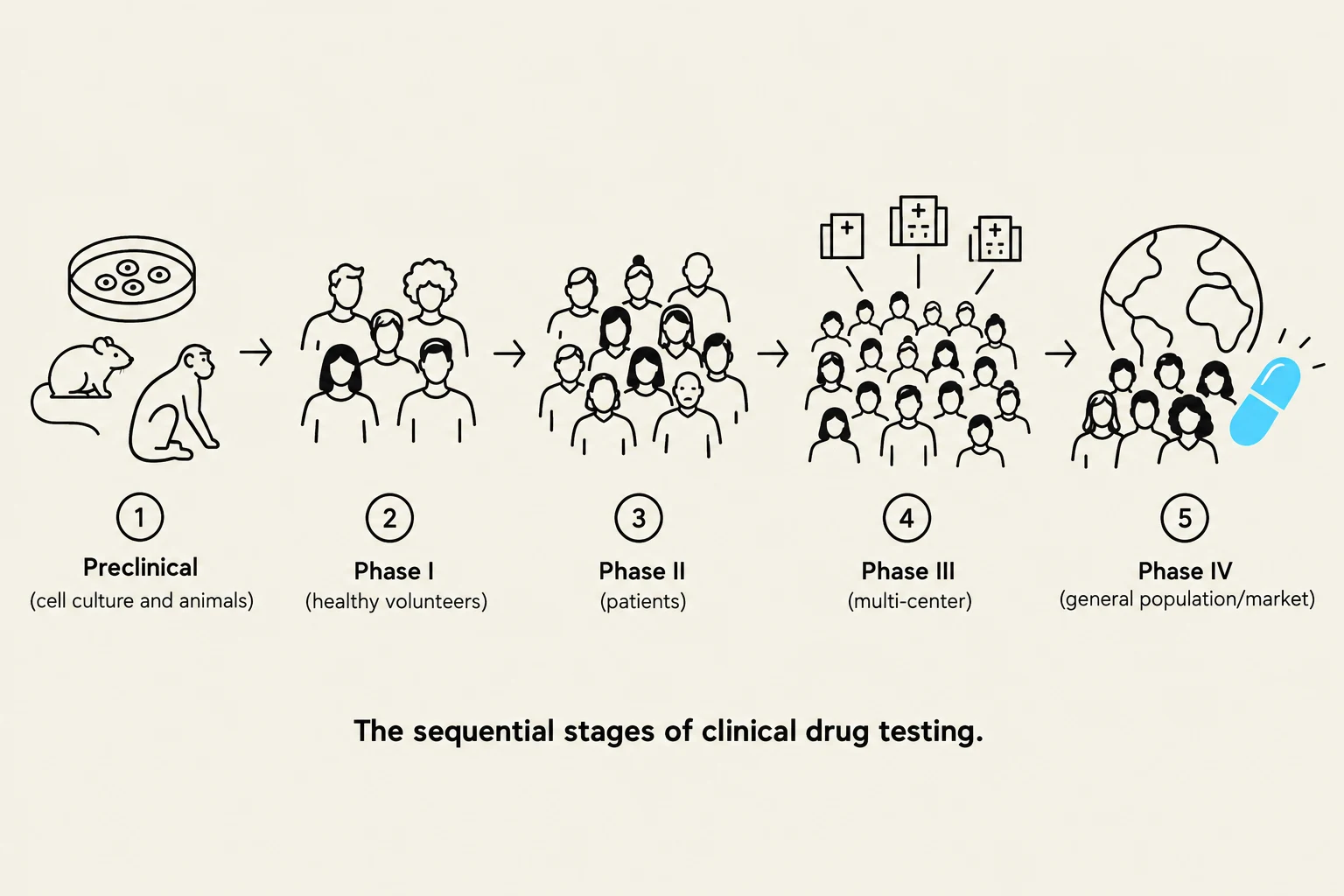
The sequential stages of clinical drug testing.
If the IND is approved, the drug enters the clinical testing phase, which is divided into four distinct stages:
Phase
Population
Primary Goal
Phase I
Small number of normal human volunteers
Study PK and monitor acute effects/safety
Phase II
Moderate number of patients with the target disease
Determine efficacy and non-toxic dosing
Phase III
Large-scale, multi-center studies
Confirm efficacy and compare to control drugs
Phase IV
General population (post-marketing)
Long-term surveillance and late-emerging toxicities
Phase I: Safety and PK
In Phase I, the drug is administered to a small group of normal human volunteers. Researchers monitor the drug's pharmacokinetics and observe acute effects—ranging from negligible to mildly toxic—across a wide range of doses.
Phase II: Efficacy in Patients
Phase II moves the drug into a moderate number of patients who actually possess the target disease. To ensure scientific rigor, these studies often use single or double-blinded designs and include a placebo. The goal is to see if the drug actually works at a non-toxic level.
Phase III: Large-Scale Confirmation
Phase III is a massive undertaking. The drug is tested on a much larger scale, often across many centers nationwide. Unlike Phase II, these studies use a control drug and are designed to mimic the drug's intended final use in the real world.
If Phase III is successful, the manufacturer submits a New Drug Application (NDA) to the FDA for marketing approval.
Phase IV: Post-Marketing Surveillance
Even after a drug is available to the public, testing does not stop. Phase IV occurs post-marketing to perform long-term surveillance. This phase is critical for identifying rare or late-emerging toxicities that might not have appeared in smaller clinical trials.
Note on Patents: A drug is protected by a patent for typically 20 years from the date of the initial application filing. Once this patent expires, generics can enter the market.
A Note on the Autonomic Nervous System (ANS)
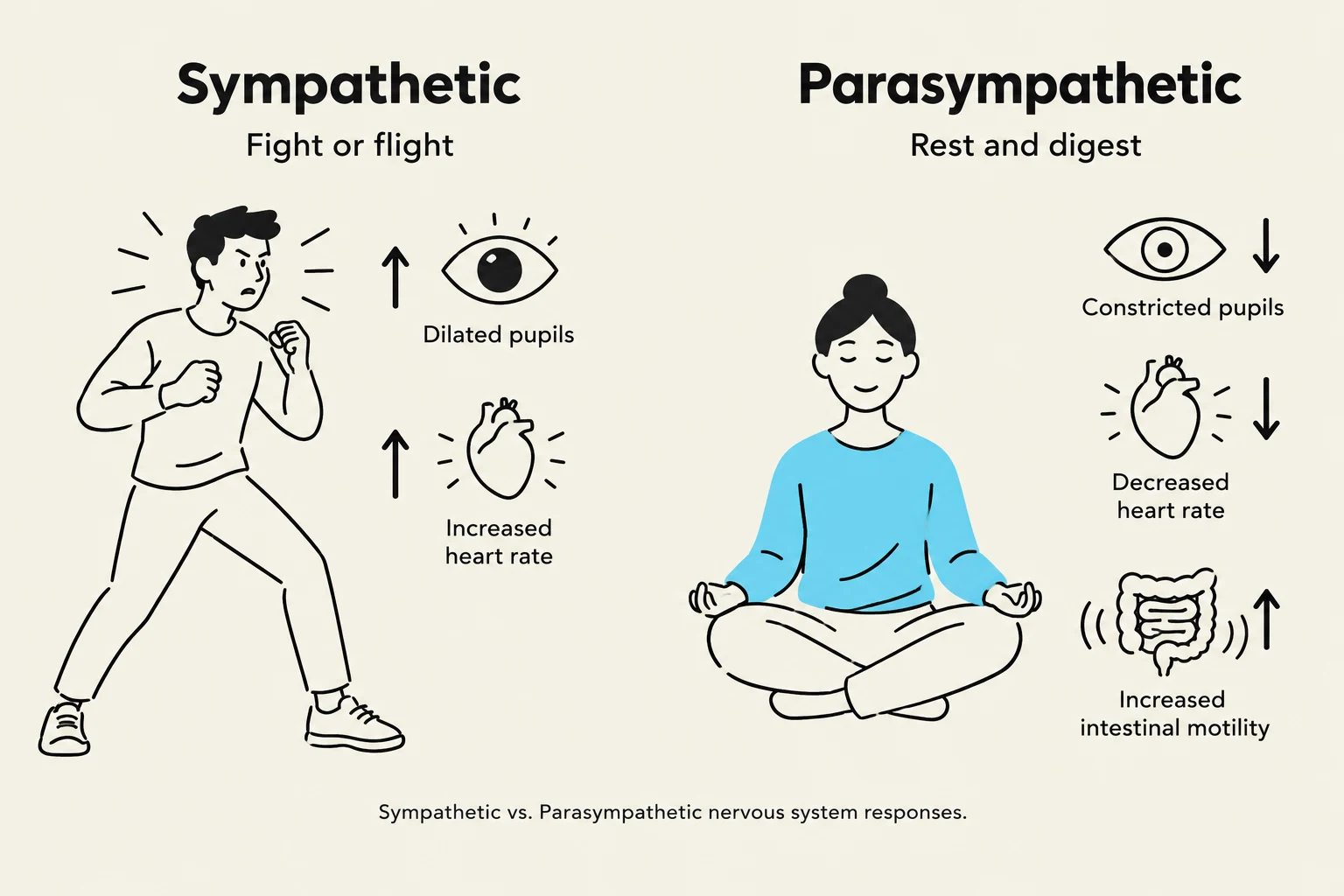
This illustration depicts the contrasting effects of the sympathetic ('fight or flight') and parasympathetic ('rest and digest') nervous systems on the body, including pupil dilation/constriction, heart rate, and intestinal motility.
While the drug development process applies to all medications, many drugs target the Autonomic Nervous System (ANS), which regulates involuntary functions like heart rate, blood pressure, and intestinal motility.
The ANS is divided into the Sympathetic and Parasympathetic systems, which often act in opposition to maintain homeostasis:
Sympathetic Nervous System: Known as the "fight or fight" system. It uses adrenergic receptors (α and β) and neurotransmitters like norepinephrine to prepare the body for action (e.g., increasing heart rate and dilating pupils).
Parasympathetic Nervous System: Known as the "rest and digest" system. It uses cholinergic receptors (muscarinic and nicotinic) and the neurotransmitter acetylcholine to promote maintenance functions (e.g., slowing heart rate and increasing intestinal motility).
Understanding these physiological responses is crucial for pharmacologists, as many drugs are designed to either mimic or block these specific autonomic actions.
Keep reading for free.
Create an account to finish this reading and make it part of your study routine.