An overview of antimicrobial agents, their mechanisms of action, clinical classifications, and common side effects, including detailed information on various antibiotic classes.
Understanding the pharmacology of antimicrobials is essential for preventing infection and managing patient safety. Antimicrobial agents are substances that inhibit the growth of or kill microorganisms. When studying these drugs, it is vital to distinguish between their primary mechanisms of action and their clinical classifications.
Fundamental Concepts: Bactericidal vs. Bacteriostatic
Before diving into specific drug classes, you must understand the two primary ways antibiotics interact with bacteria:
Bactericidal drugs: These agents actively kill the bacteria.
Bacteriostatic drugs: These agents inhibit the growth and reproduction of bacteria, allowing the host's immune system to finish the job.
Additionally, drugs are categorized by their spectrum of activity. A narrow-spectrum antibiotic is effective against a specific type of bacteria (e.g., penicillin), while a broad-spectrum antibiotic is effective against a wide range of both Gram-positive and Gram-negative bacteria (e.g., tetracyclines).
Clinical Note: Superinfection
A common risk with all antimicrobials is superinfection. This occurs when the drug kills the "normal flora" (the beneficial bacteria in the body), allowing opportunistic pathogens to overgrow. A classic example is Clostridium difficile-associated diarrhea.
Antibiotics Targeting Cell Wall Synthesis
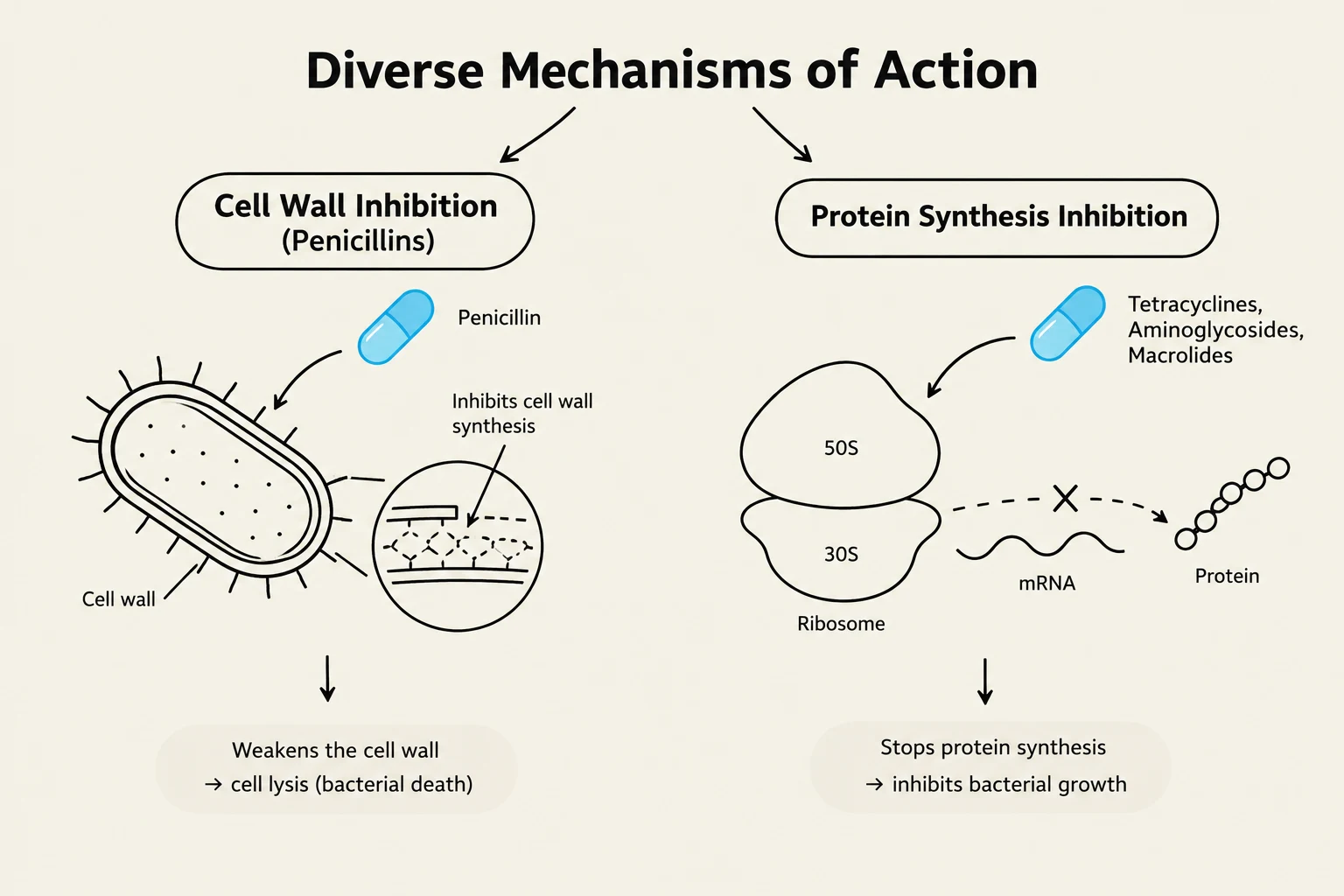
The bacterial cell wall is a primary target because human cells do not possess one. By disrupting this structure, these drugs cause the bacteria to lyse (burst).
Penicillins and Cephalosporins
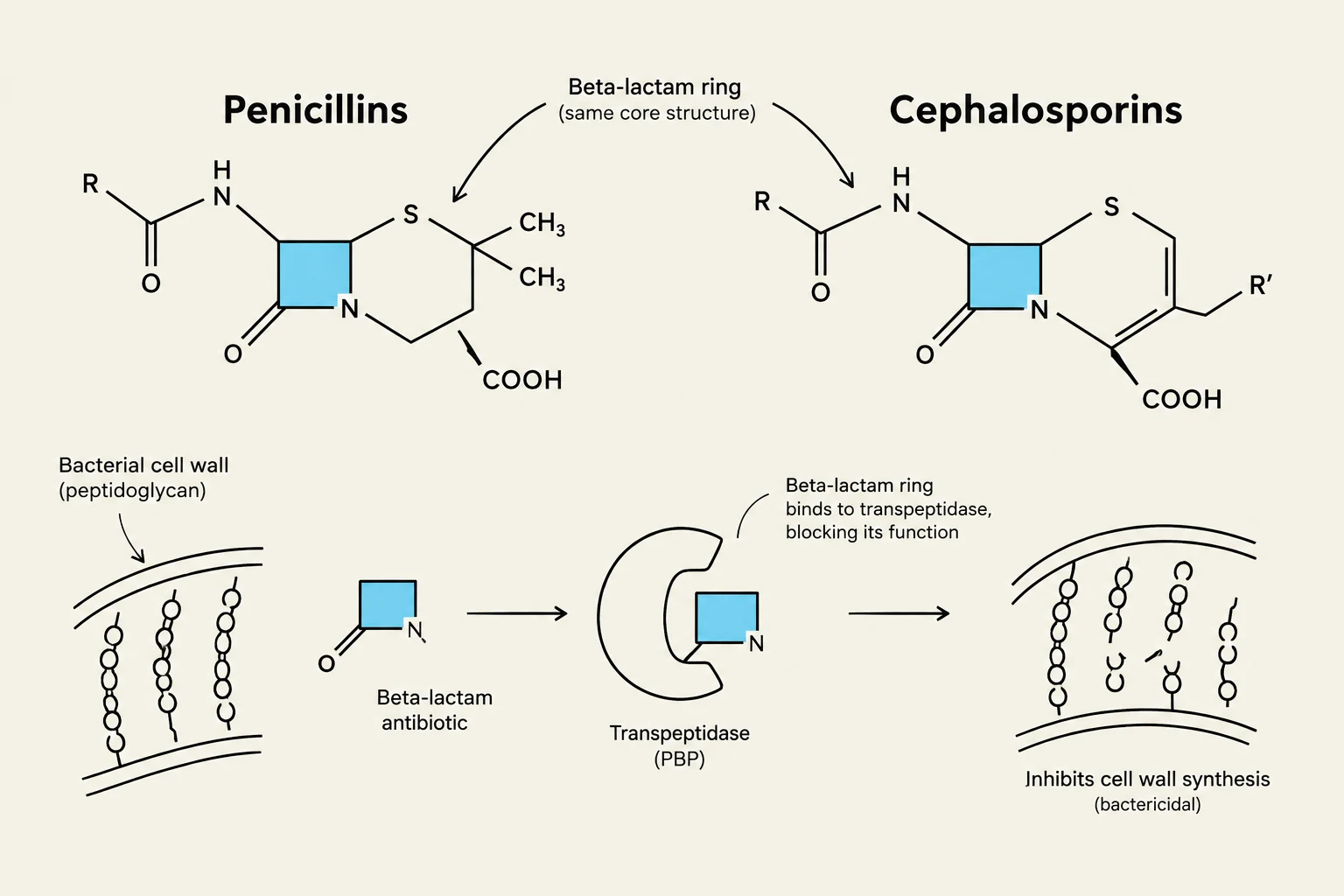
Both of these classes utilize a beta-lactam ring to interfere with cell wall synthesis.
Penicillins: These can be bacteriostatic or bactericidal depending on the specific drug and dosage. While highly effective for respiratory and skin infections, they carry a significant risk of hypersensitivity and anaphylaxis.
Cephalosporins: These are strictly bactericidal. They are organized into five generations; as you move from the first to the fifth generation, the spectrum of bacteria they cover becomes broader, and they become more resistant to destruction by bacterial enzymes called beta-lactamases.
Safety Alert: Cross-Sensitivity
Because both classes share the beta-lactam ring, there is a risk of cross-sensitivity. If a patient is allergic to penicillin, they may also react to cephalosporins. Furthermore, certain cephalosporins like cefotetan can cause a disulfiram-like reaction (flushing, nausea, vomiting) if the patient consumes alcohol.
Diagram illustrating the chemical structures of Penicillins and Cephalosporins, and their mechanism of action in inhibiting bacterial cell wall synthesis by binding to transpeptidase (PBP).
Glycopeptides (Vancomycin)
Vancomycin is a potent bactericidal agent used for severe infections, most notably MRSA (Methicillin-resistant Staphylococcus aureus).
A unique clinical phenomenon associated with Vancomycin is "red man syndrome." This is characterized by red blotching of the face, neck, and chest, often accompanied by hypotension and tachycardia. This is not a true allergy but is caused by rapid IV infusion; the nursing intervention is to slow the infusion rate. Because of the risk of ototoxicity (hearing loss) and nephrotoxicity (kidney damage), clinicians must monitor serum vancomycin levels closely.
Antibiotics Targeting Protein Synthesis
These drugs enter the bacterial cell and interfere with the ribosomes, preventing the bacteria from creating the proteins necessary for life.
Macrolides
Examples include Erythromycin and Azithromycin. They are generally bacteriostatic at low to moderate doses but can become bactericidal at high doses. They are frequently used for respiratory and skin infections, but patients should be monitored for hepatotoxicity (liver damage) and GI distress.
Tetracyclines
Doxycycline is a classic broad-spectrum, bacteriostatic tetracycline. While effective against many infections, it has strict contraindications:
Pediatric Use: It is not recommended for children under 8 years old because it can cause permanent discoloration of teeth, nails, and the tongue.
Photosensitivity: Patients must be warned about increased sensitivity to sunlight.
Interactions: It may decrease the effectiveness of oral contraceptives.
Aminoglycosides
Drugs like Gentamicin are bactericidal and highly effective against Gram-negative bacteria. However, they have a very narrow therapeutic index, meaning the line between a healing dose and a toxic dose is thin.
Nursing Priority: Peak and Trough
To prevent severe nephrotoxicity and ototoxicity (such as tinnitus/ringing in the ears), nurses must monitor peak and trough serum levels. If a patient reports ringing in the ears, this is a red flag for ototoxicity.
Diagram illustrating the mechanisms of action of Aminoglycosides and Tetracyclines on bacterial ribosomes, focusing on their binding to the 30S ribosomal subunit and their effects on protein synthesis.
Other Antimicrobial Mechanisms
Fluoroquinolones
Ciprofloxacin works by interfering with the synthesis of bacterial DNA, making it bactericidal. While effective for UTIs and respiratory infections, this class carries a serious Black Box Warning due to the risk of tendon rupture, tendonitis, and peripheral neuropathy.
Sulfonamides
Bactrim (Trimethoprim-Sulfamethoxazole) is a bacteriostatic agent that works by inhibiting the synthesis of folic acid, which bacteria need to survive. A major concern with sulfonamides is renal health; they can cause crystalluria (crystals in the urine), proteinuria, and even renal failure.
Nitroimidazoles
Metronidazole (Flagyl) is a bactericidal drug that disrupts both DNA and protein synthesis. It is particularly effective against protozoa (like Giardia) and certain bacteria like Clostridium.
Exam Tip: Alcohol Interaction
Like cephalosporins, Metronidazole can cause a disulfiram-like reaction when combined with alcohol, leading to nausea, vomiting, and headache.
This diagram illustrates two diverse mechanisms of action for antibiotics: cell wall inhibition by penicillins, leading to bacterial death, and protein synthesis inhibition by other antibiotics, which halts bacterial growth.
Summary Table of Key Antimicrobials
Class
Mechanism
Key Side Effects
Clinical Pearl
Penicillins
Cell Wall Synthesis
Anaphylaxis, Superinfection
Check for penicillin allergy
Cephalosporins
Cell Wall Synthesis
Cross-sensitivity, Disulfiram-like rxn
5 generations of spectrum
Glycopeptides
Cell Wall Synthesis
Red Man Syndrome, Ototoxicity
Slow the IV infusion
Macrolides
Protein Synthesis
Hepatotoxicity, GI distress
Bacteriostatic (usually)
Tetracyclines
Protein Synthesis
Tooth discoloration, Photosensitivity
Avoid in children < 8 years
Aminoglycosides
Protein Synthesis
Nephrotoxicity, Ototoxicity
Monitor peak/trough levels
Fluoroquinolones
DNA Synthesis
Tendon rupture, Peripheral neuropathy
Black Box Warning
Sulfonamides
Folic Acid Synthesis
Crystalluria, Renal failure
Monitor renal function
Nitroimidazoles
DNA/Protein Synthesis
Disulfiram-like reaction
Avoid alcohol
Keep reading for free.
Create an account to finish this reading and make it part of your study routine.