This content provides an overview of medications used to manage cardiac disorders, including their mechanisms of action, effects on preload and afterload, and nursing considerations. It covers ACE inhibitors, ARBs, ARNIs, diuretics, beta blockers, and digitalis glycosides, along with critical concepts like electrolyte
Managing cardiac disorders requires a sophisticated understanding of how medications influence the hemodynamics of the heart and blood vessels. To effectively treat conditions like heart failure, hypertension, and angina, clinicians must manipulate two primary variables: preload and afterload. Preload refers to the volume of blood returning to the heart (venous return), while afterload refers to the resistance the heart must pump against (peripheral vascular resistance). By adjusting these forces, we can optimize cardiac output—the volume of blood the heart pumps per minute—to ensure tissues receive adequate oxygenation.
The Renin-Angiotensin-Aldosterone System (RAAS) and Vasoconstriction
The RAAS is a hormonal cascade that regulates blood pressure and fluid balance. When the body senses low blood pressure, it activates this system, leading to vasoconstriction (increasing afterload) and sodium/water retention (increasing preload). In chronic heart failure, the RAAS is often overactive, creating a vicious cycle that stresses the failing heart.
ACE Inhibitors
Angiotensin-Converting Enzyme (ACE) inhibitors are a primary choice for patients with systolic heart failure. They work by suppressing the formation of Angiotensin II, a potent vasoconstrictor. By blocking this process, ACE inhibitors decrease afterload, improve cardiac output, and enhance renal blood flow. Furthermore, they suppress aldosterone, which promotes the excretion of sodium and water, thereby reducing preload.
Nursing Alert: Patients on ACE inhibitors should be monitored for a persistent, dry cough and the potentially life-threatening side effect of angioedema (swelling of the face/airways).
Angiotensin Receptor Blockers (ARBs) and ARNIs
For patients who cannot tolerate the side effects of ACE inhibitors (such as the cough), ARBs serve as an alternative by blocking the receptors that Angiotensin II acts upon.
A newer class of medication, Angiotensin Receptor Neprilysin Inhibitors (ARNIs) like sacubitril/valsartan, provides a dual approach. These drugs increase the levels of beneficial natriuretic peptides while simultaneously suppressing the negative effects of the RAAS.
Diuretics: Managing Fluid Volume
Diuretics are essential in treating heart failure because they reduce edema and pulmonary venous pressure by decreasing preload. They are categorized based on where they act in the kidney and their effect on electrolytes.
Thiazide and Loop Diuretics
Thiazide Diuretics (e.g., Hydrochlorothiazide): These inhibit sodium reabsorption in the distal tubule, leading to a sustained decrease in peripheral vascular resistance. They are effective only if kidney function is normal.
Loop Diuretics (e.g., Furosemide): These act on the loop of Henle and produce a much more profound diuresis than thiazides. They are often used when renal impairment is present.
Both classes are "potassium-wasting," meaning they increase the excretion of potassium.
Critical Concept: Electrolyte Imbalance
Managing potassium levels is vital when using diuretics.
Hypokalemia (Low $K^+$): Common with diuretics; significantly increases the risk of digoxin toxicity and dysrhythmias.
Hyperkalemia (High $K^+$): A risk when ACE inhibitors or potassium-sparing diuretics are used.
Beta Blockers: Reducing Cardiac Demand
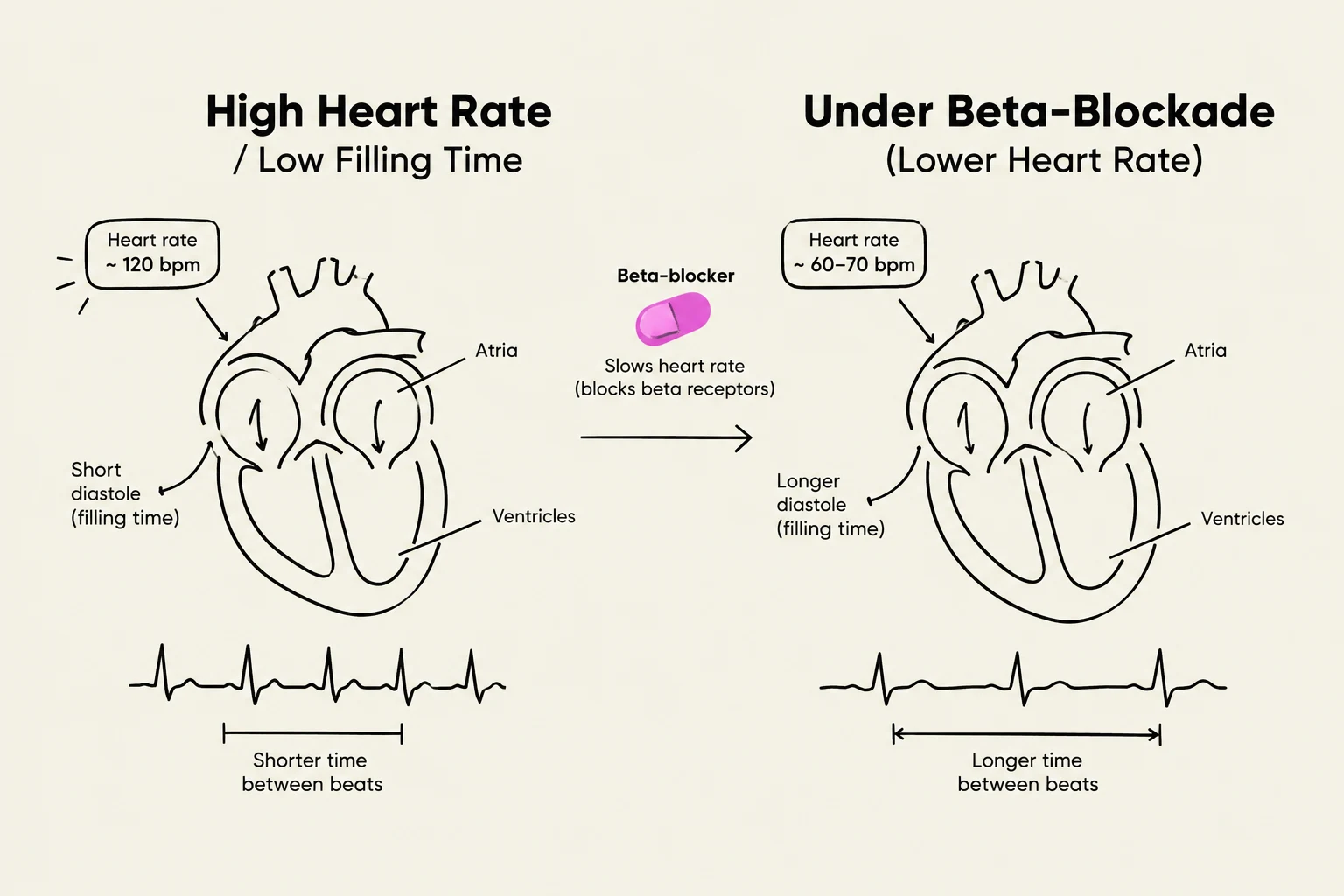
Beta blockers (e.g., metoprolol, atenolol) work by blocking β1 and/or β2 receptors. In the heart, blocking β1 receptors decreases heart rate, contractility, and conduction.
While this might seem counterintuitive in heart failure, reducing the heart rate increases "filling time," allowing the heart to pump more efficiently and reducing the overall oxygen demand of the myocardium. This helps increase survival after a myocardial infarction (MI).
This diagram illustrates the effect of a beta-blocker on heart rate and filling time. A high heart rate with low filling time is shown on the left, while the effect of a beta-blocker, which slows the heart rate and increases filling time, is shown on the right.
Digitalis Glycosides: Increasing Contractility
Digitalis glycosides, such as digoxin, are used to exert a positive inotropic effect, meaning they increase the force of ventricular contractions. This increases cardiac output. Simultaneously, they decrease sympathetic tone, which lowers the heart rate and decreases afterload.
Digoxin Toxicity
Digoxin has a narrow therapeutic range (0.5–0.8 ng/mL). Toxicity can be caused by several factors, most notably hypokalemia. When potassium levels are low, the effect of digoxin is enhanced, making toxicity much more likely.
Cardiac: Bradycardia, AV block, or ventricular dysrhythmias.
The antidote for severe digoxin toxicity is digoxin immune FAB (DigiFab).
Nursing Considerations for Cardiac Medications
Pharmacological management of cardiac patients requires vigilant monitoring to ensure safety and efficacy.
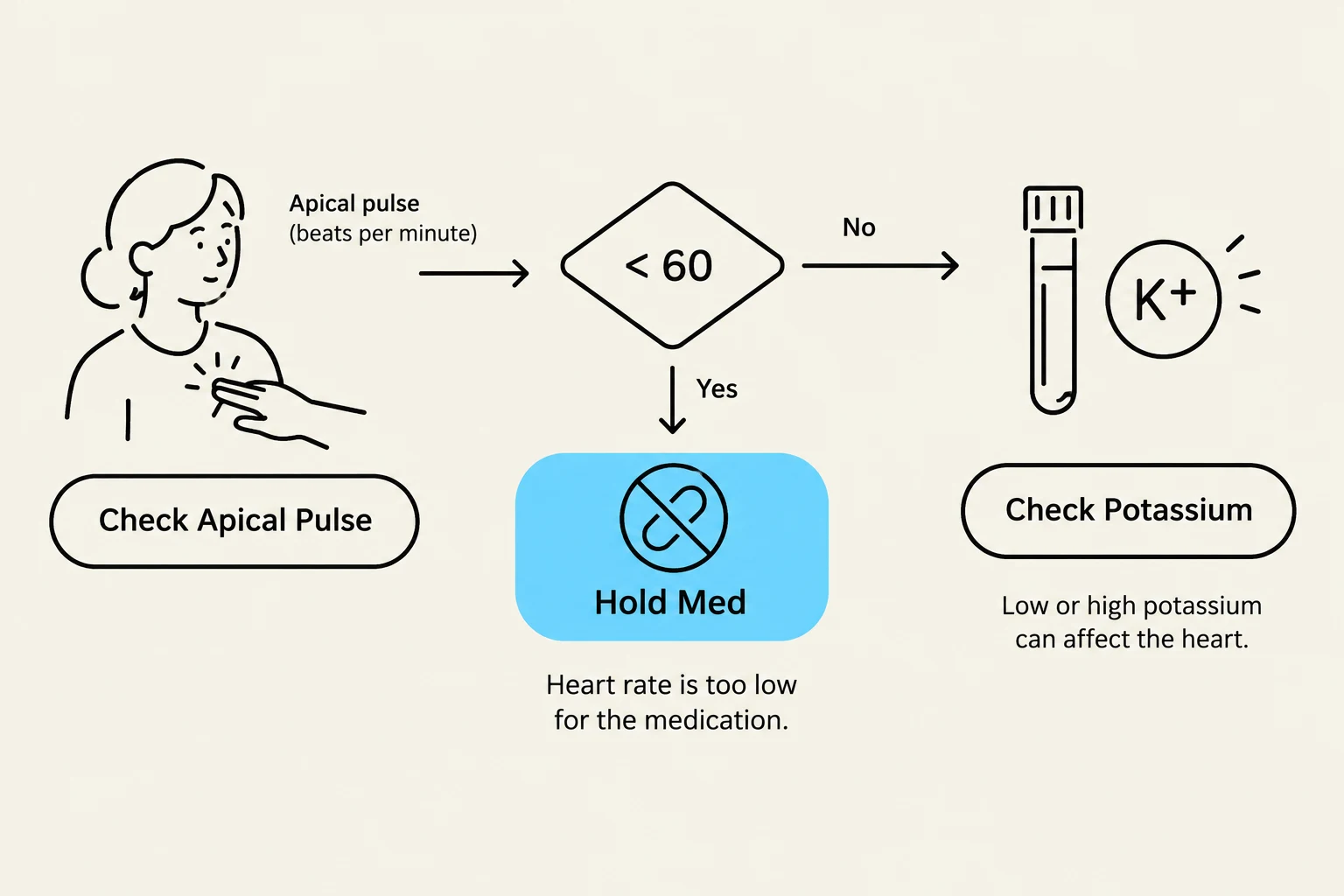
Vital Sign Assessment: Always check the apical pulse for one full minute and assess blood pressure before administering beta blockers or digoxin. Do not administer if the heart rate is <60 beats per minute.
Electrolyte Monitoring: Frequent monitoring of potassium ($K^+$) is mandatory, especially for patients on a combination of diuretics, ACE inhibitors, and digoxin.
Weight and Output: For patients on diuretics, obtain daily weights and monitor urinary output to assess the effectiveness of fluid management.
Drug Interactions:
NSAIDs: Can decrease the effectiveness of both ACE inhibitors and diuretics.
Verapamil: Can increase serum levels of digoxin, increasing the risk of toxicity.
Grapefruit Juice: Should be avoided with many cardiac medications, including statins and calcium channel blockers.
This flowchart illustrates a medical decision-making process for holding medication based on apical pulse rate and potassium levels. If the apical pulse is less than 60 beats per minute, the medication should be held. If the apical pulse is 60 or above, the potassium level should be checked, as abnormal levels can affect the heart.
Keep reading for free.
Create an account to finish this reading and make it part of your study routine.