An overview of barbiturates as CNS depressants, their mechanism of action on GABA-A receptors, chemical classification, clinical effects, and adverse considerations in anesthesia and sedation.
Barbiturates represent a foundational class of central nervous system (CNS) depressants used in clinical practice for a variety of purposes, including the induction of anesthesia, sedation, and the management of seizure disorders. Derived chemically from barbituric acid—the product of the condensation of malonic acid and urea—these agents are characterized by their ability to profoundly alter neuronal excitability. While newer agents like propofol have largely superseded them in routine induction, barbiturates remain clinically significant due to their unique pharmacodynamic profiles and anticonvulsant properties.
Mechanism of Action: The GABA-A Receptor
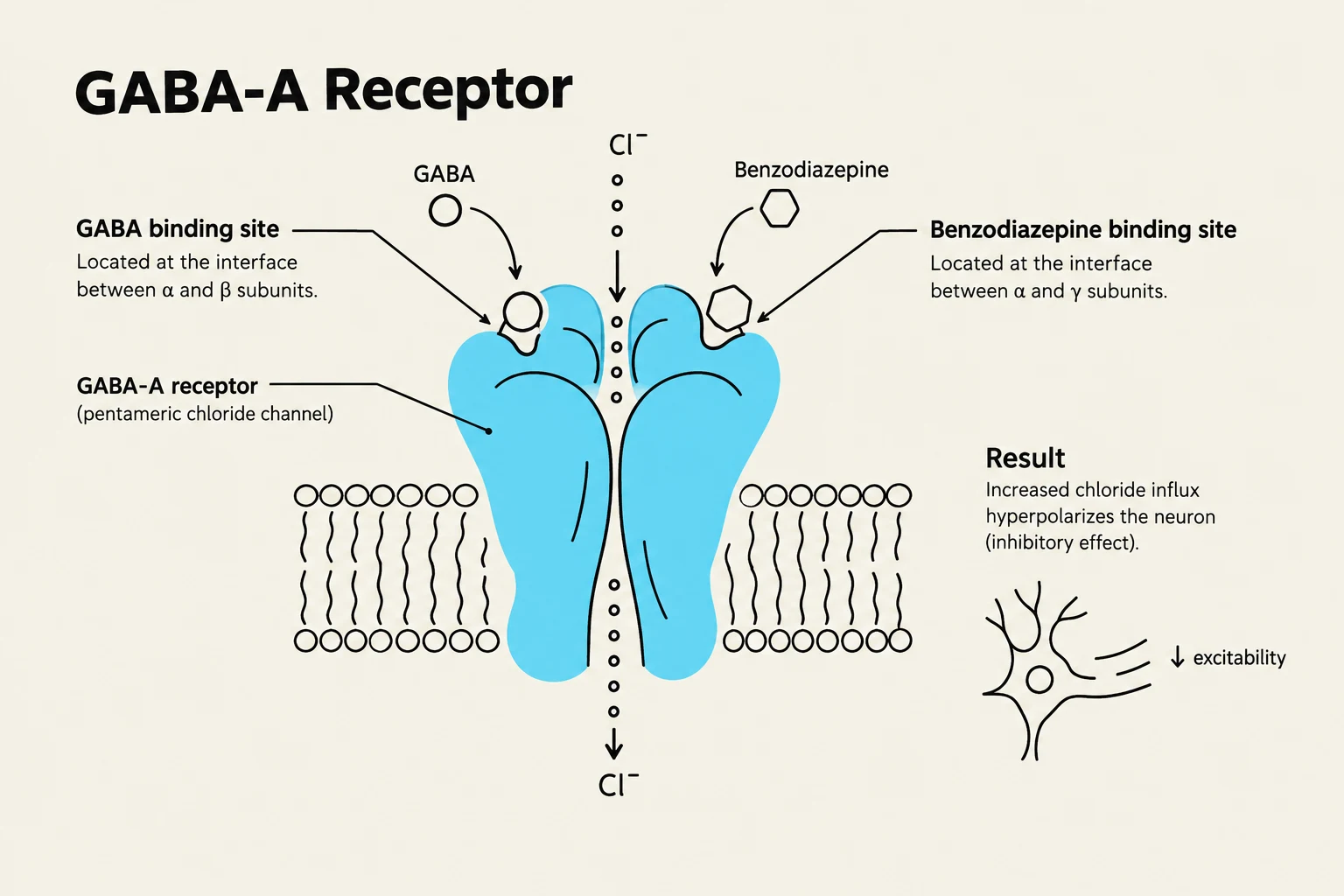
The primary mechanism of action for barbiturates involves the potentiation of the γ-aminobutyric acid (GABA) system, which is the major inhibitory neurotransmitter in the brain. Specifically, barbiturates act on the GABAA receptor, a ligand-gated ion channel composed of multiple protein subunits (typically α, β, γ, δ, and ϵ).
When GABA binds to its specific site on the receptor, it triggers the opening of a transmembrane chloride (Cl−) channel. Barbiturates act as allosteric modulators; they bind to a distinct site on the receptor to increase the receptor's sensitivity to GABA or, at higher concentrations, can directly open the chloride channel even in the absence of endogenous GABA. The resulting influx of negatively charged chloride ions leads to cellular hyperpolarization, making the neuron less likely to fire an action potential, thereby inducing CNS depression.
Exam Tip: Distinguish between Benzodiazepines and Barbiturates. Benzodiazepines increase the frequency of channel opening in response to GABA, whereas barbiturates increase the duration of channel opening and can directly activate the channel at high doses.
Diagram illustrating the GABA-A receptor, a pentameric chloride channel, showing the binding sites for GABA and benzodiazepine, and the resulting effect of increased chloride influx leading to decreased neuronal excitability.
Beyond GABAA modulation, barbiturates may also influence glutamate, adenosine, and neuronal nicotinic acetylcholine receptors, contributing to their broad spectrum of CNS depressant effects.
Chemical Classification
Barbiturates are classified based on their chemical structure, which significantly dictates their onset and duration of action.
Oxybarbiturates
Oxybarbiturates contain an oxygen molecule at the 2-position of the barbiturate ring. A prominent example is pentobarbital, an intermediate-acting agent. Pentobarbital is frequently utilized for sedation, anesthesia, and as an anticonvulsant. Its clinical profile typically involves an onset of action within 3–5 minutes, reaching peak effect at approximately 10 minutes.
Thiobarbiturates
Thiobarbiturates are characterized by the replacement of the oxygen at the 2-position with a sulfur molecule. This chemical modification results in much higher lipid solubility, which translates to a significantly more rapid onset of action compared to oxybarbiturates, making them suitable for rapid induction of anesthesia.
Clinical Effects and Applications
The clinical utility of barbiturates is dose-dependent, spanning a spectrum of CNS depression:
Sedation and Hypnosis: At lower doses, they produce a state of calm or sleep.
Anesthesia: Higher doses induce a state of unconsciousness, often accompanied by amnesia (loss of memory) and akinesia (loss of movement).
Muscle Relaxation: Barbiturates contribute to decreased muscle tone.
Anticonvulsant Activity: Due to their profound inhibitory effect on neuronal firing, they are effective in treating seizure activity.
This chart compares the pharmacodynamic effects of three intravenous anesthetics: Thiopental, Propofol, and Ketamine, detailing their impact on the central nervous system, cardiovascular system, respiratory system, muscle relaxation, and other physiological aspects.
Clinical Considerations and Adverse Effects
While effective, the use of barbiturates requires careful monitoring due to several significant side effects.
Cardiovascular and Respiratory Depression
A major concern with barbiturate administration is the depression of the respiratory and cardiovascular systems. They can cause a decrease in systemic blood pressure and a decrease in cardiac output.
Certain agents, such as thiopental, exhibit parasympathomimetic activity that may trigger bronchospasm. In clinical settings, this can be managed by pretreating the patient with atropine to induce bronchodilation.
Pediatric Sensitivity
When administering barbiturates to pediatric patients, clinicians must be aware of increased pain sensitivity. To ensure patient comfort and prevent physiological stress, barbiturates should be administered in conjunction with appropriate analgesics during painful procedures.
Clinical Note: Because anesthetic effects "can't be taken back" once administered, the choice of dose and timing must be precisely calculated based on the patient's age, weight, and comorbidities.
This diagram illustrates the pharmacokinetic processes of drug distribution, redistribution, and elimination in the body following intravenous administration. It shows how a drug is distributed to various organs, then redistributed to tissues like the brain, muscle, and adipose tissue, and finally eliminated, primarily through the liver, with metabolites excreted in urine. A graph depicts the plasma concentration of the drug over time, showing an initial peak followed by a decline.
Keep reading for free.
Create an account to finish this reading and make it part of your study routine.