An overview of the pharmacological agents used to treat asthma and chronic obstructive pulmonary disease (COPD), including bronchodilators, anti-inflammatory agents, and other relevant drug classes. This content details their mechanisms of action, classifications, and common adverse effects.
Respiratory diseases such as asthma and Chronic Obstructive Pulmonary Disease (COPD) represent significant global health burdens. While both involve impaired airflow, they differ fundamentally in their pathophysiology and management strategies. Asthma is characterized by chronic airway inflammation and hyperresponsiveness, often presenting with intermittent symptoms triggered by allergens, exercise, or irritants. In contrast, COPD is a progressive disease, most commonly caused by smoking, which involves structural changes in the lungs. Understanding the pharmacological tools available to manage these conditions—ranging from rapid-acting bronchodilators to long-term anti-inflammatory agents—is essential for effective clinical practice.
Pathophysiology: Asthma vs. COPD
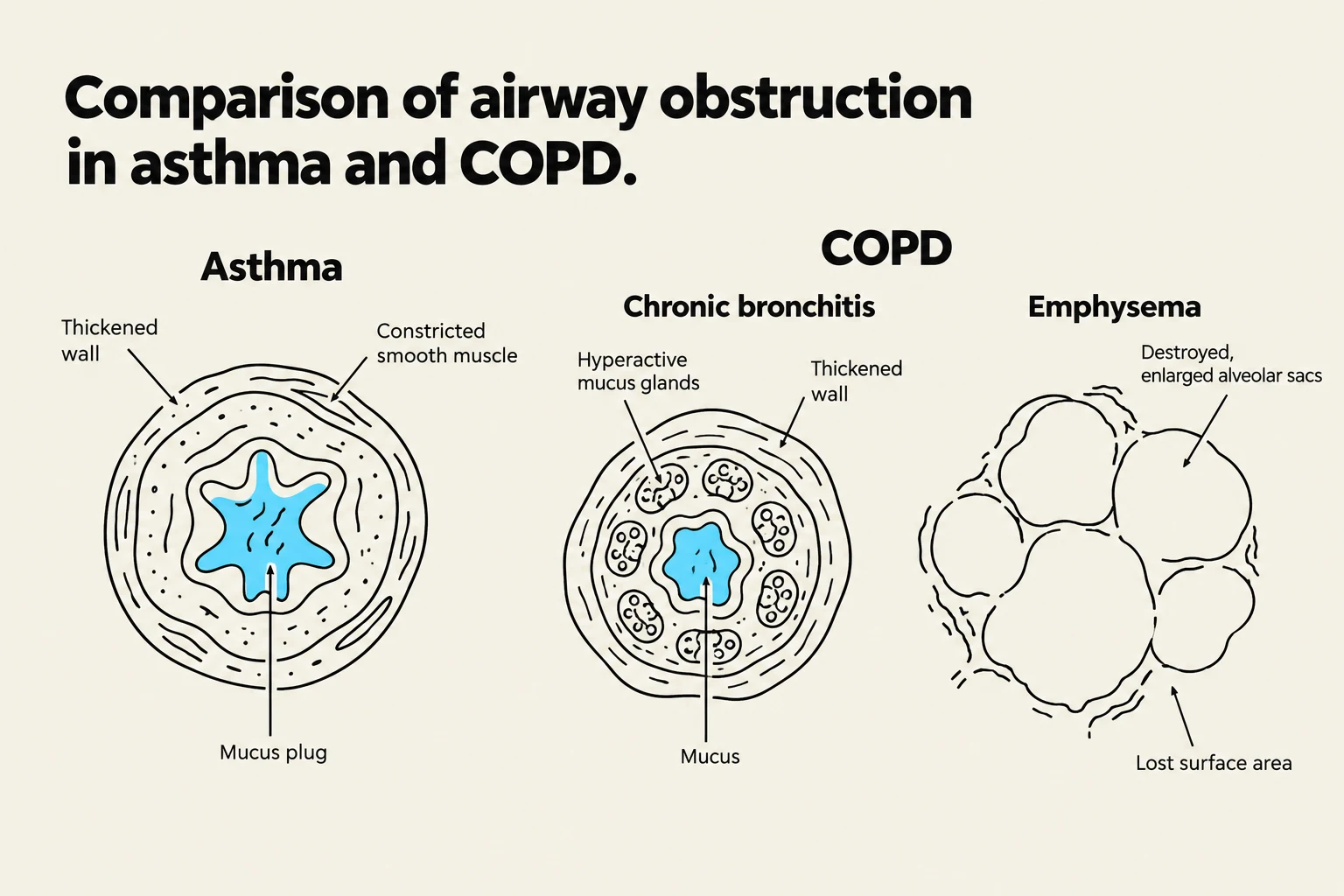
Comparison of airway obstruction in asthma and COPD, illustrating the differences in airway walls, mucus production, and alveolar sacs.
To treat these diseases effectively, one must understand the underlying mechanisms of airway obstruction.
Asthma
Asthma is a chronic inflammatory disease of the airways. During an attack, several factors contribute to limited airflow:
Bronchoconstriction: Tightened smooth muscles constrict the airway.
Inflammation: The airway walls become thickened and inflamed.
Mucus Production: Excessive mucus further narrows the passage.
The "allergic cascade" plays a major role in many patients. Exposure to an allergen leads to sensitization, an early-phase response, and a more severe late-phase response involving the release of mediators like histamine, leukotrienes, and prostaglandins from mast cells.
COPD
COPD is a progressive condition that encompasses two primary clinical phenotypes:
Chronic Bronchitis: Characterized by thickened airway walls and increased mucus production.
Emphysema: Characterized by the destruction of the alveolar structures.
Unlike the intermittent nature of asthma, COPD involves persistent airflow obstruction driven by chronic inflammation from inhaled noxious particles, such as cigarette smoke.
Bronchodilators: Sympathomimetics and Muscarinic Antagonists
Bronchodilators are the cornerstone of symptomatic relief, working to relax the smooth muscles of the airways.
Sympathomimetics (β2 Agonists)
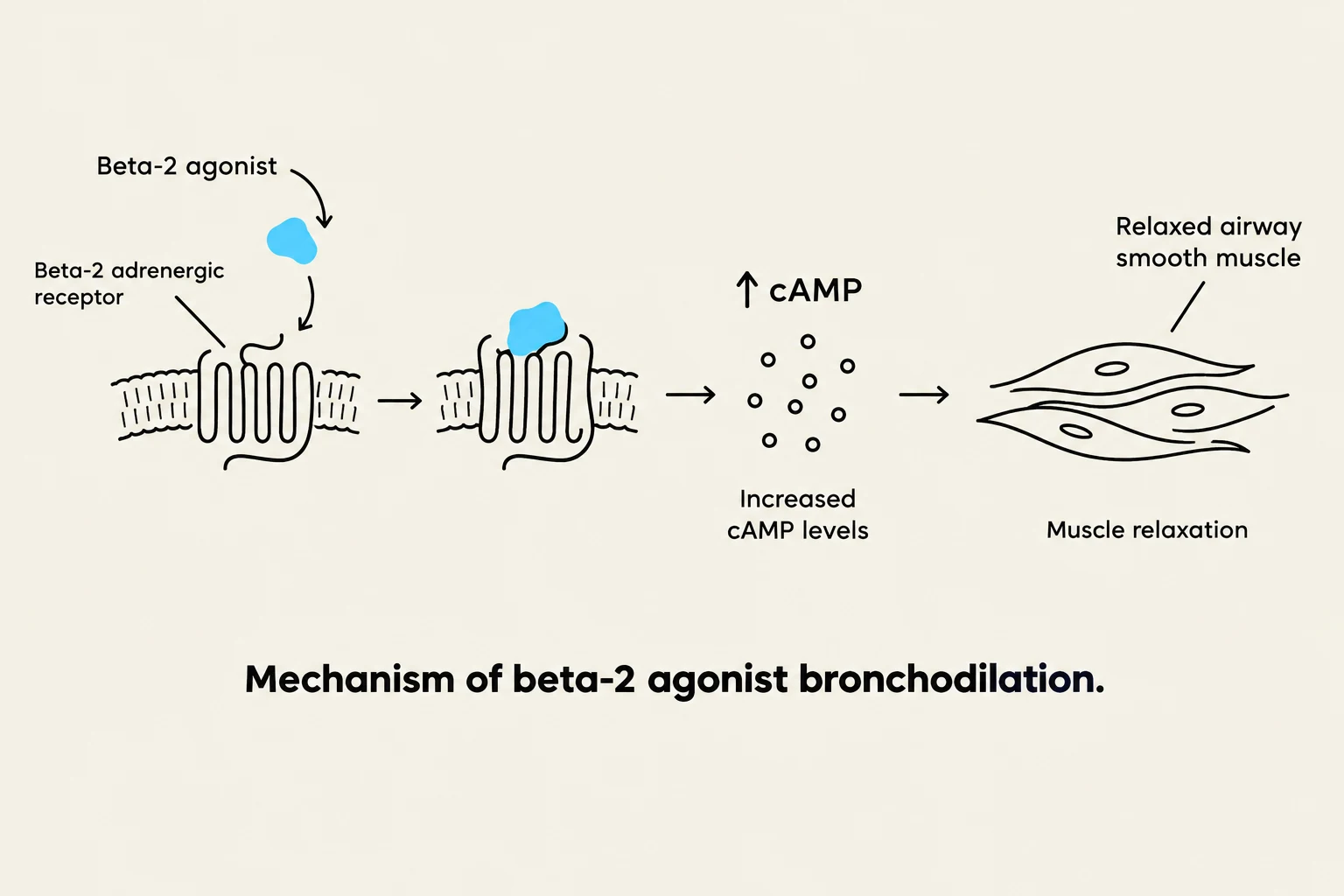
The diagram illustrates the mechanism of beta-2 agonist bronchodilation, showing how a beta-2 agonist binds to a beta-2 adrenergic receptor, leading to increased cAMP levels and subsequent muscle relaxation in the airways.
Sympathomimetics act on β2 adrenergic receptors in the respiratory tract to increase levels of cyclic adenosine monophosphate (cAMP), which results in bronchodilation. These agents are categorized by their duration of action:
Short-Acting β2 Agonists (SABA): Known as "rescuers," these provide immediate relief and last 2–4 hours. Common examples include Albuterol (Ventolin) and Levalbuterol (Xopenex).
Long-Acting β2 Agonists (LABA): These are used for maintenance and prevention rather than acute attacks. Examples include Salmeterol (12-hour duration) and Vilanterol (24-hour duration).
Clinical Pearl: LABAs should never be used alone in asthma patients; they must always be used in conjunction with an inhaled corticosteroid to reduce the risk of asthma-related death.
Muscarinic Antagonists (Anticholinergics)
These agents block acetylcholine at muscarinic receptors, which increases cAMP and promotes bronchodilation while decreasing mucus secretion.
SAMA (Short-Acting): Such as Ipratropium (Atrovent).
LAMA (Long-Acting): Such as Tiotropium (Spiriva).
While used in asthma, they are primary controllers for COPD.
Anti-Inflammatory Agents
Diagram illustrating the mechanisms of action for leukotriene receptor antagonists and synthesis inhibitors in reducing inflammation and leukotriene production.
Because asthma is fundamentally an inflammatory disease, bronchodilation alone is often insufficient.
Corticosteroids
Corticosteroids are the treatment of choice for the long-term management of persistent asthma. They work by inhibiting end-effector proteins, thereby decreasing white blood cell counts and inflammatory activity in the airways.
Inhaled Corticosteroids (ICS): The most common delivery method. They have fewer systemic side effects because they act locally. However, patients should rinse their mouths after use to prevent oropharyngeal candidiasis (thrush).
Oral Corticosteroids: Reserved for severe persistent asthma or acute exacerbations.
Leukotriene Modifiers
Leukotrienes are potent inflammatory mediators. Modifiers work in two ways:
Receptor Antagonists: Prevent leukotrienes from binding (e.g., Montelukast/Singular).
Synthesis Inhibitors: Block the production of leukotrienes (e.g., Zileuton).
These are not used for acute attacks due to their slow onset of action.
Mast Cell Stabilizers
Agents like Cromolyn and Nedocromil prevent the release of histamine and other inflammatory substances from mast cells. These are used for long-term prevention rather than acute relief.
Immunomodulators
For severe asthmatics with allergies, immunomodulators like Anti-IgE agents (e.g., Omalizumab) can be used to inhibit IgE binding to mast cells. These are expensive and not considered first-line therapy.
Other Pharmacological Classes
Methylxanthines
Theophylline and aminophylline are bronchodilators that inhibit phosphodiesterase (the enzyme that degrades cAMP). They are used for maintenance in both asthma and COPD. However, they have a narrow therapeutic index, meaning the goal plasma level is strictly between 10–15 mcg/mL.
Mucolytics
Specifically used in COPD management, mucolytics like Acetylcysteine break down disulfide bonds to decrease the viscosity of sputum, making it easier to expectorate.
Oral candidiasis, bone loss, hyperglycemia, slowed growth in children
Methylxanthines
Nausea, tremors, arrhythmias, seizures
Leukotriene Modifiers
Headache, GI symptoms, potential pulmonary vasculitis
Exam Tip: If a patient reports using their SABA (rescue inhaler) more than twice a week for symptom relief, it is a clinical indicator that their asthma is inadequately controlled and their maintenance therapy needs to be "stepped up".
Keep reading for free.
Create an account to finish this reading and make it part of your study routine.