This content explains the mechanisms of action for antiseizure medications (ASMs), including their effects on ion channels and neurotransmitter systems, and how they are used to treat different types of seizures.
The human brain is a masterpiece of electrical complexity, containing over 10 billion neurons and an estimated 10 trillion synaptic connections. Unlike the heart, where electrical signals spread synchronously through a syncytium, the brain requires the precise isolation of electrical signals to function correctly. This regulation is maintained through a delicate balance between excitatory and inhibitory neurotransmission. When this balance is disrupted—either through genetic defects in ion channels or secondary factors like neoplasms or toxins—the result can be the rapid, synchronous, and uncontrolled spread of electrical activity known as a seizure.
Antiseizure medications (ASMs) aim to restore the brain's inherent inhibitory capacity. They do this by targeting four primary molecular mechanisms: modulating sodium channels, inhibiting calcium channels, enhancing GABA-mediated inhibition, or antagonizing glutamate receptors.
Classification of Seizures
Before discussing pharmacology, it is essential to understand how seizures are clinically classified, as the choice of medication often depends on the seizure type.
Focal Onset Seizures: These begin in a specific part of the brain. They may be "without impaired awareness" (consciousness is preserved) or "with impaired awareness" (altered consciousness or automatisms). If a focal seizure spreads to involve both hemispheres, it is termed a focal to bilateral tonic–clonic seizure.
Generalized Onset Seizures: These involve bilaterally distributed neuronal networks from the start. A classic example is the absence seizure, characterized by a sudden, brief interruption of consciousness and a "blank stare".
Clinical Syndromes: Certain complex conditions involve specific seizure patterns, such as Lennox–Gastaut syndrome or Dravet syndrome.
Modulating Ion Channels
The fundamental unit of electrical signaling is the action potential, which is governed by the movement of ions through voltage-sensitive channels.
Sodium Channel Inhibitors
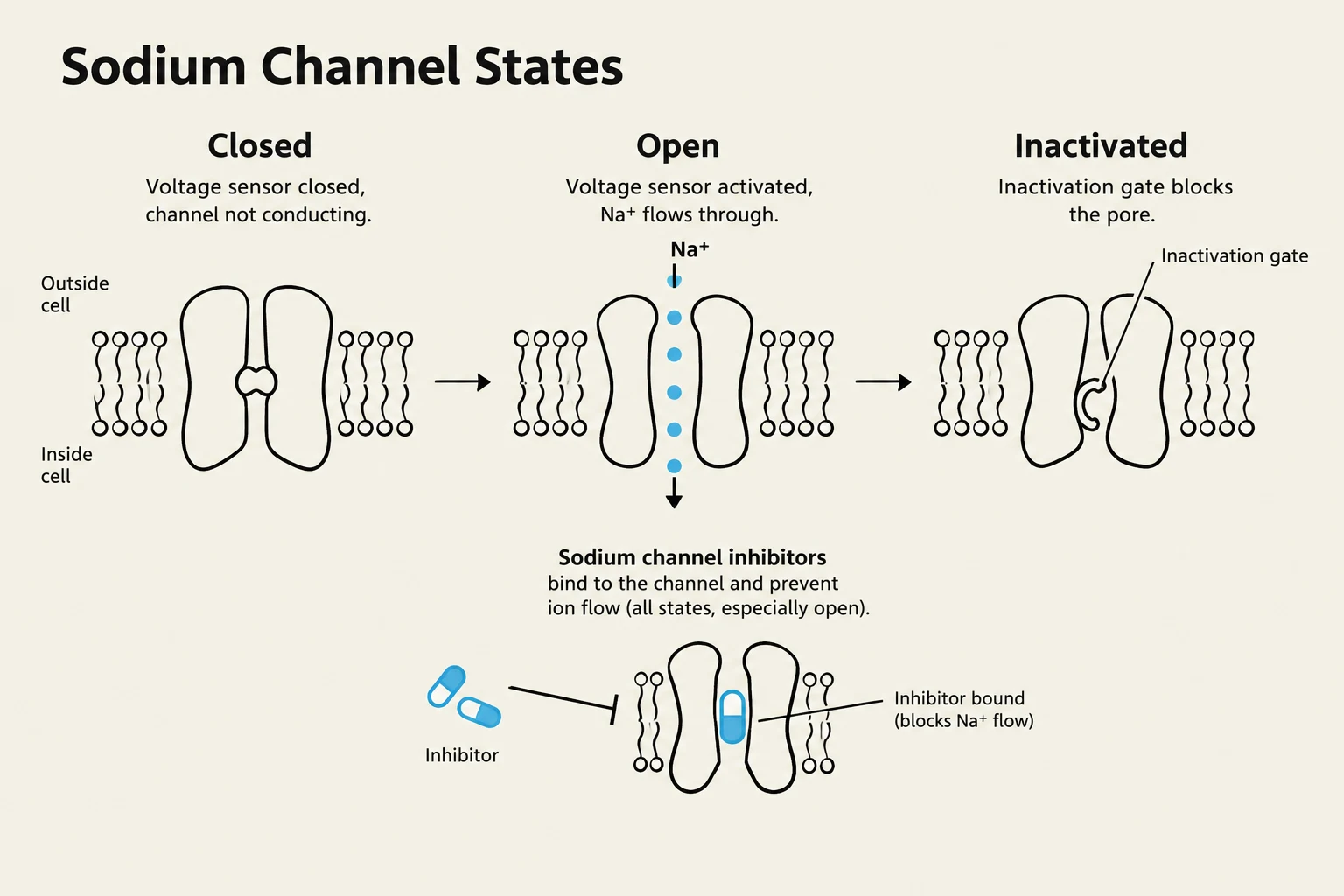
At the cellular level, the duration and frequency of an action potential are limited by the intrinsic properties of the voltage-sensitive sodium (Na+) channel. During depolarization, Na+ channels open; shortly after the peak, they enter an inactivated state.
Many ASMs, such as phenytoin, carbamazepine, oxcarbazepine, lamotrigine, and lacosamide, act by increasing the time the channel spends in this inactivated state. This is a "use-dependent" mechanism: the drugs selectively target neurons that are firing rapidly (such as those in a seizure focus), thereby preventing the repetitive, high-frequency firing characteristic of a paroxysmal depolarizing shift. Because they target high-frequency firing, these drugs are highly effective for focal onset seizures but often have little effect on the slow-firing cells involved in absence seizures.
Diagram illustrating the different states of a sodium channel: closed, open, and inactivated, along with the effect of sodium channel inhibitors.
Calcium Channel Inhibitors
Calcium channels play distinct roles depending on their type and location:
T-type Calcium Channels: These are low-threshold channels found in thalamic relay neurons. In absence seizures, abnormal activation of these channels during the awake state creates a self-sustaining cycle of activity between the thalamus and the cortex, resulting in the characteristic "spike-and-wave" EEG pattern. Ethosuximide and valproic acid are primary treatments because they inhibit these T-type channels.
High-Voltage-Activated (HVA) Calcium Channels: These are involved in the release of excitatory neurotransmitters at the synapse. Drugs like gabapentin and pregabalin inhibit HVA calcium channels to decrease the release of excitatory signals, primarily used as adjunctive therapy for focal onset seizures.
Enhancing GABA-Mediated Inhibition
γ-aminobutyric acid (GABA) is the primary inhibitory neurotransmitter in the central nervous system. A loss of "surround inhibition"—the process where GABAergic interneurons prevent the spread of excitation to neighboring cells—is a major factor in seizure propagation.
Benzodiazepines and Barbiturates
These drugs act as GABA channel potentiators, increasing the chloride current through the GABA receptor to enhance inhibition.
Benzodiazepines (e.g., diazepam, lorazepam, midazolam, clonazepam) are used for various seizure types and status epilepticus. Notably, clonazepam is used for absence seizures.
Barbiturates (e.g., phenobarbital) also enhance GABAergic activity and are used for focal and generalized seizures.
GABA Metabolism
Other agents target the GABA system through different routes. Vigabatrin inhibits GABA transaminase (the enzyme responsible for GABA degradation), thereby increasing GABA levels. Tiagabine also acts to increase GABAergic tone.
Exam Tip: When distinguishing between focal to bilateral tonic–clonic seizures and generalized absence seizures, remember that absence seizures typically lack an "aura" and are driven by T-type calcium channel activity in the thalamus, whereas focal seizures often begin with a localized symptom or aura.
Inhibiting Glutamate Receptors
Glutamate is the brain's primary excitatory neurotransmitter. Excessive glutamate activity or overstimulation of its receptors can trigger seizures.
NMDA and AMPA Receptor Antagonism
NMDA Receptor Antagonism:Felbamate inhibits the glycine binding site of the NMDA receptor, suppressing excitatory signaling. Due to risks of aplastic anemia and hepatic failure, its use is often restricted to refractory epilepsy.
AMPA Receptor Antagonism:Perampanel acts as a noncompetitive antagonist at the α-amino-3-hydroxy-5-methyl-4-isoxazole propionic acid (AMPA) receptor, which helps suppress seizure activity.
Summary of Pharmacological Targets
Because many ASMs are pleiotropic—meaning they act on multiple targets simultaneously—the clinical effect is often a combination of these mechanisms. For example, valproic acid is a "broad-spectrum" agent that stabilizes sodium channels, inhibits T-type calcium channels, and affects GABA metabolism.
Mechanism
Primary Targets
Example Drugs
Na+ Channel Inhibition
Inactivation of Na+ channels
Phenytoin, Carbamazepine, Lamotrigine
Ca2+ Channel Inhibition
T-type or HVA channels
Ethosuximide, Gabapentin, Pregabalin
GABA Potentiation
GABA receptor/metabolism
Benzodiazepines, Phenobarbital, Vigabatrin
Glutamate Inhibition
NMDA or AMPA receptors
Felbamate, Perampanel
Keep reading for free.
Create an account to finish this reading and make it part of your study routine.