Pharmacology of Anti-inflammatory, Antipyretic, and Anti-gout Medications
This guide explores the pharmacological landscape of anti-inflammatories, antipyretics, and anti-gout medications, focusing on their mechanisms, clinical applications, and critical nursing responsibilities.
Managing pain and inflammation is a cornerstone of clinical practice. Whether treating a sudden gout flare, chronic rheumatoid arthritis, or a persistent fever, healthcare providers must understand the delicate balance between therapeutic benefit and systemic toxicity. This article explores the pharmacological landscape of anti-inflammatories, antipyretics, and anti-gout medications, focusing on their mechanisms, clinical applications, and critical nursing responsibilities.
Understanding Inflammatory and Arthritic Conditions
Inflammation is a complex biological response to harmful stimuli, but when it becomes chronic or misdirected, it leads to significant clinical problems.
Common Clinical Problems
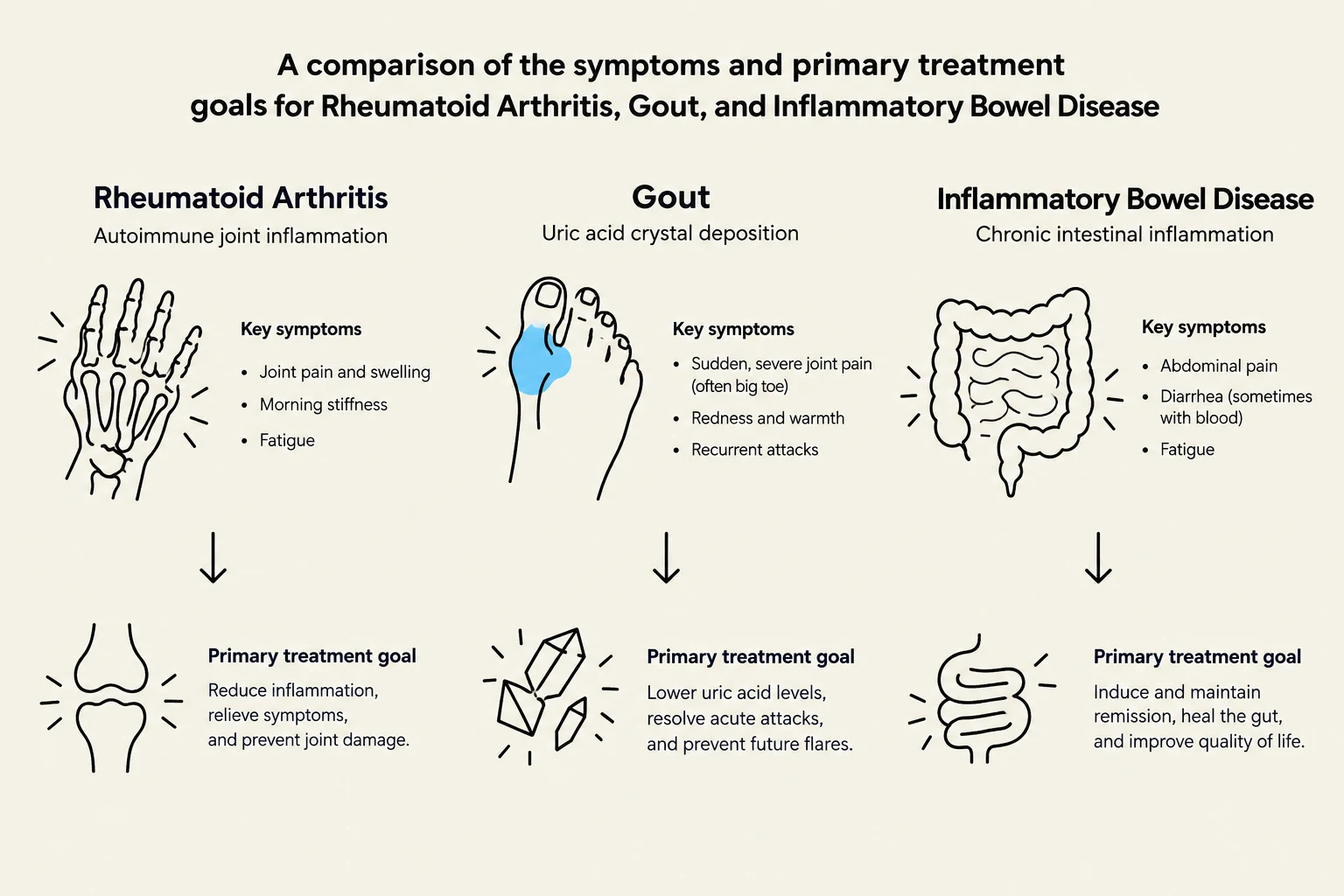
Rheumatoid Arthritis (RA): An autoimmune condition characterized by joint degradation, symmetric joint movement, stiffness (especially in the morning), fatigue, and swelling.
Gout: A condition caused by hyperuricemia (excess uric acid), which leads to the deposition of crystals in the joints and kidneys. Patients often experience severe, unilateral joint pain, redness, warmth, and swelling; "tophi" (visible crystal nodules) may also be present.
Inflammatory Bowel Disease (IBD): Including Crohn’s disease and Ulcerative Colitis, presenting with abdominal pain, diarrhea (sometimes bloody), weight loss, and fatigue.
Clinical Note: While NSAIDs are common for many inflammatory issues, they are not typically the primary treatment for Inflammatory Bowel Disease, which often requires amino-salicylates, corticosteroids, or biologics.
A comparison of the symptoms and primary treatment goals for Rheumatoid Arthritis, Gout, and Inflammatory Bowel Disease.
Mechanisms of Action: The Role of COX Enzymes
To understand how these drugs work, we must look at the cyclooxygenase (COX) enzymes. These enzymes are responsible for the synthesis of prostaglandins, which mediate pain, fever, and inflammation.
COX-1 (The "Housekeeper"): This enzyme is constitutively present throughout the body. It performs essential "housekeeping" functions in the gastric mucosa (protecting the stomach), kidneys, platelets, and vascular endothelium.
COX-2 (The "Inflammatory" Enzyme): This enzyme is induced by inflammatory stimuli. It is primarily found at sites of injury, in inflamed tissues, and in the hypothalamus (where it regulates fever).
This diagram illustrates the distinct roles of COX-1 and COX-2 enzymes in the body. COX-1 is associated with protective effects in the stomach, platelets, and kidneys, while COX-2 is linked to pathologic effects such as inflammation and pain.
Pharmacological Agents
Salicylates: Aspirin
Aspirin (acetylsalicylic acid) is a unique salicylate because it inhibits COX-1 and COX-2 irreversibly. This means its effect on platelets lasts for the entire life of the platelet (approximately 7 days).
Uses: Analgesic (pain), antipyretic (fever), anti-inflammatory, and for risk reduction of stroke, TIA, and myocardial infarction.
Dosing Nuance: "Baby aspirin" (81 mg) is used for platelet inhibition/risk reduction, while higher doses (325 mg) are used for acute pain or fever.
Safety Warning:Never give aspirin to children with viral infections due to the risk of Reye’s syndrome.
Non-Steroidal Anti-inflammatory Drugs (NSAIDs)
NSAIDs reduce pain, fever, and swelling by inhibiting prostaglandin synthesis. They are categorized into two types:
Nonselective NSAIDs: Inhibit both COX-1 and COX-2. This provides relief but increases the risk of gastric ulcers and bleeding due to COX-1 inhibition. Examples include Ibuprofen, Naproxen, and Ketorolac.
Ketorolac (Toradol): The strongest NSAID; used as an opiate alternative for short-term postoperative pain (less than 5 days).
Selective NSAIDs: Inhibit only COX-2. These carry a lower risk of GI bleeding but an increased risk of cardiovascular events like MI or stroke.
Celecoxib: A primary example of a COX-2 selective agent.
Antipyretics: Acetaminophen
Unlike NSAIDs, Acetaminophen (Tylenol) works centrally within the brain (specifically the hypothalamus) rather than peripherally.
Uses: Relieves pain and fever, but it has no significant anti-inflammatory properties.
Toxicity Risk: The primary concern is hepatotoxicity (liver injury).
Dosing: The maximum daily dose is 4g (or 3g for those with heavy alcohol use or hepatic impairment).
Antidote: Acetylcysteine IV is the antidote for acetaminophen overdose.
This chart compares the properties and mechanisms of action of Aspirin, NSAIDs, and Acetaminophen, detailing their effects as analgesics, antipyretics, and anti-inflammatories, and how they work by targeting COX enzymes.
Anti-Gout Medications
Gout management is divided into two phases: treating the acute flare and managing chronic hyperuricemia.
Acute Management: Colchicine
Colchicine does not remove uric acid crystals; instead, it blocks neutrophil action at the joint to inhibit the inflammatory response triggered by those crystals.
Administration: Often uses a "loading dose" (a larger initial dose) followed by smaller subsequent doses.
Adverse Effects: GI distress is common; rare but serious effects include rhabdomyolysis and blood dyscrasias.
Chronic Management: Allopurinol
Allopurinol targets the root cause of gout by inhibiting the enzyme xanthine oxidase, which is necessary to convert purines into uric acid in the liver.
Goal: To lower uric acid levels and prevent future crystal formation.
Clinical Pearl: Starting allopurinol can actually trigger a gout flare initially; therefore, it is often started alongside colchicine or NSAIDs.
Warning: If a patient develops a rash or skin reaction, the medication must be stopped immediately due to the risk of Allopurinol Hypersensitivity Syndrome.
Nursing Implications and Patient Education
Nurses play a vital role in monitoring for toxicity and ensuring patient safety when administering these agents.
Assessment Priorities
Renal Function: Monitor for signs of renal impairment or acute kidney injury (AKI), especially with long-term NSAID use.
Gastrointestinal Health: Assess for signs of bleeding (black stools, abdominal pain, large bruises) and monitor Hgb/HCT and platelet counts.
Liver Function: For Acetaminophen and Allopurinol, monitor ALT/AST levels.
Pain and Fever: Baseline assessments are required to evaluate drug efficacy.
Patient Teaching
Administration: Take NSAIDs and Allopurinol with food to minimize GI upset.
Lifestyle: Stay hydrated and limit alcohol intake. For gout, patients should limit high-purine foods.
Safety: Advise patients to report any signs of bleeding (e.g., black stools) or skin rashes immediately.
Exam Tip: Remember the "Organ Toxicity" rule of thumb:
Aspirin/NSAIDs→ GI Tract & Kidneys
Acetaminophen→ Liver
Celecoxib→ Cardiovascular (MI/Stroke)
Keep reading for free.
Create an account to finish this reading and make it part of your study routine.