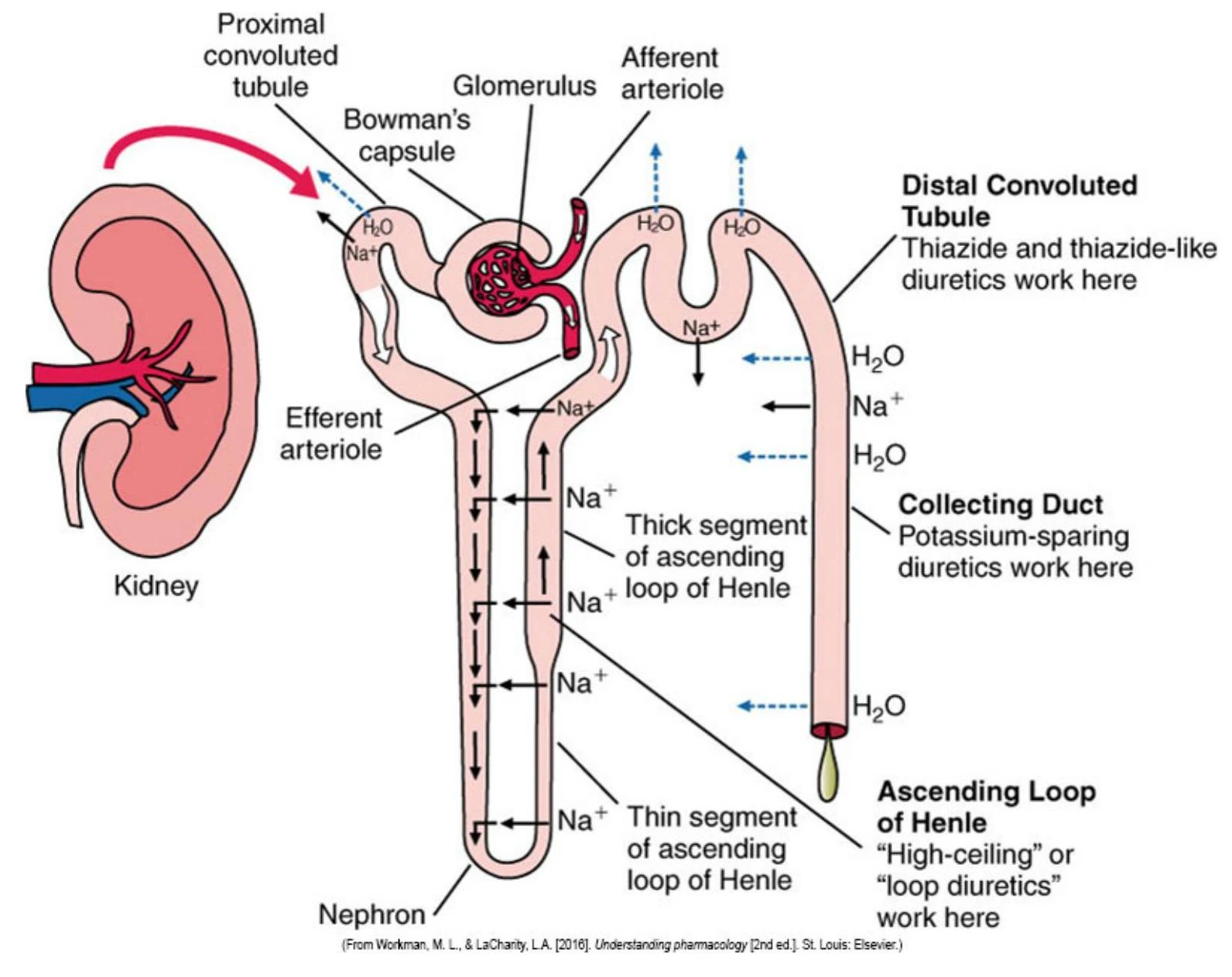
Potassium-Sparing Diuretics
These act on the collecting duct.
- Prototypes: Spironolactone (Aldactone) and Amiloride (Midamor).
- Action: They act as aldosterone antagonists, increasing water and sodium excretion without losing potassium.
- Uses: Hypertension, heart failure, and off-label uses like treating acne or hirsutism due to anti-androgenic effects.
- Nursing Considerations: Monitor for hyperkalemia (irregular/slow pulse) and educate patients to avoid high-potassium foods.
Clinical Tip: For all diuretic therapy, nurses should prioritize daily weights, monitoring Intake and Output (I&O), and tracking serum electrolytes, BUN, and Creatinine.
Management of Benign Prostatic Hyperplasia (BPH)
BPH involves the enlargement of the prostate, which can obstruct urine flow. Two main pharmacological approaches are used to manage this condition:
- Alpha-1 Adrenergic Receptor Blockers:
- Prototype: Tamsulosin (Flomax).
- Action: Relaxes the smooth muscle in the prostate, bladder neck, and urethra to improve urine flow.
- Side Effects: Hypotension and decreased libido.
- DHT Inhibitors (Testosterone Inhibitors):
- Prototype: Finasteride (Proscar).
- Action: Interferes with the enzyme that converts testosterone to dihydrotestosterone (DHT), thereby decreasing DHT levels.
- Safety Warning: These are highly teratogenic. Women of childbearing age should not handle the medication, and men must use barrier protection.
Overactive Bladder (OAB) and Urinary Pain
Patients experiencing Overactive Bladder (OAB) often suffer from involuntary bladder muscle spasms.
- Urinary Antispasmodics: The prototype Oxybutynin (Ditropan) inhibits involuntary contractions of the detrusor muscle. Common side effects include anticholinergic effects (e.g., dry mouth) and decreased sweating.
- Bladder Anesthetics: For patients with Urinary Tract Infections (UTIs), Phenazopyridine (Pyridium) can be used as a local anesthetic on the urinary mucous membranes to decrease urgency, frequency, and burning.
- Note: Phenazopyridine turns urine an orange-red color and should only be used for short-term symptom relief (approx. 2 days); it does not treat the underlying infection.
Erectile Dysfunction (ED)
Pharmacological treatment for ED focuses on improving blood flow through vasodilation.
- Prototype: Sildenafil (Viagra).
- Action: A Phosphodiesterase type 5 (PDE5) inhibitor that leads to potent vasodilation of specific arteries.
- Contraindications: Must not be used with nitrates.
- Side Effects: Flushing, hypotension, vision changes, hearing loss, and priapism.
Infections and Inflammatory Disorders
Urinary Tract Infections (UTIs) and Pyelonephritis
Infections of the urinary tract or the kidney (pyelonephritis) are treated with various antimicrobial classes:
- Fluoroquinolones: Ciprofloxacin, Levofloxacin.
- Sulfonamides: Sulfamethoxazole/Trimethoprim.
- Cephalosporins: Ceftriaxone, Cefaclor.
- Aminoglycosides: Gentamicin.
Glomerulonephritis
Treatment for glomerulonephritis focuses on managing inflammation and secondary symptoms:
- Antimicrobials: Used if an infection is present.
- Diuretics: To reduce edema.
- Antihypertensives: For severe hypertension.
- Corticosteroids/Immunosuppressants: To decrease inflammation.
Acute Kidney Injury (AKI) and Chronic Kidney Disease (CKD)
Renal health can be severely compromised by external factors or progressive disease.
Nephrotoxicity and AKI
Acute Kidney Injury (AKI) can be caused by nephrotoxic medications, including aminoglycosides, radiopaque dyes, and NSAIDs.
Progression to CKD and ESRD
As Chronic Kidney Disease (CKD) progresses, the kidneys' ability to eliminate medications decreases, which can lead to toxicity even with "simple" drugs. Furthermore, mineral levels such as calcium, phosphate, magnesium, and potassium often become dysregulated.
In End-Stage Renal Disease (ESRD), specialized treatments are required:
- Phosphate Binders: Used to manage phosphate levels and prevent hypocalcemia.
- Epoetin-alpha (Epogen, Procrit): Used to stimulate red blood cell production, which is often deficient in ESRD.
- Dialysis Considerations: For patients on hemodialysis, it is critical to consult with a provider or pharmacist to determine if a medication is "dialyzable" so that dosing can be timed appropriately around dialysis sessions.