An overview of pharmacology, covering drug nomenclature, classification, and the three phases of drug activity: pharmaceutics, pharmacokinetics (ADME), and pharmacodynamics. It also discusses adverse effects and safety.
Pharmacology is the broad science of drugs, encompassing the study of how chemical substances affect the physiological processes of living organisms. For healthcare professionals, understanding pharmacology is not merely about memorizing names; it requires a deep comprehension of how drugs are prepared, how they move through the body, and how they interact with cellular receptors to produce either therapeutic or toxic effects.
The Scope of Pharmacology
Pharmacology is a dynamic, multidisciplinary science that integrates principles from chemistry, biology, and physiology. Because of its complexity, it is divided into several specialized subfields:
Pharmaceutics: The science of preparing and dispensing drugs, focusing on dosage form design.
Pharmacokinetics: The study of what the body does to the drug, specifically the processes of absorption, distribution, metabolism, and excretion (ADME).
Pharmacodynamics: The study of what the drug does to the body, focusing on biochemical and physiological interactions at receptor sites.
Pharmacotherapeutics: The clinical use of drugs to prevent and treat diseases.
Toxicology: The study of poisons and the adverse effects of chemicals on living systems.
Pharmacognosy: The study of drugs obtained from natural plant and animal sources.
Pharmacoeconomics: The study of economic factors, such as cost-benefit analyses, that impact drug therapy.
Pharmacogenetics (Pharmacogenomics): The study of how genetic factors influence an individual's response to drugs.
Drug Nomenclature and Classification
Every drug acquires at least three distinct names during its lifecycle. Understanding these is critical for preventing medication errors.
Chemical Name: Describes the drug's specific chemical composition and molecular structure.
Generic Name: The official, nonproprietary name approved by regulatory bodies (such as Health Canada). It is shorter than the chemical name and is not protected by a trademark.
Trade Name: The proprietary, commercial name registered by the manufacturer (e.g., Tylenol®).
Drugs are organized through drug classification, which groups substances based on their chemical structure (e.g., β-adrenergic blockers) or their therapeutic use (e.g., antibiotics).
Exam Tip: When comparing medications, remember that therapeutic equivalence occurs when drugs are proven to have the same therapeutic effect on the body, allowing one to be substituted for another, often to reduce costs.
The Three Phases of Drug Activity
The relationship between a drug dose and its clinical effect is described through three interconnected phases: pharmaceutics, pharmacokinetics, and pharmacodynamics.
1. Pharmaceutics and Dosage Forms
Pharmaceutics determines how a drug is delivered. The dosage form (e.g., tablet, capsule, injection, or patch) influences the rate of dissolution—the process by which a solid drug disintegrates and becomes soluble in the gastrointestinal tract.
Different forms offer different advantages:
Liquids (syrups, elixirs): Usually absorbed fastest because they are already dissolved.
Enteric-coated tablets: Designed to resist stomach acid and dissolve in the more alkaline environment of the intestines.
Time-release technology: Uses specialized coatings to release drug molecules over an extended period, increasing the duration of action and improving patient adherence.
2. Pharmacokinetics (ADME)
Pharmacokinetics tracks the drug's journey through the body via four stages:
Absorption: The movement of a drug from its administration site into the bloodstream. A key concept here is bioavailability, which is the fraction of the dose that reaches systemic circulation unchanged.
First-pass effect: When drugs are taken orally, they are absorbed through the GI tract and transported to the liver via the portal vein. The liver may metabolize a large portion of the drug before it ever reaches the rest of the body, significantly reducing bioavailability.
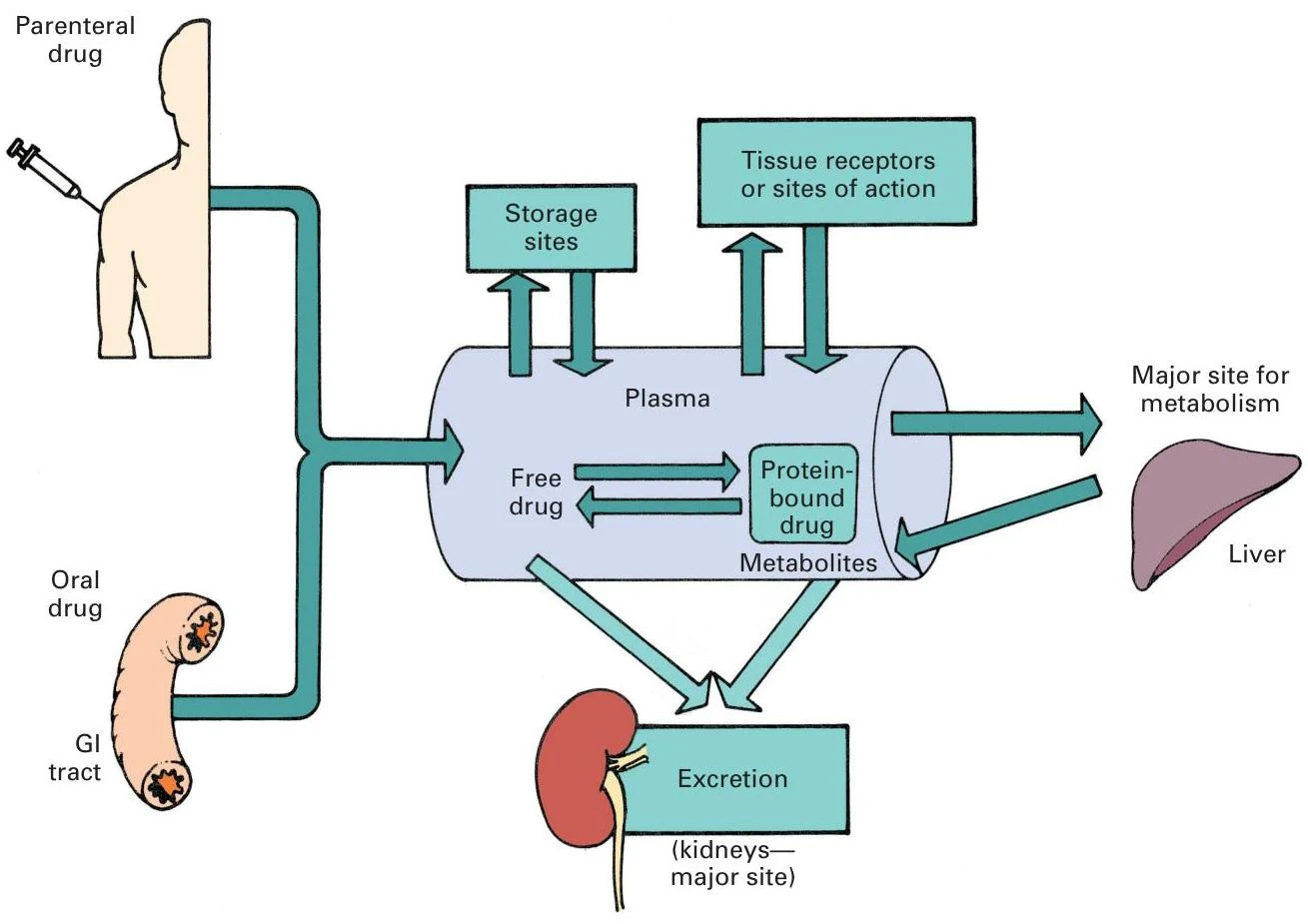
This diagram illustrates the pharmacokinetic processes of drug distribution, metabolism, and excretion in the body, showing how drugs administered orally or parenterally are processed through plasma, storage sites, tissue receptors, liver, and kidneys.
Distribution: How the drug moves through the bloodstream to various tissues. Many drugs bind to plasma proteins like albumin; only "free" drugs can cross capillary walls to reach target sites.
This illustration depicts the transport of drugs in the bloodstream. Albumin, a protein in the plasma, binds to drugs, forming a complex. This bound drug can then interact with capillary walls. Unbound free drug molecules can pass through capillary cell pores to reach tissues.
Metabolism (Biotransformation): The biochemical conversion of the parent drug into metabolites by enzymes, most notably the Cytochrome P450 system in the liver. Some drugs are administered as prodrugs, which are inactive until metabolized into an active form.
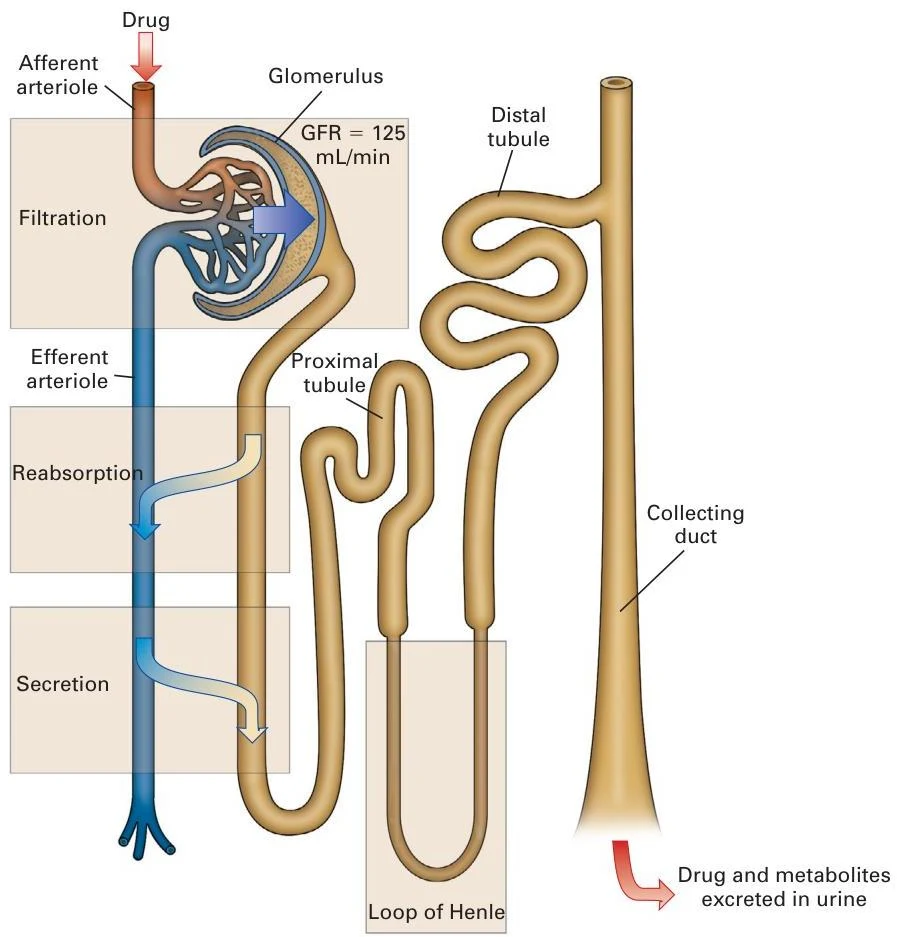
Excretion: The removal of drugs and metabolites from the body, primarily through the kidneys via glomerular filtration, tubular secretion, or reabsorption.
Diagram illustrating the process of drug filtration, reabsorption, and secretion within a nephron, leading to the excretion of drugs and metabolites in urine.
3. Pharmacodynamics
Pharmacodynamics focuses on the drug's interaction with receptors—molecular structures on or within cells.
Agonists: Drugs that bind to and stimulate receptor activity.
Antagonists: Drugs that bind to and inhibit receptor activity.
Diagram illustrating how agonist and antagonist drugs interact with receptor sites on a cell membrane to produce normal, mimicked, or blocked responses.
The relationship between drug concentration and effect is often visualized by looking at the therapeutic window—the range between the minimum effective concentration and the toxic level.
A graph illustrating the concentration of a drug in the body over time, showing absorption, distribution, elimination, and the therapeutic range.
Adverse Effects and Safety
While the goal of drug therapy is a therapeutic effect, drugs can also cause undesirable responses.
Adverse Drug Reactions (ADRs): These can be predictable pharmacological reactions (an extension of the drug's effect, such as low blood pressure from an antihypertensive) or unexpected idiosyncratic reactions caused by genetic variations.
Allergic Reactions: An immune-mediated response where the body recognizes the drug as a foreign invader.
Toxic Effects: Resulting from poisonous qualities or excessive dosages.
Teratogenesis: The development of congenital defects in a fetus due to drug exposure.
Clinical Note: In emergency situations, the intravenous (IV) route is preferred because it bypasses the first-pass effect and provides immediate bioavailability, whereas oral (PO) medications may take 30 to 60 minutes to act.
Summary Table: Routes of Administration
Route
Description
Key Consideration
Enteral
Via the GI tract (Oral, Sublingual, Rectal)
Subject to first-pass metabolism.
Parenteral
Via injection (IV, IM, Subcutaneous)
Bypasses first-pass effect; rapid onset.
Topical
Applied to skin or mucosa (Ointments, Patches)
Can act locally or be absorbed systemically.
Keep reading for free.
Create an account to finish this reading and make it part of your study routine.